Subjectivity and the Subjugated

Feathers and beak but not a bird, not quite. It is roughly man-shaped; and though the head tilts and the arms outstretch like a midnight stranger, without a face and without hands it is not a man either, not quite. It is Man-but-not-Man, that most ancient mold for the manufacture of disquiet, never failing to lend a nightmarish quality to the unknown. The light is cluttered with hard shadows and the mind, unsure, is forced toward interpretation. You are a child and it is a swooping, enveloping horror. You are a hunter and it’s an avenger. You are a Freudian and it is your mother hovering, unreachable, in the middle-distance. You are a seer and it is an omen. You are a vaudevillian and it is a punch-line delivered into silence. You are a captain of industry and it is an accusatory night-sweat. On and on for each. At bottom its simple: you are a you and it is not, which is enough. Its “otherness” provokes an aggressive subjectivity. 

The figure in the image is actually a Kwakiutl tribesman dressed as a Thunderbird. It’s a detail of a photograph shot by Edward S. Curtis, published in 1914. If you’ve never heard of Curtis he was a portrait photographer, living in Seattle, who decided sometime around 1900 to begin documenting the Native American tribes living in the Pacific Northwest. This project, with eventual interest of Theodore Roosevelt and resultant funding by J.P. Morgan, evolved into a 20 volume ethnographic opus called The North American Indian. The first volume was published in 1907, the last in 1930, at which point Curtis had shot about 45,000 photographs of over 80 separate tribes. Impressive though those numbers are, and expansive though the project was Curtis died in 1952, broke, and with his life’s work forgotten.

“They cannot represent themselves, they must be represented.” So said Karl Marx. Were that representation pictorial and cultural rather than political, the sentiment might well be characterized as the driving force behind The North American Indian project. Curtis was a strong adherent to the prevailing sense that the American Indian was a “vanishing race” with no hope of maintaining any identity as Indian, and that it was the duty of the dominant culture to record the existence of the one being absorbed.

It was this conviction that lead him, in the course of his documentations, to go so far as to stage photographs depicting tribal traditions which had gone out of popular practice 50 years prior to his arrival with camera in hand. He paid tribes to undertake ceremonies out of season and reestablish ceremonies no longer practiced. He brought with him props, wigs, shirts, and other accouterments to “reenact” scenes, and was careful to remove “modern” items already adopted by tribes from the frame before shooting. His interest was in the “traditional” Indian, regardless of whether those traditions had already evolved away from the preconceptions of white america.

It’s because of this subjective tampering that Curtis’ photographs, even after their rediscovery and popularization in the 1970’s, remain somewhat controversial. On the one hand there are charges that his photographs, to large degree, simply reenforced the condescending stereotype of the “noble savage.” On the other hand it is unarguable that much of the material in The North American Indian does, in fact, represent unique ethnographic data recorded nowhere else. The prevailing attitude toward the project seems to be that though it is most assuredly “of its time,” harboring all manner of preconception, it is none the less invaluable for what it did manage to record.

In any case as regards Curtis’ life work I think it’s important to mention two things:

1) Even without intervention or the use of props or staging, photographs of this kind, framing a conquered culture through the conqueror’s lens and produced specifically for the conqueror’s consumption, will inherently deal in presuppositions. That seems inescapable. They will reinforce stereotypes to the exact degree to which the viewer, or framer, holds them dear.

2) Regardless of exactly the nature of what his photographs evoke, they are evocative, and very often beautiful, which is possibly the best one can say about a photograph from the artist’s standpoint. Not from a documentarian’s, or an ethnologist’s standpoint certainly, but from an artist’s.

Now to the photographs themselves…

Let me be the first to admit that when you have a collection as large as Curtis’ to draw from, you can gather together a group of pieces that illustrate damn-near any point of view you wish to support. For my part, I don’t want to drive home any particular point about Curtis’ outlook or the experience of the Native American’s he photographed.

I chose 18 images, drawn mainly from his time spent with the Kwakiutl and Navajo tribes, and exclusively of men obscured by ceremonial dress, their humanity left only as a vague outline, because I find them to be, as a group, a particularly potent illustration of the subjectivity inherent to viewing not only photographs of other cultures, images of the “Other,” and images of the unknown, but images of the past in general. These photographs are of men without men’s faces, without eyes to search, without familiar situations to read into, and so you are left to your own perceptual devices.


Quote: “It is a truism that to visitors of a new land – certainly to settlers – the original inhabitants were profoundly Other: The settlers may have had to struggle physically with the indigenous people for possession of the land, and in the process the original inhabitants became that which the settlers defined themselves against. It was virtually inevitable that the representations… would incorporate, reflect, or respond to, perhaps justify, the assumptions of the dominant (whites). ...The representations produced by the project tend to conform, in other words, to the lineaments of “the white man’s Indian.” ...Members of a dominant group, no matter how “intimate” their sense of their involvement with the people concerned, will represent nothing but the assumptions of their own kind.” – From the introduction to Edward S. Curtis and the North American Indian by Mick Gidley.


Quote: “If the modes of seeing in different communities are at least in some respect irreconcilable because they reflect incommensurable presuppositions about the human situation, how can such communities understand one another? Or are cultures windowless monads– communally solipsistic entities in which only those who share the same conventions can make sense of one another, with everything outside the cultures walls either ignored or relegated to the status of error? Can one culture use its own terms to say something about another culture without engaging in a hostile act of appropriation or simply reflecting itself and not encountering the otherness of the Other? –From Chapter 2 of Play and the Politics of Reading: The Social Uses of the Modernist Form by Paul B. Armstrong.


Quote: “When the last Red Men shall have perished, and the memory of my tribe shall have become a myth among the white man, these shores will swarm with the invisible dead of my tribe, and when your children’s children think themselves alone in the field, the store, the shop, or in the silence of the pathless woods, they will not be alone.” -Attributed to Cheif Seath in an address surrendering the Puget Sound region to Governor Isaac Stevens in 1854, but which is almost certainly a fanciful recreation set down by some unknown author many years later. Coincidentally, it was Seath’s daughter, Princess Angeline, who was Curtis’ first Native American subject. 


Personally I find this group of photos, in the almost total disembodiment of their actual subjects, really compelling. Their historical accuracy makes no difference. I can’t help but imbue them with a host of disparate, sometimes totally contrary emotions. My mind draws all kinds of corollaries and branches out into all kinds of narratives. Most likely you, yourself, draw a whole other set of conclusions…

Anyhow, though Curtis didn’t live to see it, his work is now widely written about and very well represented on the internet. Curtis’ story is a fairly interesting one, the debate over and reactions to his work even more so, and there is a whole lot of it to be seen out there if your so inclined-

Nortwestern University Collection
Library of Congress Collection
Old-picture.com collection
First People
Project Gutenberg
Edward S. Curtis in Context
Selling the North American Indian
Flurry & Company Ltd.
Video excerpts from Coming To Light
PBS American Masters
Prayer to the Great Mystery
The Imperfect Eye of Edward Curtis.
Etc, Etc, Etc.

Hope you enjoyed.


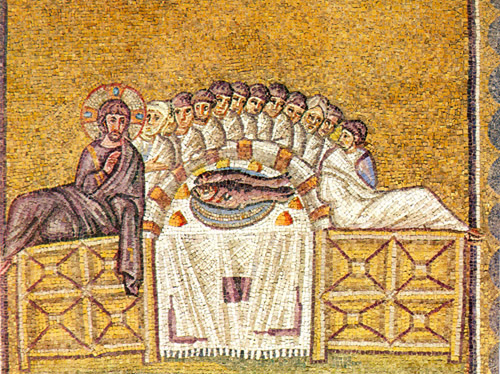
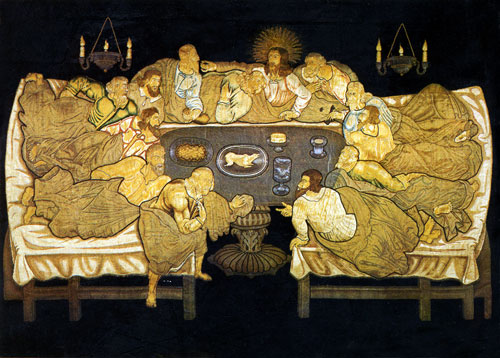
A spring day. A holiday. A beautiful day for origins laid bare. The question arises from within and without, from mischievous children and coots embittered by a lifetime in minority, “what do bunnies and eggs have to do with anything?” And there might be a squirm, and their might be a laugh, and there might even be an answer which deigns to include the word “Goddess” or “fertility” or “birth.” It’s a beautiful day for the survival of annexed symbols and the bright light of incongruousness that they shine. There is an implicit acknowledgment of lineage in those symbols that a hundred generations of voices crying “ultimate Truth” can’t drown out; a moon which won’t be eclipsed.

Across the northern hemisphere bodies are goaded and throb, independent of mind and careless of culture, as they always have. Biology, the great uniter, offering every animal their undeniable cues. Today, in the spring light, warm and feminine in its promise of fecundity, we’re presented a beautiful day for clarity. Feeling that light on our face, its winks and hints at comfort, we might ask, “Why should this light be refracted through a lens of bloody beatings and spear tips and torture? What has this light to do with the adventures of a murdered man’s corpse?” Or, “Have we moved the movable feast too far?” Perhaps today is the best day in the year to feel plainly the qualitative difference between healthy biological realities and the dark, gnarled festoons and embellishments of human abstraction.

Note: The image is a detail of Hans Baldung Grien’s Death and the Woman c.1517.

03.23. filed under: belief. humanity. observations. 4

So here is an image and with it, I’ll assume, a good deal of blank faces. Possibly a small percentage understand the insinuation straight away, but they aren’t much amused. The rest perhaps sigh their askance, “Ho-hum, so what’s this then?” Let’s parse it shall we? There is text. It reads, “An then yer arse fell aff.” This is Scottish vernacular; A phrase employed to call out the tell-tale wafting of bullshit particles into a nasal cavity. Below the text we have a kilt. Taking into consideration the inclusion of legs and socks, surely purposeful, we could assume that the focus is not the kilt specifically but rather the tartan pattern itself. A good assumption, making an ass of no one. So what are we left with then? Why, a calling-out of the incredible hokum which is the “ancient Scottish clan tartan.” That’s what. 

Minds the world over, when compelled to conjure a Scotsman without the benefit of personal experience, likely create a burly, bearded fellow, with scotch on his breath, rectum pressured by haggis gas, bagpipes at the ready, his wind-tightened balls just out of sight behind a kilt which is itself woven in his ancient clan’s proud, traditional tartan…

Our minds are complete ignoramuses, obviously, but we who navigate them over the shoals of stereotype can’t bear all the blame. This image, or some slight variation of it, forms in our feeble minds for a good reason: because it sells, and has for a long time, and is consequently perpetuated. Oh yes, as any representative of the Scottish tourism board will tell you under condition of strict anonymity– “it’s all aboot the Sterling Laddie!!” If you could get a Hollywood exec to stop sniffing coke through his rolled-up Braveheart residual-check for a second he’d likely tell you the same.


Depiction of various clans and their dress from La Costume Historique, 1888


This oversimplification of Scottish culture down into a few Highland-specific customs is such a widespread phenomenon that there is actually a term for it– Tartanry.

The fact is that the “small kilt” is not ancient at all. As for the “clan tartans” they bare, overwhelmingly these are not of ancient origin either. The whole kilt/tartan business, in the cohesive, romanticized form it’s celebrated today, is less than 300 years old, and is so willfully mixed-up it’s hard in many cases to separate the facts from the folklore and finance.


Crest of the Skene Clan


The kilt itself began brushing kneecaps en masse sometime in the mid 1700’s. A possibly apocryphal story has long credited its invention to, of all people, an Englishman by the name of Thomas Rawlinson. True or not the fact seems to be that there is no record of the “small kilt” prior to the 1690’s.

What the Highlanders actually wore was the Breacan or “big wrap,” or “belted plaid,” which had emerged in the late sixteenth century as the first identifiably “Scottish” form of dress. Plaid, or “plaide” is actually Gaelic for “blanket” and that’s what the belted plaid basically was.


Old man of the clan Furquharson. Plaid, kilt and stockings of the clan breacan. Detail from La Costume Hhistorique, 1888.


Quote: “The kilt was a traveling tent… The garment itself was a length of woolen cloth, two yards by six yards… At night the clansman wrapped himself in it and slept. In the morning he laid a belt on the ground and then carefully pleated the great lump of stuff on top of the belt. And then he lay down on top of the lot, brought the ends of the belt up, and buckled it round his waist. He was now enclosed in a tube of cloth, reaching from his knees to right over his head.” –Clifford Hanley.

That the kilt has come to symbolize all of Scotland can, ironically, in large part be attributed to three kings George.

King George II imposed the Act of Proscription on the Scots in 1746. Among its many provisions, created to try and assimilate the “rebellious” Highlanders, was the Dress Act which made the wearing of tartan or kilts illegal. The logic was that by criminalizing the cultural signifiers of the clan system they could eventually break down the system itself.

Quote: “The Highlanders had been wearing their outlandish tartan suits, and since the Highlanders were weird beasts anyway, in the eyes of authority, the tartan was taken to be a very big juju. heap strong totem, like Sioux war bonnets. The government realized it could shear the Scotsman of his courage by abolishing the stuff altogether. Later that year a law was passed forbidding the wearing of multicolored cloths in the Highlands. Penalty for the first offense was six months in jail; for a second offense, seven years’ transportation to the Colonies. A few rash Highlanders were actually nabbed for this fiendish crime.” –Clifford Hanley.


Crest of the Macfarlane Clan


The Act was repealed in 1782 by King George III and soon Highland dress became all the rage as fashion among all classes of Scottish society, the vast majority of whom had never worn a kilt or tartan in their lives, and in fact, as Lord Macaulay put it in the 1850’s, was previously “considered by nine Scotchmen out of ten as the dress of a theif.”

Quote: “...the kilt had fallen out of use as an item of ordinary dress, allowing for the romantic rehabilitation of Highland dress… No longer the threat from the north, the image of the Highlands could represent this wilderness within the bustling economy of the “new” Britain. Rather than dangerous, barelegged barbarians, the Highlanders became admirable, a kilted version of the “noble savage.”

This romantic fascination reached its peak in 1822 when another George, King George IV, staged a lavish visit to Edinburgh wearing the full Highland regalia.

Quote: “This publicity stunt promoted the kilt as fashionable wear among the Scottish nobility and, in so doing, helped establish the kilt as the national dress of Scotland. However, the king’s clothes, like those worn by Scottish noblemen, were far removed from those worn by the Highlanders of the previous century. Given the fact that they were largely designed for the levée, assembly, and ballroom, the emphasis was on the dramatic and spectacular… ‘Highland dress’ turned into ‘tartan costume.’"-Andrew Bolton, From The Kilt, a Metropolitan Museum of Art thematic essay.


Morrison?


Which brings us to the “clan tartan” itself. This is where outside historical forces and the natural flow of fashion give way to straight-up sham and flim-flam, of which the Scots are, themselves, complicit.

Contrary to popular belief, and to clarify the “lies by omission” offered by hundreds of websites offering family patterns to genealogically obsessed consumers, specific tartans almost never trace their roots in a straight line back to antiquity, nor in a curvy, jagged, or meandering line for that matter.


Crest of the Macgillivray Clan


Quote: “...the Highlanders wore any tartan that came up their backs. They had never heard of the idea of an official clan design, and if they had, they would have dodged it because in those days advertising your name could easily get you a dirk between the ribs.” –Clifford Hanley.

Or as C.C.P. Lawson put it in his History of the Uniforms of the British Army “Remembering the continuous clan feuds and the consequent state of more or less perpetual hostilities, a recognizable clan plaid would have been a positive danger to the wearer outside his own territory.”


Macintyre?


The truth is that the fashion craze for all things Highlander that began with the repeal of the Dress Act directly leads into the Clan Tartan craze of modern times. The growing excitement paired with a consuming desire by Scots, both of highland and indeed lowland and border dwelling descent, to claim some ancient clannish birth-rank of their very own, rendered reality and actual tradition of negligible importance.

Around this time two clever con-men saw which way the wind was blowing and got to work cashing in.


Mackinnon?


These con-men were the Brothers Allen, better known today under the aliases John Sobieski Stewart and Charles Edward Stuart. Where they spent their early years before arriving in Edinburgh and what they did prior to this episode is unknown, as is much about them. 

Quote: “All that we can say of them is that they were both talented artists in many fields. They wrote romantic poems… they were learned, though evidently self-taught, in many languages; they were skillful draughtsmen, wood-carvers, furniture makers. They had persuasive manners and great social charm, which enabled them to move at ease in the best society. Whatever they did, they did thoroughly and with flair.” — From The Invention of Tradition, by Eric J. Hobsbawm.


Angus?


All you need know about the brothers in context of Clan Tartans is that in 1829 they revealed to a patron that they had in their possession a Latin manuscript dating back to at least 1571, of noble provenance, titled Vestiarum Scoticum or The Garde-robe of Scotland. This manuscript “just happened” to directly feed into the Highlander craze while simultaneously validating the tartan’s ancient origins.


Balmoral?


Cumin?


In 1842 the Vestiarum Scoticum was published in limited edition, and billed as a reproduction, with color illustrations , of the original Latin manuscript setting forth, unequivicably, the ancient origins of 75 tartans and their clan associations.

Though it didn’t take long for the experts of the time to dismiss the Vestiarum Scoticum as a hoax, and its creators as charlatans, the book was a huge success anyway. In that it offered validation to not only Highlanders but Scots from the lowlands and border-clans as well, people seemed willing to overlook the little matter of it being total bullshit. So long as no one spoke up, it simultaneously offered them a solution to their desire and salve for their conscience.

As Clifford Hanley puts it, “Everybody, of course, wanted to be in on the act. Families who hadn’t even had a pair of knees now discovered they had a tartan, all to themselves.”


Jacobite?


Man of the clan Colquhoun, 18th century; long plaid, flat cap and the emblem of the clan. Detail from La Costume Hhistorique, 1888.


Gunn?


Two years later the brothers published an even more lavish book titled The Costume of the Clans which expanded their portfolio of fictional tartans and traced their origins back even further. Not long afterward their claims of royal blood caught up with them and forced them to leave Scotland, but this little nudge from two dubious brothers, in the form of two books, was essentially all that it took to kick-start an extremely lucrative industry; one that just happens to depend on the indefinite extension and continual elaboration of a con.


Douglas?


Maclachlan?


What interests me here is not that an industry would prop-up a line of bullshit to make cash, obviously, but that an entire population would so willingly abandon reality and not only adopt the bullshit in its stead but perpetuate it for generations… well, it leaves you kind of speechless.

It makes modern complaints of “tartantry” seem altogether more amusing. More than that knowing the truth transforms the burly, bagpiping, kilted figure that your mind conjures at the mention of “Scottish” into an entirely more complex figure. Where as initially you might have felt vaguely embarrassed or guilty at your mind’s involuntary employment of such stereotypical imagery, now you almost have to laugh.

I mean, think about it… who the hell is that guy anyway? An “ignorant oversimplification” of a fictional romantic character amalgamated from various traditions and conceits who himself is masquerading as an historical figure? A caricature of a false historical ideal who none the less reflects, on some level, the actual modern figures who have adopted the fiction as a fact and by their action made him real? How do you even begin to approach a creature like this emotionally or philosophically?

Truth is I haven’t the faintest idea. I just think the whole thing fascinating. But then I am a Morrison lad after all, and whatever else he is, that burly, farting, bagpiping, kilted figure with his balls exposed to the Scottish wind is quite possibly me coosin!

Anyhow, crazily longwinded though this post was , I hope at least a few among you soldiered through and enjoyed.


As an enthusiast for interesting, beautiful, forgotten thingamagigs, I’ve made many small discoveries. I’ve learned things. One overarching lesson has been that when searching out hand-made objects of any kind, especially those of ancient origin, one can always look East, specifically to Japan, to find the kind of obsessive attention to detail and devotion to craft that elevates damn near anything to a masterpiece-spawning artform. Today, as example of just this principle, I offer a cursory glance at the tsuba.

A tsuba is the small metal guard at the end of a sword’s grip, which sits between the hand and the blade itself… and that’s it. A humble object basically. Shaped by 14 centuries of Japanese sword culture and metalworking, however, you’d never know it.


Quote: “The tsuba served as the most important functional fitting and, due to its size and location, also had the greatest symbolic importance. It protected the hand, helped to balance the sword, and was the most visible decorative object when the sword was worn. Inasmuch as the samurai usually wore two swords at all times, and would not be seen without them, the kinds of tsuba worn often depended upon the day’s activity. One might, for example, prefer an iron guard for battle and a highly decorated soft metal guard for court use. although these distinctions were not invariable. The samurai usually owned several tsuba and matching fittings for each blade, and changed them to suit mood or occasion. -From the Introduction of the exhibition catalogue, Tsuba, put out in 1980 by The Cooper-Hewitt Museum.


The tsuba evolved with advances in technology and to accommodate the needs of changing forms of warfare. The earliest examples were disks made of bronze or copper. In the 12th century plain iron disks, patinated to a “pleasing black color,” or allowed to rust slightly prior to stabilization to achieve a redish tint, were the norm. Inlayed, gold leafed, chiseled, complexly perforated, carved soft metal, and other decorative forms evolved later.


The perforations, punched or forged, visible in many tsuba began as a purely functional consideration. Iron tsuba could be made lighter with a few well placed perforations. Over time these perforations became more and more decorative in nature, to the point that functionality actually suffered. Some of the most ornate and complex examples were almost certainly used for formal or ceremonial occasions only.


Quote: “The use of alloys such as shakudo, shibuichi, as well as copper, brass, bronze, gold and silver together allowed color and contrast to become an overiding factor in decorative techniques toward the end of the fifteenth century.” —knives.com


Quote: “When peace came, however, tsuba making was carried out by rapidly proliferating schools of technically expert artisans whose production was seldom intended for use in warfare. The decorative styles of eighteenth-century tsuba matched their peaceful use; ornamentation of the tsuba became an end in itself and the art deteriorated. Although a few individuals and schools maintained the high standards of previous eras and produced magnificent works even in the twentieth century, a general conversion of art to artisanship continued until the wearing of swords was banned by Imperial decree in 1871, and the blades and fittings largely passed into the province of the scholar and collector.” -From the Introduction of the exhibition catalogue, Tsuba.


The images in the post (which were adapted and placed in my own desired groupings) were taken from the following sources-
Japanese-tsuba.com
George’s Tsuba Pictures
Ricecracker.com
Choshuya.co.jp
Aoi-art.com
Nihonto.com
Nihonto Kanji Pages
Japanese-swords.com
Shibuiswords.com
Tsuba.jyuluck-do.com

All of those sites feature a wealth of tsuba for your viewing, and in most cases, purchasing pleasure, and these are only the tiniest sampling of what’s available out there. Beautiful stuff.

Hope you enjoyed.

03.13. filed under: art. design. history. 7

The captain, crew, and palace retinue were dead; meat stripped from bone, broken and brined like soup carcasses. The ship was no more. Water to their thighs the three boys were standing somehow, breathing somehow, alive. A prince presumptive and his young guards facing an unknown shore beneath a fast darkening sky. Bred for leadership but having never lead, the prince was silent. He felt the sand dragging over the tops of his feet, sucked backward by the tide. He trembled. He thought of the ceremonial sword bestowed on him that very morning, its blade now plunged into the sea floor. In the woods beyond the the edge of the shore animals moaned and chortled and sung. 

"We must build a fire.” said one of the young guards, the water dissolving caked blood from his tattered breeches. “Night falls, and to what proportion grows the animal’s madness by moonlight I’d remain ignorant.”

“Let us all three to work.” seconded the other guard, scraping the grey sand from his face and teeth. “Two for wood and one to find good stones, and with haste.”

The prince, his mind still in the icy waters off-shore, remained motionless. He thought of the velvet-lined box which contained his rings filling with black water. He thought of a jellyfish releasing the gush of its seed into the linen of his vestments.

Snarls and howls and lunatic hoots echoed from the island wood. The sun sank and though there was was no wind the trees swayed and shuddered in the dying light.

Seeing the prince frozen there, eyes empty, his young guards raised their voices to rouse him.

“Come! We must move. Or are you curious to feel a beast’s tongue on your belly?!”

“The sea has its tongues as well, and its teeth. Let us go! Now!”

The prince imagined a mollusc sliding itself into his embroidered slipper, the viscera and slime making a home in its toe. Finally he spoke.

“Are my servants now commanders?” He asked it softly, dreamily, as though in monologue. “Has the crushing tide that brought my ship low also brought my lowly high?”

He imagined protozoa and plankton being filtered through the fine gold lattice of his ceremonial scepter. He imagined its handle being gripped now by a dark blade of kelp.

The anger rose up in him. “You dogs.” Anger at the sea. “You filth!” Anger at the Fates. “You issue orders to me!” Anger at having his ship splintered on the very day of his reaching manhood. “You dare raise your voices to command? You? The low-born sons of cheap sluts and swine? Do you not see this that I wear upon my head?!

The sun was gone now. The sound of footpads on sand could be heard a short ways off. “Aye, I see it.” said one of the guards.

And what is it you cretin?! What is it that even the mighty sea, which today crushed 70 skulls and whipped blood to froth, could not strip from my brow?!  Answer me! What do I wear upon my head?!

Being bred to service but never broken, the guard, looking upon the prince’s contorted face, a face which had never sprouted a whisker nor brushed the inside of a woman’s thigh, responded simply, “It is a metal hat.”

“Aye” chimed the other. It was nearly a whisper, for he was looking inland at the massive black shapes which now approached from the wood, heads down, backs broad, their knuckles leaving grooves in the moonlit sand. “And wont it look splendid leaving a gorilla’s asshole in the dawn light.”

03.09. filed under: fiction. misc.

Crows and Coins

Or: Extrapolations from Josh Klein’s Vending Machine

When I first read about Josh Klein’s “Crow Vending Machine” I laughed. It seemed funny as hell somehow. After heading over to Klein’s site to read some more about his invention and intentions I stopped laughing. For one thing it’s supervillian clever. Successfully training crows to scour the earth for cash with nothing more than the promise of a peanutty reward is ingenious. More than that though I stopped laughing because I began thinking about the crows themselves and couldn’t help but extrapolate…

First let me get you up to speed on what exactly Klein’s invention is all about in case you missed the story-

NPR’s site explains it as follows:

Quote: “Klein says this all started when he used a modified version of Skinnerian training to teach his cat to use the toilet, and it worked really well. That made him think that he might be able to use the method with crows. The first inklings that he would work with crows came about 10 years ago, at a cocktail party, when he argued that harnessing the birds to do something useful would be a much better plan for his native Seattle, plagued by crows, than mass slaughter.

In the first two steps of his four-step experiment, Klein says he provides crows with coins, peanuts and the vending machine, in order to get them used to the materials. Then he provides the birds only with coins, and in frustration they bang around until the coin gets in the machine’s slot. That introduces the next step, when the machine dispenses a peanut as a reward for each coin. In the fourth step, he gives the birds nothing. But the crows see that coins have been spread on the ground near the machine. This reveals what’s special about crows. Squirrels, for example, look at the box a half-dozen times, then disappear to play in traffic. Crows make the connection: Pick up the coin, put it in the box and receive a reward.”

Because the crows “make the connection” the vending machine idea works, as might more complex ones some day.

Crows have demonstrated their intelligence time and again. They have a penchant for trickery (a.k.a. tactical deception), seem to create their own “dialects” as a means of differentiating family groups, and have exhibited the ability to solve a problem spontaneously by crafting a tool, a feat not even our cousins the chimps have managed. All of this seems to points to sophisticated cognition skills, a trait which itself suggests crows share some abstract thinking skills with us humans.

So… the point is crows are smart.

Which got me thinking.

If we start stimulating their abstract thinking, with that most stimulating of abstractions– cash, what associated experiences might we be opening them up to? I mean, what else might our cognitive brethren learn, that we ourselves have learned, by being placed on this fast track of abstract thought? What epiphanies and what unpleasant shocks lay between them and their eventual empire of the birds?

These are questions responsibly-all-powerful and world-shaping beings must consider. For instance…


Will they learn the gut-twist and discomfort of the “awkward encounter” as multiple crows arrive simultaneously at the vending machine? Will they stare at their claws after a polite, but not overly welcoming, caw? Will they learn to feign interest in some banal object in the safe haven of the middle-distance? Will they pretend the machine is out of the particular peanuts they like and walk away, preferring to sneak back later when that super-annoying crow from accounting is gone?


Will the crows learn the infuriation of trekking all the way from their nest, with exact change, only to have their quarter clank through the innards of the machine and spat out again, and again, and again, until they, feathers beginning to rustle, inspect the coin and find it’s… Canadian!? Will they caw a beak-clenched epithet at Canada? Or at the deli clerk who passed the thing off? Will they throw the coin in disgust before flying away or, irrationally, and with no good reason whatsoever, keep it?


And what if after a few generations of commerce their abstract thinking improves to the degree that they notice the variances in iconography which help to differentiate one coin from another? And what if their jump-started cognition actually produces some sparks of recognition?

What if, in the lazy hours of the afternoon while distractedly fondling a smooth coin with their wings, they begin to look more closely?


I would assume that the fierce eagle, so beloved as symbol in these United States of America, might have somewhat different associations for the moneyed crows about town.


And the feathers in some American Indian’s headdress? Surely a celebration of the proud splendor and noble traditions of indigenous cultures would not be the very first thought to pop into their minds?


As for our mythologies, our winged women and our Mercury’s and Pegasi and Griffons and Sphinx’s… well, I can’t even begin to imagine the crows’ consternation at the thought of these, most likely hungry, abominations.


Lastly, I wonder what, a hundred successfully-vended and belly-filled years from now, when the crows have learned well and their dependance on the coin has increased… when the first few murders of young have already been born with enhanced coin-detecting vision that sees straight through pants pockets and purse leather… when a crude “pawnshop dialect” has been invented approximating human-sounding phrases like “oh hell naw!” and “c’mon mister, that’s a family heirloom!”... I wonder what those unfortunate crows not fortunate enough to be hatched with a silver dollar in their beak might be reduced to?


Not so funny is it?

Anyhow, it’s a fascinating invention, so kudos to Mr. Klein… my low-browed, yuk-yuk, ah-cha-cha-cha! sullying of it notwithstanding. You can read more about the vending machine, Klein’s ultimate aims, and see a short video as well, at the official site.

Hope you enjoyed.

03.08. filed under: ideas. observations. play. 6

And the Hippos Were Boiled in Their Tanks

Being dead has got to be a drag. Being dead and famous? Still a drag, but at least you impressed yourself into the wax of the world sufficiently to live on, if only in name, for a while longer. Being dead and a famous artist? That’s a whole other tank of hippos. It would seem if you achieve fame in your lifetime as an artist your fate after death is to have every awkward, stinking, aborted creative-effort dragged from the darkness of its banishment, tagged, and shoved under the bright lights. That thing you made whilst naked in the mountains, blindfolded, heartbroken, raving, high on poisonous toad-skin, which you set down in grasshopper blood on the back of a banana leaf… that thing which you awoke three days later to find wedged between a wet deer skull and your car’s front tire… if you were too weak to burn it then when you had the chance, that thing will be found and packaged, and your name will be emblazoned across it, and it will be sold. Yes indeed. It will be sold to someone, or anyone, or everyone with a jangling pile of coins burning a hole in their pocket.

News (via) was just recently released that Penguin will be publishing a novel co-authored by Jack Kerouac and William Burroughs which was written in 1945, before either achieved fame, or, one might argue, before either achieved talent. Not that this is necessarily a case such as that sketched in my over-dramatic first paragraph, but I can say with something approaching certainty that there is a reason why artists decline to put particular works out there.

Is this one a festering pustule on the golden, glorified legacies of two beat luminaries? I have no idea. Burroughs himself dismissed it as “not a very distinguished work.” So the question begs to be asked, though we hail famous artists as “geniuses,” and fawn over their pronouncements, and make pilgrimages to their grave sites, and gobble critical texts parsing their brilliance, does it just so happen that the one area in which they are totally deficient is judging the merits of their own work?

The title of this “undistinguished” novel is evidently something Burroughs heard on a newscast about a zoo fire: And the Hippos Were Boiled in Their Tanks . I actually love the title, though perhaps And the Artists Were Exploited in Their Caskets would be closer to the bone.


My own admittedly “not very distinguished” addition: an imagining of the novel’s cover.


The events which inspired And the Hippos Were Boiled in Their Tanks certainly sound novel-worthy, complete with obsession, drunken knife-fights, murder, body dumping, and the incarceration of our intrepid beat luminaries. Surely its publication will have some redeeming value? Whether just for historians and completists and rubber-neckers, or as a work in and of itself, is yet to be seen.

I have to wonder what the artists themselves would think were they alive? Would they be embarrassed? Displeased? Would the fact that even their “undistinguished” works made it to a clamoring marketplace simply satisfy their egos and overrule their internal editors? Would they grin from their easy chairs unable to beat back the maniacal words, “I am legend”?


My “not very distinguished” mock-up of the UK edition.


Letting “unsuccessful” works linger in drawers and boxes under beds is a weakness for most artists I’d say, but then, when they are your creations, even abortive ones, abhorrent ones, embarrassing ones, and your intention is to mournfully review them every decade or so as you would review old correspondences or family photographs, they retain a definite personal value. A personal value.

After Henry Miller’s death Moloch and Crazy Cock came to light, neither of which were sterling examples of his incredible talent , likewise Bukowski has had damn near as many books of poetry published since his death as before. At what point does the pile of “not ready for prime time” work of an artist begin to tarnish his or her legacy? Does it ever? Is our insatiable desire to know everything about those we’ve immortalized self-defeating? And are we actually entitled to see the things artists didn’t want to have seen? It may well be that we afford our idols more “personal space” physically, after their deaths, than we do metaphorically. 

It’s a moot point I guess. There’s money to be made and industry marches on. And perhaps, just perhaps, the rationalization that even a turd from a master is better than nothing is true. One thing we can be sure of is that neither Jack, nor William, nor Henry, Nor Buk give a good god-damn either way right now, and we can take heart in the fact that while they lived, their art was their own.


Digging The Diggers

In case you are not up on your 60’s history and are as yet unfamiliar with them I offer the following: The Diggers, who took their name from the English Diggers of the seventeenth century, were an underground improv theater troupe, of radical-left / anarchist bent, operating in the Haight-Ashbury District of San Francisco in the mid-1960’s. They preformed street theater, staged art-happenings, disseminated broadsides and leaflets, organized concerts, opened “free stores” and, most famously, distributed free food in Golden Gate Park to anyone with an empty stomach.

I can hear what you’re thinking: “In other words they were hippies.”

Yes. In other words they were hippies.

The reigning young-bloods of the world love to needle the hippies. This, I surmise, is because the hippies are now their parents, grandparents, weird uncles, and, worst of all, their dick-head corporate bosses. The words Haight-Ashbury are as likely to induce a lemon-faced cringe as be met with a blank stare I would guess.

Not that most of us have been allowed to forget it for a single instant, but I’ll gently remind you anyway that there was a time when hippies were the avante-garde. A time when there were few personages thought more “happening” on planet Earth.

In any case I have no interest in discussing the hippies’ utopian experiments or their eventual backslide into the big black boots of the establishment… no, as is the norm in these parts, I simply want to share some pretty pictures with you, and as it happens, The Diggers quest for a “free city” did yield quite a bit of quality printed matter.

Quote: “The commune’s founder brought his printing presses to San Francisco in the summer of 1968, inspired by two fellow Diggers who suggested a free publishing venture. Over the next several years, the Free Print Shop published a variety of materials including flyers for other communal groups, for free services, ecology groups, free arts groups, and the occasional political protest. In the spring of 1969 the Sutter Street Commune began publishing an intercommunal newspaper, Kaliflower, named for Kaliyuga, the Hindu name for the last and most violent age of humankind and the Hindu goddess Kali. Each Kaliflower was printed and bound by hand. The binding used the Japanese method of yarn overstitched on either the top or side. Every issue was a different color, and offset printing was the method by which the issues were printed. Kaliflower became an important mode of communication among the communes.” –Patricia L. Keats.
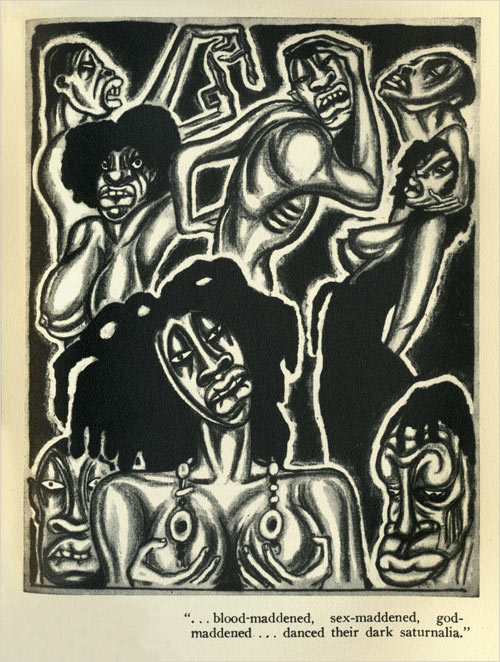
Below you will find 20 examples of printed Digger ephemera, mostly culled from Kaliflower, but also including content from Free City News and a few leaflets and posters. Have a look.


“It’s paid for, all of it. A cellophane bag represents 5000 years of machine history, inventors suicided by their inventions, aeons of garbage dedication, paid for in cancer wombs, in fallen cocks, in the crazy waste of our fathers..."


(I love that last one so much.)

Digger output in the form of Kaliflower and related items from the Free Print Shop were only produced for a few years it seems. Before long the mock-funeral for the “Death of the Hippies” was staged, the communes began disappearing, and well… we know how the rest turned out.

For a ton of information and many many more examples of The Diggers’ work look no further than The Digger Archive which is packed with avant-of-yore goodness.

Meanwhile, if you’re in the mood for some related reading you might try Manhood in the Age of Aquarius By Tim Hodgedon, which goes into considerable depth.

Note that the image which began this post is not by Diggers, but of them, I adapted it from a photo of the famous free food giveaways.

Hope you enjoyed.

03.02. filed under: art. design. history. people. 3

She wasn’t a religious woman. There was no denying that. She hadn’t given Heaven much thought at all, so to say her expectations had been confounded would not be quite accurate. And yet, moving along there on that seemingly endless escalator, she felt confounded anyhow. Not that Heaven ought to exist you understand. Not at all. People on Earth brow-beat one another about its dress code and management and admittance policies continuously, treating the whole of the world like one giant, chaotic, waiting-line, jostling and elbowing and murdering one another to get a bit closer to the velvet rope. That it existed, though admittedly surprising, did not in fact seem strange to her. It was the escalator itself which was perplexing. The thing creaked, and groaned, and was rusted to such an extent it seemed miraculous that it functioned at all.

She was afraid of heights so she didn’t look around, just straight ahead, eyes glued to the stretch of escalator directly in front of her, and staring at it with its flaking paint and leaking sealant and crumbling surfaces she began to get nervous. Alone there, high above the Earth, she said out loud, “It’s almost as though… it has been completely ignored since the day of its creation… or forgotten.”

(Note: the image, which is not actually of an escalator to heaven, was found here.)

03.02. filed under: belief. fiction. misc. 3

A Little Girl Dreams Of Taking The Veil

Before the combination of Photoshop and, this vast repository of source-materials, the internet began spawning what now certainly amount to billions of wry photo-mashups, there was a predecessor which required of its practitioners expert hand-skills and vision and resourcefulness. I’m talking, of course, about collage, and in the days before pixels, indeed before periodicals positively overflowed with photographic imagery, a fellow, without formal training, by the name of Max Ernst took the form to places previously unimagined.

Around 1919, after having studied philosophy at the University of Bonn and serving in the German army on both the Western and Eastern fronts, Ernst began experimenting with collage. He explains the impetus as follows:

“One day (in 1919), whereas I looked at an illustrated book of objects (umbrellas, watches, tools, clothing, etc) I was surprised to see such different things tight beside the others, things which one does not see together usually, my eyes saw other objects, I wanted to add with the pencil some lines and hatchings between the various objects so that it gives the same images that I see in my dreams.” –Max Ernst.

“It was enough at that time to embellish these catalogue pages, in painting or drawing, and thereby in gently reproducing only that which saw itself in me, a colour, a pencil mark, a landscape foreign to the represented objects, the desert, a tempest, a geological cross-section, a floor, a single straight line signifying the horizon ... thus I obtained a faithful fixed image of my hallucination and transformed into revealing dramas my most secret desires--from what had been before only some banal pages of advertising.” —Max Ernst: Beyond Painting 1948. 

The collage-novels which Ernst began creating in 1929, including La Femme 100 têtes (The Hundred Headless Women) and Une Semaine de bonté (A Week of Kindness), undoubtedly represent a pinnacle of the form.

I’d like to share with you some examples from a third collage novel by Ernst, published in 1930, titled, Rêve d’une petite fille qui voulut entrer au Carmel or, A Little Girl Dreams of Taking the Veil, which I am lucky enough to own a copy of. It is the story of a girl who loses her viginity on the day of her first communion and so commits herself to “taking the veil.” The collages, each accompanied by a few short lines, are visualizations of the impious, schizophrenic, and mostly nightmarish dreams she has that night.

The book begins with a 5 page surrealistic sketch by way of introduction. Here is an excerpt:

Academy of Science.

The night will come when the Academy of Science itself will not disdain to cast its gaze on the sewers of the world. The night will come when, covered with all their jewels, the secondary skeletons that one calls scientists will ask themselves this question:

What do little girls dream of who want to take the veil?

On that night a violent storm will break against the doors of the academy of science and the water will roar in the pipes.

The water will remember the shameful year 1930, the year it would have liked to see all the cathedrals of the universe parade in far-too-short dresses. It will remember above all a certain night because…

On Good Friday night of the shameful year 1930 a child hardly sixteen years old dipperd her two hands in the sewer, pricked her skin and with her blood traced these lines”
To love the holy father and to dip one’s hands in a sewer, such is happiness for us, children of Mary.

77 collages follow, separated into four sections. Below I’ve reproduced 15 of them complete with accompanying text. Have a look.


I already find myself alone. Too alone with myself, face to face with myself...”


“...oh what a joy! Here come the leech-charmers!...”


“...and to all of us a theatrical death...”


“Who am I? I myself, my sister or this obscure beetle?” (Embarrassment.)


Marceline-Mary, coming out of the anthropophagus tree: “All my hummingbirds have alibis, and a hundred profound virtues cover my body."


“...upsy-daisy! Upsy-daisy!...”


“...you won’t be poor anymore, head-shaven pigeons, under my white dress, in my columbarium. I’ll bring you a dozen tons of sugar. But don’t you touch my hair!”


Marceline-Mary: “My place is at the feet of a merciful husband.” The hair: “To dream, to dress, to babble on sick Friday."


“...my body is growing soft and white..."


“...thanks to the invisible fiancé."


The superior of the convent: “I saw myself in the form of a wolf. I sped through space with the rapidity of words.”


The assistant mother superior: “Separated from everything I went with God into his vast interior.”


The first Shipwrecked barbarian: “Hit me, my child, for you are the little saint..."


Marceline and Mary (of one voice): “What a gentle awakening!..."


Marceline: “You are in especially bad taste.” The celestial bridegroom: “Certainly, I always charge too much. I am the weed of palaces, not hovels. I’m going now and I leave you my anger.”


The book’s translator’s note has this to say on the collages themselves:

“Each one of these collages uses cuttings often from the most banal of pre-photography illustrated penny novels, and from popular tomes about nature, science, and exoticism. The result may seem to embody our most frequent tragedies, our wriest enslavements, our most terrible solutions. Specificity dissolves in the timeless and the general.” —Dorothea Tanning.

The introduction to Max Ernst: A Retrospective adds the following:

“Max Ernst’s collages, for all their strangeness, strive for overall coherence and technical plausibility. This ‘plausible’ imagery, unlike the papiers colles of Picasso and Georges Braque, depends on an expurgation of the visible difference between artist’s hand and non-artistic quotation. The joins and overlappings had to be concealed from the viewer. This is why Ernst frequently published his composite imagery only in printed form, in photographic reproduction or in versions later touched up with watercolour. Thanks to these tactics of concealment he succeeded in presenting collage as that which he thought it should be: a completely developed and autonomous system in which the origin of the separate elements is submerged in the final, total image. He was out to produce irritating imagery in which, as in the perfect crime, every clue to its identity had been erased.” — Werner Spies.

To me there is a gravitas to etchings and wood engravings, a sort of official-ness, which is unshakeable. Perhaps it is simply the obvious effort involved in their creation or their historic connection with inherently valuable printed matter (be it newspaper or book) which lends the form these overtones. In any case, I think it is exactly this implied gravitas playing against Ernst’s strange, poetic, feverish, and funny subject matter, which creates the oddly arresting magnetism they still manage to exert almost 80 years later. I can only wonder at the effect they had on viewers in the 30’s… Some mixture of giggle and shiver I would imagine.

Anyhow, hope you enjoyed these.

For more on Ernst’s collage-novels see:
Une Semaine de Bonté: A Surrealistic Novel in Collage on google books.
Une Semaine de Bonté at La Boîte A Images.
A Week of Kindness at Giornale Nuovo.
La femme 100 têtes at Koninklijke Bibliotheek.
Werner Spies’ piece at Artchive.com.
The enduring significance of the work of Max Ernst By Stuart Nolan.
Max Ernst’s Adventures in Collage from The New York Times.
Kindness Week a film by Ernst based on his collage.
Ernst related videos at Tiosam.com

-

Note: This post is in a series of reworkings of old posts which date from before the redesign of The Nonist. The text has been reworked and added to considerably, the amount of images has been doubled, and the links are all new. I will be periodically adding these reworkings into the flow of new content in an effort to eventually remove all the old pages from circulation.

02.24. filed under: art. books. history. people. 8