mysterious, plentiful, and space faring: tardigrades
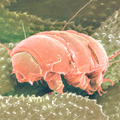 file this post under; “things i must surely have learned in school but at some point forgot, or more likely forgot instantly during a flurry of doodling, note passing, and brooding.” this particular offshoot of that huge category concerns some fascinating little buggers called tardigrades. I’m slightly embarrassed to say my re-introduction to tardigrades, or “water bears” as they are commonly called, came from a less than high-brow source, namely: the fortean times. they have an article in their science section of this month’s issue. they are very tiny (typically 0.3 to 0.5 mm). they are extremely widespread being found across the planet. They live in mosses, lichens, and liverworts. a few species live on plants in fresh water. they have a mouth, head, brain, legs, eyes, nerves, claws, and muscles, their control of which is precise in that they move like “higher animals.” what is most interesting about them, however, is that they are nearly indestructible.
“indestructible?!” you exclaim. if you happen to be a stuffy british type you likely say, “pah! rot! utter poppycock! fortnight’s old treacle my good fellow!” with much mustache twirling and harumphing. in any case let me explain. what makes them so tenaciously attached to life is their ability to reversibly suspend their metabolism. they can enter a truly deathlike state known as cryptobiosis in which their Metabolism lowers to 0.01% of normal or is entirely undetectable and the water content of the body decreases to less than 1%. they are capable of 4 types of cryptobiosis depending on what environmental extreme they are faced with—anhydrobiosis, cryobiosis, osmobiosis, and anoxybiosis. these states make the bear’s hibernation seem like a daydream on a dmv line. tardigrades have been revived after a period of 120 years from dry moss samples in a museum. it is estimated that they may be able to revive after periods as long as 1,000 years. very tenacious indeed.
according to one article: “scientists have tested the tardigrades’ ability to survive other conditions too: dunking them in liquid helium close to absolute zero, zapping them with x-rays, exposing them to hard vacuum, and blasting them with an electron microscope. they can survive all of these.” so essentially not only can the water bears survive lack of food and water but they can survive a deep freeze, lack of air, and extreme radiation. interesting skill set no? it also so happens that the commonly accepted theory as to how these tiny earthbound creatures managed to spread over the earth is as follows: “they travel on wind, surviving the freezing temperatures of the upper atmosphere and riding the jet streams, before falling 50,000 ft harmlessly to earth.” sound like the prefect astronauts don’t they?
and this idea is likely the crux of the tardigrade story being included in the fortean times. their article goes on to say: “...this leads to an interesting question- tardigrades are in a phylum of their own, recognized as being separate from any other type of animal. could they have come from another planet?” this seems a natural enough question. why would an animal need to develop a resistance to vacuum, near absolute zero temps, and hard radiation? are those defenses just happy side effects of their other abilities?
the article goes on: “molecular biologists who have studied tardigrade dna doubt it. tardigrades share dna with insects and crustaceans, suggesting that all three probably come from a common earthly ancestor.” o.k. fair enough. though it should be noted on the whole tardigrades still remain somewhat of a mystery. everyone seems to agree they need more study.
the really interesting thing about their story, to me, romantic fool that i am, still has to do with space however. again, being interested in just that this sort of conjecture, fortean times sums it up well: “the meteorite known as alh8401 that brought possible martian fossils to earth was blasted off of mars by a meteorite impact. in the same way meteor impacts on earth, like the one that possibly wiped out the dinosaurs, will have sent tardigrades into space. they are so ubiquitous and plentiful (as many as 500 per gram of soil in some places) that any impact will have sent out millions as involuntary miniature astronauts. after all this time they could have travelled quite some distance - in theory, some light years.”
“pah! rot! utter poppycock! it’s all conjecture!” sure, every last bit of it. but boy that’s the kind of conjecture i like! imagine them out there… good stuff. while you ponder it, here are some water bear images collected from all around so you can put a tiny body and face on your miniature astronaut fantasies.

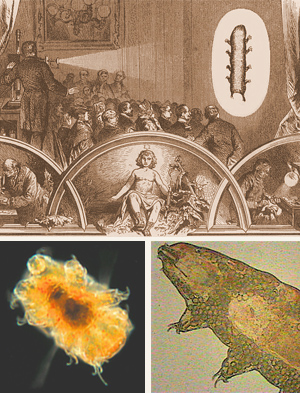

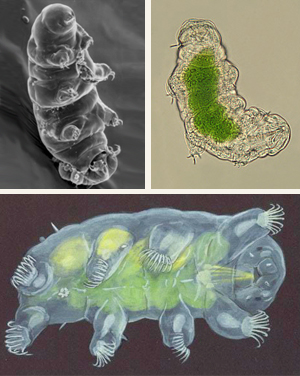

finally if you are interested in knowing more about them here are some links-
a nice article called extreme animals from astrobiology magazine.
tardigrade facts from the species distrobution project.
here’s a long link list offered by agerman site.
and last but not least, the home of tardigrades on the net, tardigrades.com.
Read Less...

Sometime in the mists of adolescence I read a science fiction story about a spacecraft that crashed on a planet where its crew had no chance of survival or escape; it was barren, offering little more than puddles. So they gene-engineered humans from their own DNA of a microscopic size to populate this world’s puddles (gliding conveniently over the issue of brain size/human intelligence). Soon the full-size humans died, leaving water-dwelling micropeople to fight off vicious rotifers and build a civilization. Rotifers aren’t water bears, but they also are small and weird and aquatic, and look at this fellow: http://dmc.utep.edu/rotifer/main.html
Does he not look like a sinister cheshire cat?
posted by .(JavaScript must be enabled to view this email address) on 04/19 at 11:56 PM

that or the ungodly microscopic spawn of batman and jabba the hut. scary looking little bugger either way.
posted by
jmorrison on 04/20 at 12:59 AM
Commenting is not available in this channel entry.


