







 scale. isn’t it a bitch? always a human at human scale with human scale perceptions. sheesh. at some point in our distant history i suppose our scale must have proven beneficial. you know, big enough to slay a dragon, small enough to live in the belly of a whale if the need arose. or to put it another way- tall enough to see over the high grasses and spot predators, short enough to dwell comfortably in a cave. it seems to me though at some point the story of human history turned into a struggle against our human scale. too big to be able to sustain a population of 8 trillion or see the quark-gluon interaction inside a proton, but too small to poke out a hurricane’s eye or see wether we’ve got any neighbors in the universe so we can wave to them from our front porches. scale’s a bitch i tell you.
it seems to me that scale is really everything. we are a certain size in proportion to everything else. our perception of that everything else- the world, the universe- and even of ourselves has been shaped in large part by our scale. why for example did we believe so many seemingly odd, hysterical, and bizarre things and for so long? well, because we couldn’t see things clearly enough to make sensible observations. right?
for example george santayana had this to say about our grandaddies “the ancients”-
The ancients saw and imagined everything on the human scale. For them the terms of thought were obvious and unquestioned: either gross physical objects, with their observable habits, or else the categories and the passions of the human mind, as grammar or poetry might distinguish them. As for the unknown, they conceived it mythologically, by projecting into nature and enlarging to a divine scale these same human terms, and peopling the infinite with optical images, verbal powers, and invisible images, verbal powers, and invisible persons. What wonder if they felt at home, and thought they had discerned the true fact of reality, by inspection in the foreground and by divination beyond? A man had but to open his eyes, and whet a little his natural understanding, and when once a few childish cobwebs or tears had been wiped away, the truth of things would luminously appear. If there was ever a conflict of dogmas under such circumstances, it could be only incidentally, when some confusion or diseased doubt had arisen by chance, or at the instigation of some wicked demon. That difficulty once solved, or that temptation vanquished, the philosopher could settle down again contentedly in the conscious possession of the truth.
makes sense to me.
isn’t it true that many leaps in scientific knowledge coincided with leaps in our ability to see further outside (or inside) ourselves? whether it be seeing things smaller or things further away or greater masses of things from a better vantage point?
imagine if primates had the ability from day one to focus their vision down to microscopic scales and outward to cosmic scales… we would have figured a lot of things out more quickly wouldn’t we? sure. but then again imagine dipping in to kiss your mate only to see eyelashes crawling with mites (or worse going to mount them and seeing…) then looking away in disgust only to see a sun exploding… primates would have gone bat-shit in a week and torn their eyes out. so perhaps it’s not such a good idea. things were and are as they were and are because they couldn’t be any other way. fine. any other way and nothing would be as it was, would it?
lewis carroll penned this tidbit, part of Sylvie and Bruno Concluded-
a scientific friend of mine, who has made several balloon-voyages, assures me he has visited a planet so small that he could walk right round it in twenty minutes! There had been a great battle, just before his visit, which had ended rather oddly: the vanquished army ran away at full speed, and in a very few minutes found themselves face-to-face with the victorious army, who were marching home again, and who were so frightened at finding themselves between two armies, that they surrendered at once! Of course that lost them the battle, though, as a matter of fact, they had killed all the soldiers on the other side.
or alternately from the same story-
What do you consider the largest map that would be really useful?
About six inches to the mile.’
Only six inches!?
We very soon got to six yards to the mile. Then we tried a hundred yards to the mile. And then came the grandest idea of all! We actually made a map of the country, on the scale of a mile to the mile!
Have you used it much?
It has never been spread out, yet, the farmers objected: they said it would cover the whole country, and shut out the sunlight! So we now use the country itself, as its own map, and I assure you it does nearly as well.
anyhow microscopy and telescopy helped us get outside (and inside) ourselves, helped us get some context. but it’s never enough is it? we still cant find a grand unifying principle can we? we can’t find a way to stop shaq in the paint. we still have to travel 22 hours or something for a nice vacation on the other side of the world. and anyhow, though the knowledge these things brought us have fundamentally changed our perceptions in the grande sense in the particulars we still act like big dumb apes most of the time.
they say the fear of the unknown is the worst and whoever “they” are they are probably right, but isn’t there still a healthy shiver down the spine for things we
doknow thanks to microscopy and telescopy which we’d rather not think about. microscopy especially has brought to light some very unsettling images hasn’t it? things that even now we are grateful to be blind to…
which brings me to the point of this malignant post. finally!
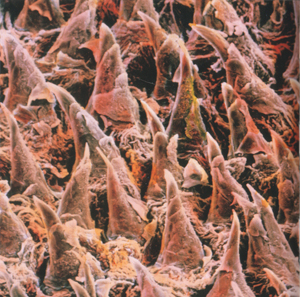
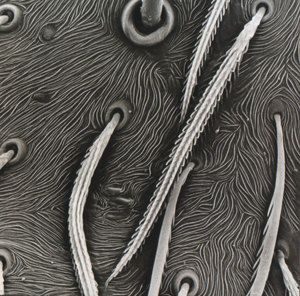
bellow you will find a few such images. ones that our battle with scale have brought to light. they’re quite beautiful in most cases, aesthetically at least. once you know what they actually are it’s hard to suppress a little “eeek.” with that in mind i’ll save the explanations of each until the end so you can soak them up a bit first…

1
2
3
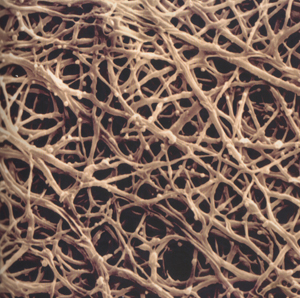
4
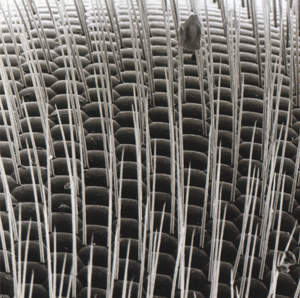
5

6
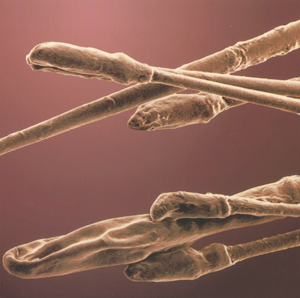
7
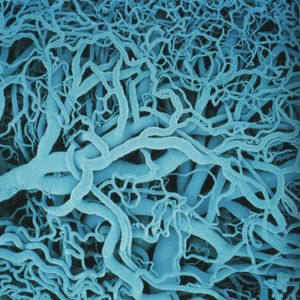
8

9

10
beautiful huh? yeah in the abstract. they depict as follows-
1. snail’s teeth
2. the surface of a human tongue
3. a spider’s exoskeleton
4. an eggshell
5. a bee’s eye
6. human skin
7. eyelashes
8. blood vessels
9. spongy bone
10. a heart valve
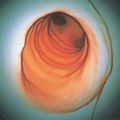
the thumbnail. carotid artery
all the images are from phaidon’s gorgeous little volume unseen by the naked eye, heaven and earth.
hope you enjoyed the pretty pictures if not the meandering slabs of seemingly pointless text which lead to them… i know i didn’t exactly make a point. truth is i spent a coupe hours searching out some content on the subject of our perception, it’s limitations due to scale, philosophy dealing with the idea, etc, but came up empty. couldn’t even figure out what words to string together in a search query to find any critical thought on the subject. ah well. i just have this sneaky feeling that no matter how deep we magnify or how far we manage to look outward we’ll never find “the end.”