








 tom and i finally managed to mount an excursion to the newly re-opened moma yesterday. the line was of near space mountain proportions, winding it’s way around the building through a series of crowd control barriers. it was raining. i arrived about 20 minutes early. in that small swath of time i’d say at least 220 people made their way into the unassuming new digs. at the new $20 admission price that’s at least $4,400 dollars in 20 minutes. not bad. so how was the actual experience once we made it inside? also not bad. somehow not quite amazing, not quite mind blowingly fantastic but certainly not bad.
the space is admittedly fantastic. i could not help but feel like a small plastic figurine in an architectural model or worlds fair poster from the 30’s. it is huge, open, airy, minimal, with the odd stink of “the future” still fresh everywhere. before actually glimpsing any of the collection i found myself thinking back to when i’d get high and make long, slow, meandering, solo excursions through our beloved museums. i imagined the hours i could happily fritter away in a private world of hallucinatory, epiphany-dotted wandering, lost in the shifting crowds. the new building just seems made for it. having left that all behind me i was happy to just stick my hands in the pockets of my corduroy blazer, and soberly execute the two-man, synchronized, museum blow through. and after a semi-covertly smoked cigarette in the courtyard that’s what we did. we didn’t do too much dawdling. we avoided the video installations as best we could, we rejected the architecture galleries out of hand, and we read precious little above and beyond the artist name for any given piece, even so it took us a good two hours to make our way through.
obviously i can’t speak for tom, but i came away feeling oddly torn. on the one hand the space itself was impressive. on the other, though most of the expected masterpieces were present and most of the heavyweights represented in some manner, i managed to come away feeling distinctly unimpressed with the art. sounds ridiculous, but there it is. i came away feeling how distinct an oxymoron the name “museum of modern art” inherently is.
there were certainly high points and little shivers of excitement. the contemporary galleries on the second floor felt wonderful to stroll through, filled with more electricity than the work on display deserved to generate. the small scale prints and photography on floors above were enjoyable as well. as you move further upward through the museum toward the masterpieces of modern painting the galleries seem to shrink. the effect is like heading up into the crowded attic of a family home to view the heirlooms which though undoubtedly priceless become over generations more holy, more weighty, more revered, and thus, paradoxically, less meaningful somehow as physical objects. as we climbed higher into the galleries i found myself feeling the same way i felt recently at the national museum in washington, bored. i know it’s sacrilege to say, but that’s the essence of it. i was bored. get your stones cocked and ready to cast: i’m fucking tired of picasso. i never liked matisse or de kooning. pollock is soul crushingly boring. and starry night? it’s been reproduced to the point of being meaningless. ok? there. i said it.
perhaps my attic metaphor is not quite right now that i think about it. after all, who’s attic is crammed so full of people it’s impossible to even get a full view of grandmas moth eaten wedding dress? let alone get a few quiet unjostled moments to ponder it? i guess in reality that’s part of the problem. the masterpieces in the moma’s permanent collection, of which there are unarguably very many, would really need an intimate viewing to be able to reveal themselves to us in any personal way beyond the crushing weight of words written about them. and that’s just not possible. in a certain way i wish they’d create a room to permanently house Les Demoiselles d’Avignon, the starry night, Dance (first version), One (Number 31, 1950), flag, The Persistence of Memory, the false mirror, Unique Forms of Continuity in Space, and Bicycle Wheel. 1951 (third version, after lost original of 1913). then they could create a separate entrance and funnel the greater part of the crowds into this one room. allowing the rest of us to actually get a glimpse of what remains. while they’re at it if they made a doorless room in the basement and put de kooning’s woman, 1 inside i’d be extremely gratified.
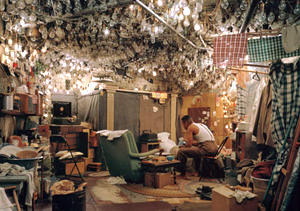
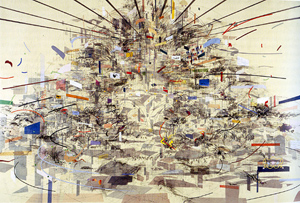
in any case, as i said, there was a lot to enjoy. the contemporary galleries had some zing, though again as stated, what felt like more than deserved. the matthew barney piece for instance, stripped of context, had zero power, and seemed more peculiar than profound. koons’ vacuum cleaners were, as always, insulting. hirst’s spot paintings were, as always, bloodless and cold. meanwhile gursky’s photographs seem less interesting with each viewing. but to spite these and many other ho-hum contemporary works there were a few that left a mark for me. jeff wall’s light-boxed photograph after invisible man by ralph ellison, the prologue. 2001 (above) was incredible and stopped me in my tracks. on the wall beside it josiah mcelheny’smodernity, mirrored and reflected infinity, 2003, (thumb at top) was also strangely gripping. it’s hard to get a sense of these works (especially “modernity…”) from the links but they were both almost painfully crisp and alive. similarly julie mehretu’s empirical construction. instanbul (below) was fascinating to take in. there were others of which i neglected to note artist or title, and unfortunately the moma offers precious little specific information on their anemic website, unless that is you are in the market for a poster of the starry night. so, as always, you’ll have to take the trip, stand in the line, pay the dough, and mine the gems for yourself.
so in the end, for me, the moma trip was decent. the space is wonderful, the work is by and large exactly what you’ve come to love or be bored by, which is to say exactly what you expect. all that remains is for the museum to decide whether it is in fact the care taker of “classical modernism,” a sort of new offshoot of the met meant to enshrine a time period, or wether it is a living institution devoted to “the art of our time” as they choose to describe themselves. i am not at all sure it can be both.