The Histoire Naturelle des Indes, created sometime in the 1590’s, is one of the earliest illustrated records of European contact with the America. Also know it by its informal title The Drake Manuscript it was donated to the the Pierpont Morgan Library in 1983, who after many years of study graciously produced a full color facsimile. I happen to have said facsimile, which was published in 1996, right here in front of me. Shall we take a gander?
First a few words on the manuscript’s origins and possibly misleading title.
The Drake Manuscript is named for Sir Francis Drake, the famed English privateer, navigator, slave trader, politician, and pirate of the Elizabethan era, whose travels it is thought to illustrate. Though Drake was himself something of an artist ⊕, the images in Histoire Naturelle des Indes were not created by his hand. Nothing of his artwork survives as it turns out.
Truth be told there is no conclusive evidence to suggest that Drake had anything to do with the manuscript, let alone that it ought to be informally named after him. Such are the gears of history- grinding the anonymous down to invisibility and raising the famed higher… for a while at least.
The best guess as to the manuscripts origins are something along these lines-
The naive drawings ⊕ show signs of being created by several separate hands. Context reveals that these were likely the hands of Huguenots. Drake is known to have employed not only Huguenots on his voyages but artists as well. A “considerable number” of the images correspond to ports of call familiar to Drake, in some cases associated directly with his voyages, and Drake is mentioned by name, twice, in the manuscript itself. Hence, with a nice pile of circumstantial evidence to stand on, and no other clues, we have The Drake Manuscript.
Anyhow, whether this is simply an instance of a famous name capturing otherwise anonymous historical debris with its considerable gravitational pull ⊕ or simply an instance of fine deduction on the part of historians doesn’t matter much. What matters are the 199 fascinating images and accompanying captions.
Taken as a whole the images are an interesting mixture. The drawings of plants and animals are presented in a sort of cold practical manner, removed from their natural surroundings, with captions that read almost like a sales catalog, listing the virtues and drawbacks of each. ⊕ The drawings of the indigenous peoples themselves on the other hand are altogether warmer and seem to serve no greater purpose than curiosity.
The styles of the images are an interesting mixture as well-
Quote, “Some drawings are well rendered, others mere daubs, but most have a kind of buoyantly piquant vision of their subjects. Some are true to life, some–particularly the fishes with doglike snouts and ears–arise from an almost medieval fancy, and some may reflect a knowledge of printed sources.” - Verlyn Klinkenborg.
I’ve reproduced a group of the images below for your scrutiny. Some were chosen because I particularly liked the drawing, some because I was amused by the caption, and some because the ghost of Drake, boarding the deck of my apartment and holding me at sword-point, compelled me to. Have a look for yourself.

PETVN
(Tobacco)
“A special herb which the Indians use for food as well as an extremely beneficial medicine; when they are sick, they breathe in the smoke by mouth with a straw; soon the ill humour escapes by vomiting. They often pulverize it and, putting it in their noses, it distills several drops of water from the brain to discharge it. It is also found very helpful for toothache…”

MANTTE
(Manta Ray)
“This fish is very large and no less vicious. When the negroes dive in the sea for pearls it jumps on them to make them drown and afterward eats them.”
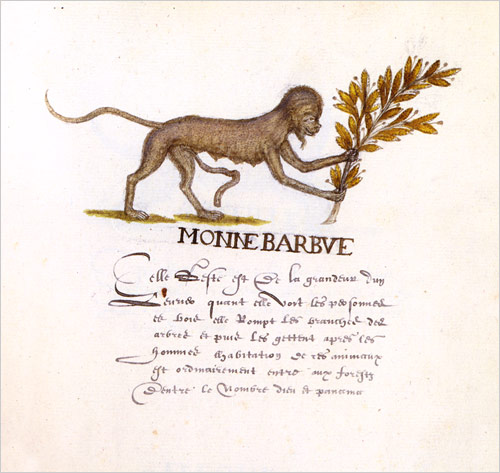
MONNE BARBVE
(Bearded Mona)
“This animal is the size of a greyhound. When it sees people in the woods it breaks off branches and throws them at them…”

MOVQITES
(Mosquito)
“These are small flies which are so small one cannot see them, they are very dangerous. When there is no wind and the weather is calm, they come in droves attacking people, stinging them in such a manner that one would take them for lepers…”

HINDIANE
(Woman of the Indies)
“This woman chases the flies away with a little bell hanging from a tree branch, afraid that when they bite their children, they will cry, for seeing their children cry makes them sad, having visions that at that time the devil is in their body…”

MENSENILLE
(Manchineel Tree)
“A very piusonous tree, so that if a person looks up to it, he will be blinded for three hours afterwards. The Indians hide their arrows in this tree when they are at war in order to make them poisonous.”

CENT PIERNE
(Centipede)
“A very poisonous beast. It feeds in places where there is wine and vinegar. It only moves around at night. A person who has been bitten by this animal lives only for twenty-four hours afterwards. It finds the Indians in their beds in order to kill them.”
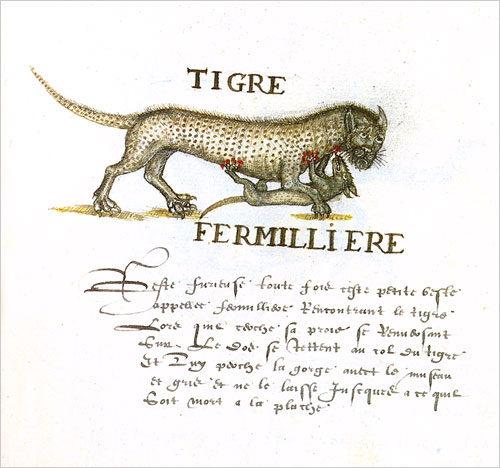
TIGRE FERMILLIERE
(Tiger and Anteater)
“Savage beast. However, whenever this small animal called anteater encounters a tiger looking for prey it turns on its back and throws itself on the tiger’s neck and pierces its throat with its snout and claws and does not release him until he is dead on that spot.”


FEU
(Island called “Fougue” or Fire Island)
“During the day one always sees smoke on top and when the sun has set and night has come, one likewise sees a great fiery blaze because on the island and on the summit, the earth produces sulfur and there is thunder and lightening which cause the continuous fire…”

HINDE DE LA TRENITE
(Indian of Trinidad)
“Tha manner of catching parrots is this: if they are large, they make a trap with string attached to it. In this trap they put a parrot with his feet tied and next to him a small animal called a catille which plucks him. When the parrot cries and the other parrots, hearing his voice, come to his rescue, freely joining him in the trap, the Indian seeing this pulls the string and the parrots are instantly trapped.”

PIOVCHE DE MER
“This is as valuable as a louse.”

CIFRE
(Monkey)
“This is a very agile beast. The Indians cannot tame it or feed it for they die of grief and do not eat in captivity. They have a face like a human and are very mischievous and rebellious and throw themselves against people mainly in their faces and eyes.”

PERIQITE LEGERE
(Sloth)
“The nature of this animal is so to climb with its belly uppermost and, climbing this way, it moves faster than a man could on foot. The skin of this animal is very excellent for people suffering from falling sickness [epilepsy]. The head of the afflicted is covered with it then one realizes how effective the skin is.”

HINDES DE IHONA
(Indiands of Ihona)
“When the Indians have defeated their enemies, they make them lie down on the ground, then pound on them, and after that, give them a blow on the head with their sword. When the blood starts flowing, they hold it back promptly, thinking that by this means the body will make a better roast for a solemn feast, calling this a deed of prowess.”
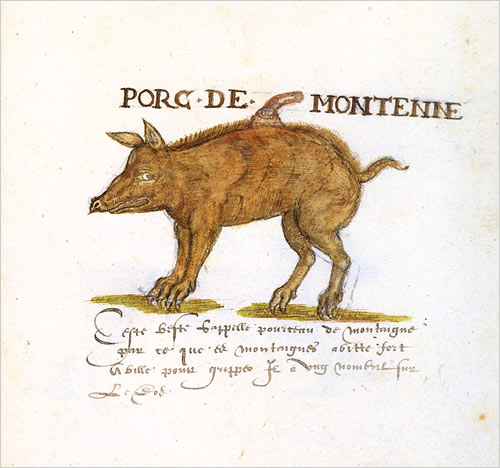
PORC DE MONTENNE
(Mountain Pig)
“This animal is called a mountain pig because it lives in the mountains. It is adroit at climbing. It has a navel on its back. “


AVILANNES BLANCHES GOMITES
(White Physic Nut)
“They may well be called white nuts… They don’t make one vomit at all.” This is as opposed to the black Physic Nut which has quite different effects. “When a person has eaten them, he will throw out everything in his body above and below.” The Indians evidently ate the black nuts when they felt they’d been poisoned as a way of expelling the poison from the mouth and from “below.”

TIBERON
(Shark)
“This fish is very viscious in the sea so that when a sailor throws himself into the water for some reason this fish turns on his back and tears out a leg or an arm and eats it.”
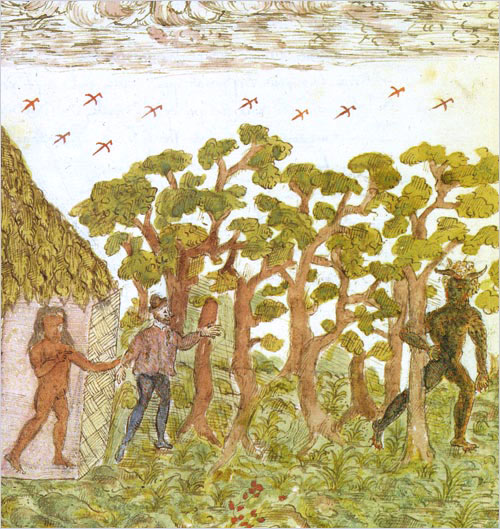
COMES LES YNDIENS ONT ORDINAIRM[ENT] DES JLLUSIONS DU MALING ESPRIT
(How the Indians Usually Have Visions of the Evil Spirit)
“The Indians are much tormented at night by visions of the Evil Spirit whom they call in their language “Athoua.” They do not dare leave their houses at night–only when light has come–and this is because they have no belief nor education and do not worship anything…”
I find these fascinating, and believe me when I say I had trouble choosing from the 199 plates reproduced in the excellent facsimile.
Concerning the images themselves it amazes me to look at them in the artistic context of their time, because though I undoubtedly find them beautiful, when I remind myself that they were created in the 1590’s, and that at that same moment El Greco, Rubens, and Caravaggio were all active… well it’s surprising. Thought of in those terms it’s a wonder these weren’t made by the “Indians” themselves.
I think today, with television and advertising and graphic design having made the shared “visual language” so pervasive, we have a tendency to regard varying levels of visual sophistication simply as styles which homogeneously blanket entire eras, permeating everything from high art to life’s daily banalities. It may be true, to some degree, as far back as the 19th century, but images like those in the Drake Manuscript are, for me, a useful reminder that if you travel further back, our conceptions begin to break down and become little more than assumptions, based on the retrofitted categorizations art historians have coined for us.
The captions fascinate and amuse me for a similar reason. There is something comical to me about contemporaries of Shakespeare, Giordano Bruno, Cervantes, and Galileo ⊕ traveling to these “savage” lands, filled with a blustery and inalienable sense of their own superiority over the ignorant inhabitants, who upon arrival and lengthy inspection proceed to relay information as goofy and superstitious and folkloric ⊕ as their dark-age ancestors might have believed.
Of course, as not to fall into the same trap of egoistic presumption, and lest snide ephemera hunters of the 3000’s stumble upon this blog (attributing it, of course, to Markos Moulitsas or Xeni Jardin whilst my anonymous bones decay in quietude) and scoff at the wrong-mindedness of it all, I’ll shut my mouth right there.
-
For a bit more on the manuscript see-
Histoire naturelle des Indes on Google books.
This pdf from the National Humanities Center.
-
I’ll only say this in closing, I enjoyed these and I hope you did as well.
hide full text