Quote: “Take a deep breath! You have just inhaled oxygen atoms that have already been breathed by every person who ever lived. At some time or other your body has contained atoms that were once part of Moses or Isaac Newton. The oxygen mixes with carbon atoms in your lungs and you exhale carbon dioxide molecules. Chemistry is at work. Plants will rearrange these atoms, converting carbon dioxide back to oxygen, and at some future date our descendants will breathe some in.”
This quote is taken from the introduction for the book, The Particle Explosion by Frank Close, Michael Marten, and Christine Sutton. It continues as follows:
Quote: “If atoms could speak, what a tale they would tell. Some of the carbon atoms in the ink on this page may have once been part of a dinosaur. Their atomic nuclei may have arrived in cosmic rays, having been fused from hydrogen and helium in distant, extinct stars. But whatever their various histories may be, one thing is certain. Most of their basic constituents, the fundamental particles—the electrons and quarks—have existed since the primordial Big Bang at the start of time. In recent years, physicists have learned to make these particles in the laboratory, and by studying them, they hope to learn about the origin of the Universe.”
Published in 1987 the book is a historical overview (aimed at the layman) of the field of particle physics, from its beginnings in the 1890’s straight through to the time of the book’s writing, the mid-eighties. It is good stuff if I may say so.
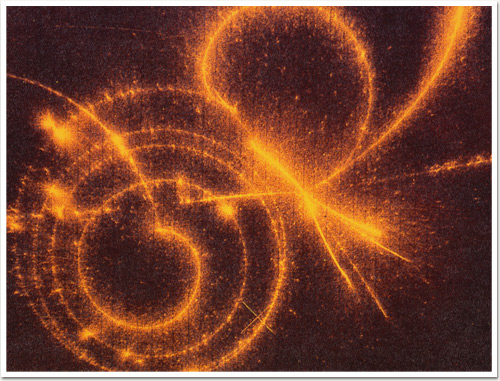
One of my favorite aspects of the book are the false color images of particle events as recorded in bubble and cloud chambers. Images of these events are always fascinating, not only because of their scientific implications but for their aesthetics as well. They are just plain ol’ beautiful to look at. In as much I wanted to share some of them with you.
The examples in this book aren’t actually the most beautiful particle event images I’ve come across (a matter of personal taste perhaps but it seems to me that if it’s possible for particles which have existed in some form since the beginning of time to look “dated” or “of a certain era” then these qualify) but they are handome in their way and interesting all the same. In keeping with the fanciful nature of the introductory quote above, I will not only include a brief scientific explanation of the events pictured but also an extrapolation as to just where the particles involved may have been residing at the time of the book’s publication.
Behold.

The particles in this event once dwelled in a nose hair. The hair was knocked from said nose when an extremely irritated John Madden, distracted from an afternoon session of diagraming defensive plays for his Oakland Raiders by the incessant beepings of the Atari game Missile Command, strode from his office, into the living room, and roughly clapped his son on the back of the head. Boom!

The particles shown here were once part of a tiny chunk of foam which was dislodged from the muppet Beaker’s nose by an errant fly fishing lure. The errant lure was cast by a drug addled puppeteer who rather than paying attention to the task at hand was instead gawking at the soundtrack album artwork for John Lennon’s Imagine, on which the cover caricature’s hair was being swept back by a hallucinatory wind.

On Halloween night, 1986, a teenage boy attended a party dressed as the cartoon singer Jem. The party was held at a run down discotheque called Synergy off of the Jersey Turnpike and the main attraction, other than the peppermint schnapps and eyedropper full of acid he’d smuggled in, was the special “Frankie Goes to Hollywood” laser light show. The particles seen here were once part of his retina.

The particles in the event pictured here were once contained in a dollop of antibacterial ointment. The ointment had been applied to the bandages of a burn victim, who, on his way home from an auction where he’d purchased the original umbrella used by Julie Andrews in Marry Poppins, got caught in a heavy downpour. Unable to resist the temptation, he opened the Marry Poppins umbrella which was promptly turned inside out by a gust of wind and blown, with him still grasping it covetously, into a downed power line.

In 1983, in a lovely furnished basement in suburban Ohio, a ritual was preformed by three teenagers hoping to become members of the local chapter of the Church of Satan. The ritual called for the following ingredients to be combined in a silver chalice: the veins of Nicolai Tesla’s left nut, the spinal fluid of a seasoned Deadhead, a crumpled Old Testament page containing the verse Exodus 3:2, and an electric currant from a car battery. The particles in the event seen here were scooped into bags by the local volunteer fire department.

One of the protons pictured here was at some point contained in the tiny section of black ink which described the shape of Charlie Brown’s famously anemic tree on the Betamax sleeve of A Charlie Brown Christmas. Coincidentally the other protons were contained in the sleeve of the VHS version.

Left: The particles pictured here were once contained in a bit of paper pulp, which was itself once part of a crumpled and cast aside first draft of an attempted reworking of the famous Hitchcock profile logo for the television show The New Alfred Hitchcock Presents. Right: The electrons here once existed in a scab on Stevie Ray Vaughn’s fingertip.

After having their minds altered by a mysterious 5-dimensional being calling himself The Fuse, the Green Lantern and Iron Man were training their energy beams on one another in a forced battle to the death. At exactly the moment their beams were about to cross (an act whose explosive force would have decimated the entire city) an unfortunate daddy long-legs spider, set adrift on cluster of windborne dandelion seeds, came between them, inadvertently braking The Fuse’s hold and saving the city. The particles pictured in this image once took up residence in the braincells I would have used to formulate an idea for this paragraph, had I not destroyed them one afternoon in 1987 sniffing super-glue.

The particles here were at one point part of a microscopic shaving from Joan Miró‘s palette knife. The shaving was chipped loose during an altercation at a cocktail party in which he, and a young Ralph Steadman, engaged in a gentleman’s duel (palette knife vs. rapidograph) over the issue of which was a nobler creature, the squid or the sailfish.

Amongst the birds there is a legend, chirped to hatchlings at night, about a bloodthirsty and merciless Buttonquail whose nest was lined with a thousand bird legs, torn violently from the bodies of a thousand naughty chicks. The particles pictured here were not from said Buttonquail, but from the nest of a disturbed parrot named Lugo who could only be sexually excited when perching on the carcass of a dead stickbug.
“If atoms could speak, what a tale they would tell.” Indeed.
Hope you enjoyed.
hide full text