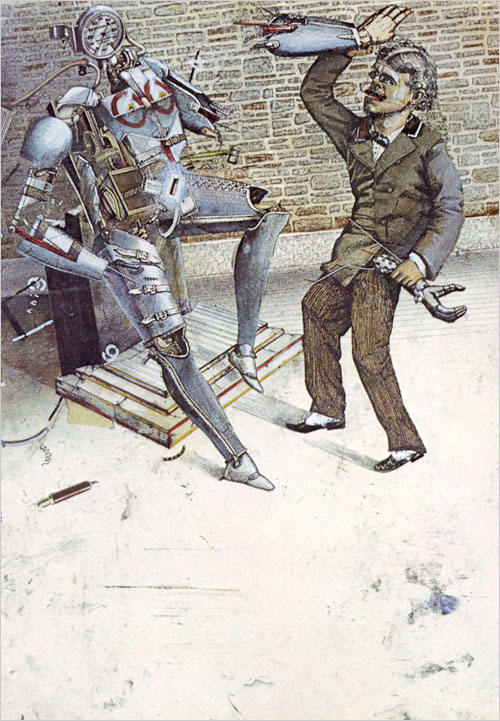
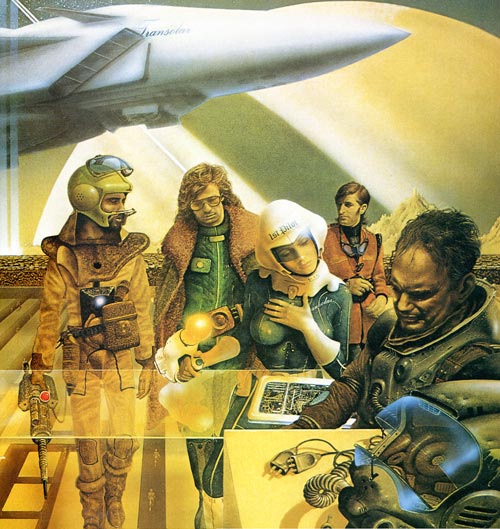
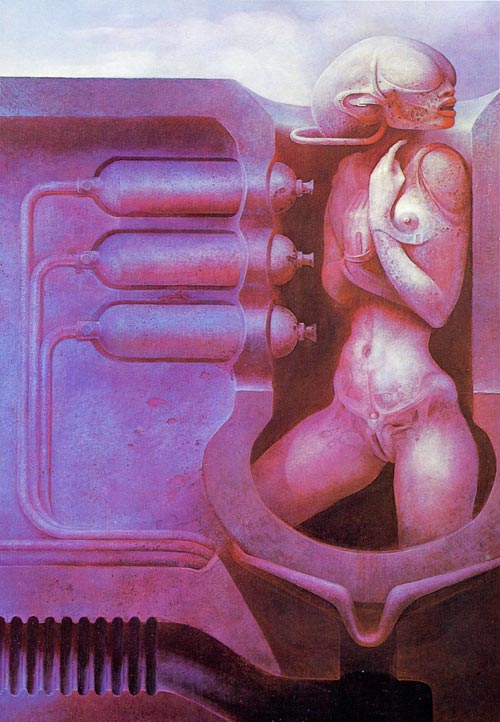
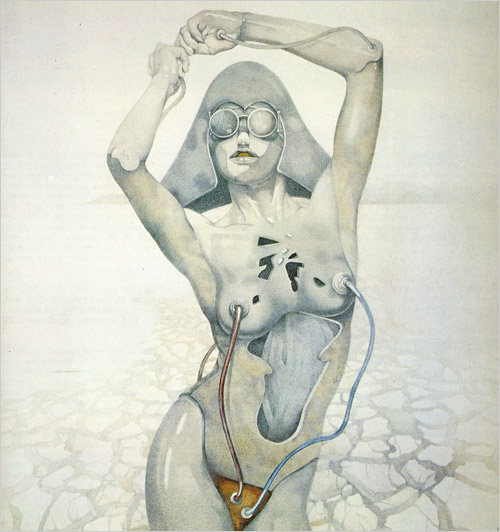
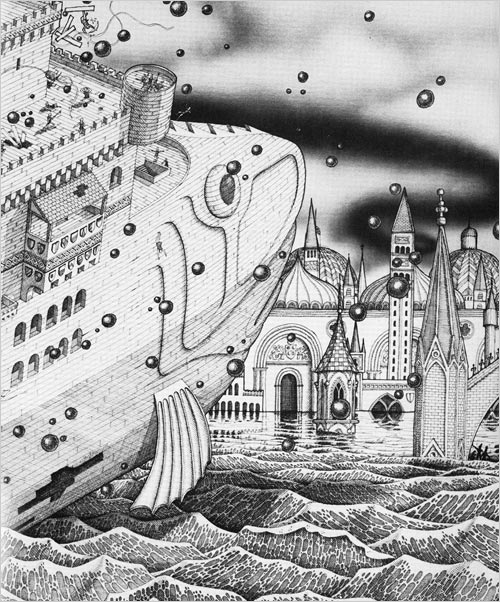
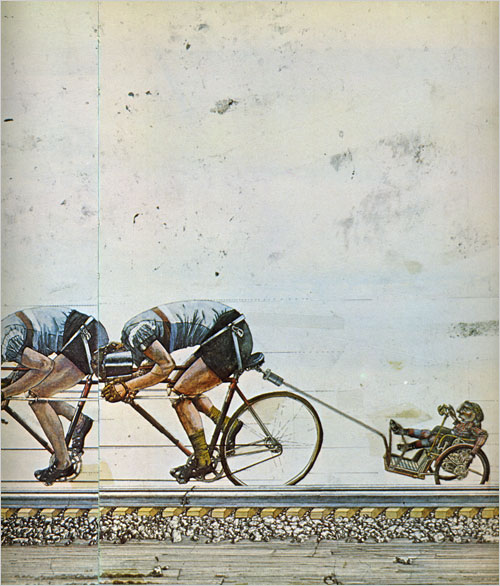
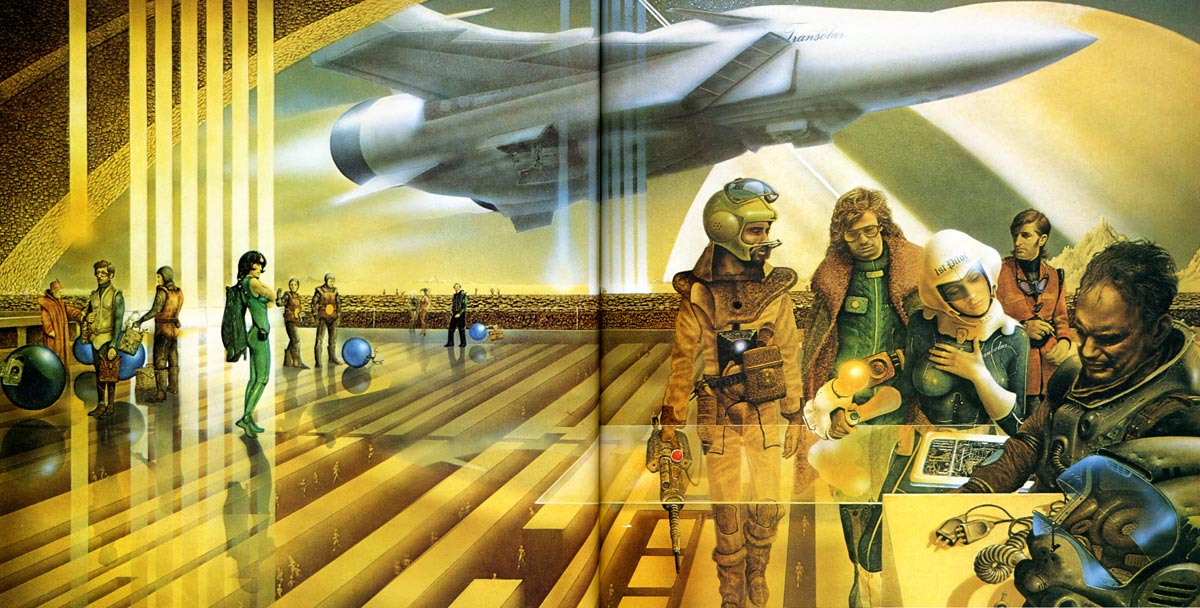
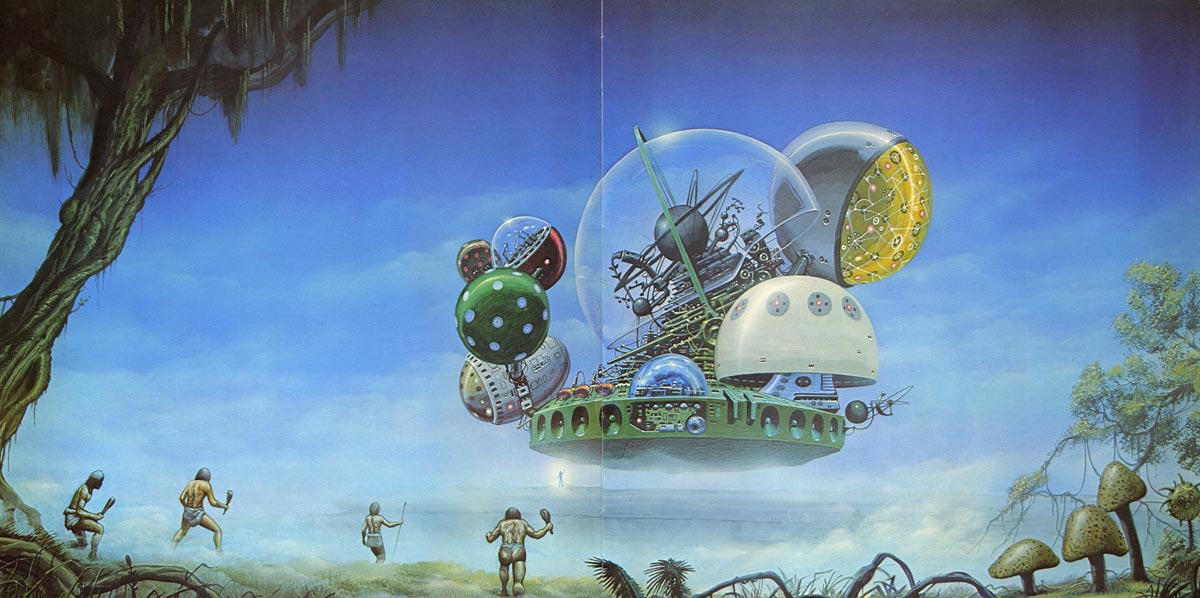
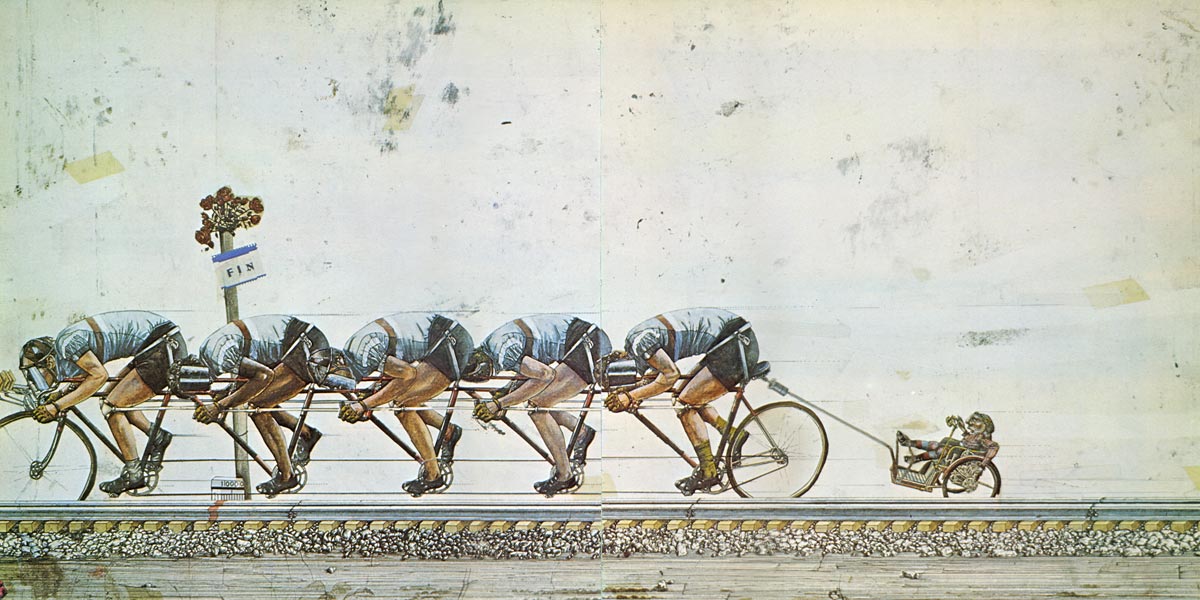
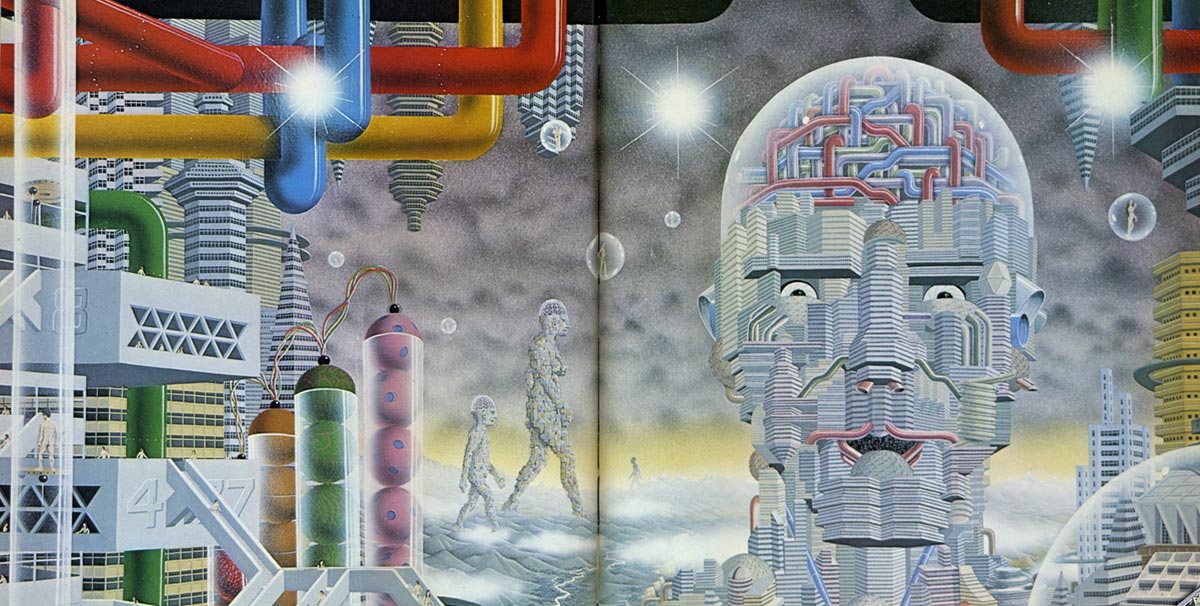
A few weeks ago I picked up a book in the bargain bin at Strand titled Mechanismo. When the guy ringing me up at the checkout counter came upon it in my stack, he stopped, flipped through it quickly and somewhat sheepishly, and alerted a buddy standing a few registers down. They admired it together. I remember thinking, “Well, guess that one is Nonist worthy.” ⊕ The book, published in 1978, is essentially a collection of essays by the venerable Harry Harrison on all things science-fictional. What makes the book standout, however, is the bounty of 70’s era sci-fi illustrations contained within, and it’s some of these that I’d like to share with you.

Mechanismo
Or: praise of futures past








The Repugnant Mugs of Ugly Bugs
Bugs- weird, off-putting, unknowable, swarming and creeping and crawling masters of the Earth. Even when seen from across a poorly lit room, at only a few millimeters long, scurrying for cover, we, the thumb-flexing warhead-builders, fear and revile them. Their “otherness” disturbs us I’ll venture to guess, because in nearly every encounter we reflexively let the boot-heels fall. So how, as a species, do we usually come to terms with things which we do not understand? Why, by looking at them more closely of course! Were we to make the effort and take the time to look at our insect neighbors more closely, face to face as it were, we’d see something in them that would bridge that gap of “otherness” and quell that deep-seated horror; we’d approach some new enlightened understanding which would, over time, in perhaps as few as two generations, effectively curb our instinct for instant murder, replacing it instead with feelings of fellowship for they who are, after all, not so very different from ourselves… right? Uh… think again.
Ten years worth of entries for the Oklahoma Microscopy Society’s Ugly Bug Contest, which are essentially micrograph mug-shots, ought to dispel any of those human/insect utopian notions. Check it out: 07, 06, 05, 04, 03, 02, 01, 00, 99, 98, 97. Yeesh. Where did I put my hobnailed boots ?

Quote: “The Chinese philosopher Zhang Hêng invented the earliest known seismoscope in 132 A.D. The instrument was said to resemble a wine jar of diameter six feet. On the outside of the vessel there were eight dragon-heads, facing the eight principal directions of the compass. Below each of the dragon-heads was a toad, with its mouth opened toward the dragon. The mouth of each dragon held a ball. At the occurrence of an earthquake, one of the eight dragon-mouths would release a ball into the open mouth of the toad situated below. The direction of the shaking determined which of the dragons released its ball. The instrument is reported to have detected a four-hundred-mile distant earthquake which was not felt at the location of the seismoscope.” Neat.
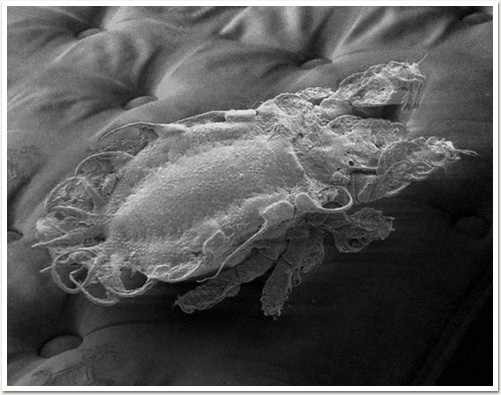
The humble Crotoniidae mite, cousin of the spider, opened its own private little Pandora’s box. Quote: “In a first in the annals of animal evolution, these mites have rediscovered the joy of sex, regaining the ability to mate after descending from ancestors that had lost the capacity for it.” Ah yes. And along with the joys of sex (of which there are unarguably many) the Crotoniidae mite can now also rediscover a world of hurt– feelings of inadequacy and regret, dysfunction, confusion, guilt, self-loathing, unquenched desire, disgust, and all manner of deep dark shadow-casting neurosis! Whoopee! In 20 years their progeny will be cursing that first horny mite couple who slapped the gift horse of evolution in the mouth and cast their whole family, yet again, out of the garden of serene Eden. If you’ve got some cash to burn in the stock market now would be the time to invest it in mite-sized sports cars.
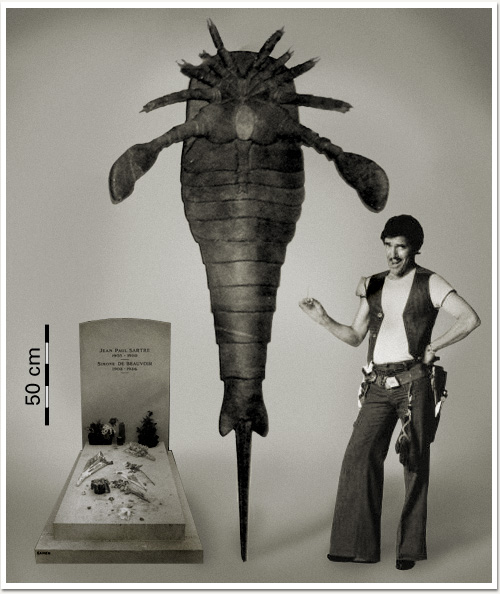
Some researchers at the University of Bristol, UK, have unveiled their findings as to a 46-centimetre eurypterid claw which was found near Prüm in Germany. After some fevered calculations and ratio checking the fossil is now believed to have belonged to the largest sea scorpion ever discovered. As Nature reports, “At 2.5 meters, this monster was bigger than a man.” Eeek.
To give you a real sense of scale I’ve included the image above, in which we see a eurypterid beside both Jean Paul Sartre’s grave, which he shares with Simone de Beauvoir, and a certain Duane Schneider from the hit 1970’s television show One Day at a Time. Hopefully that gives you some perspective.
(Story brought to my attention by the excellent Heraclitean Fire.)