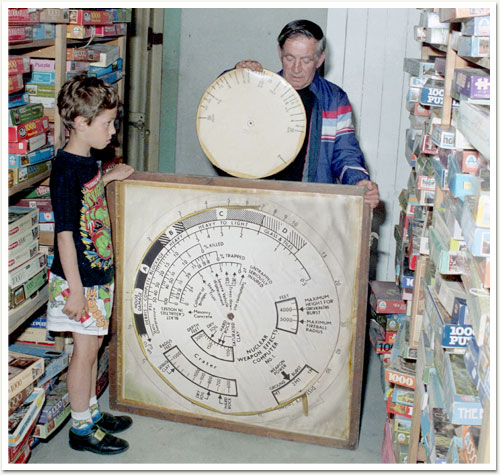
He kept his homemade, oversized, “nuclear weapon effects computer” in a room packed floor to ceiling with puzzles.⊕ To me, smugly distanced from the fearful zeitgeist of the atomic age (and its pragmatic preparations) this choice seems perfectly fitting. I can think of none better in fact. Circular slide rules manufactured to calculate the various effects and time lengths of a post nuclear landscape were once fairly common items. If you handed me one today and expected an important calculation in return you might as well hand me a icosahedron-shaped rubik’s and expect in return a nice slice of strawberry pie.

Let’s do a visualization exercise.
Try to let go of your movie-induced visions of post-apocalyptic struggle, centered on flesh eating irradiated men, broken eyeglasses, and thunderdomes, and focus instead on standing in a dark, rubble-strewn bunker trying to make heads or tail out of a (greek to me) number-laden slide rule… do you see what I see?
Now that’s horror!
(Why, oh why, am I so unprepared? And why did I take so many gad damned Humanities courses anyway? Fucking art school!)
Personally I don’t remember ever even seeing one of these items first hand. That seems to have as much to do with the timing of my birth (1974) as with my decidedly hippy-leaning parentage. Let’s look to John Walker (maintainer of fourmilab.ch and co-author of AutoCAD) for some firsthand accounting-
Quote: “Anyway, when some champion of human liberty in a Che Guevara T-shirt and Mao jacket was haranguing his audience with claims like “A single Hiroshima bomb set off downtown would annihilate this university and all of us in the blink of an eye”, what better way to burnish one’s Strangelovian credentials than to whip out a handy-dandy nuclear bomb computer slide rule, whip—slip—slide, and interrupt, “Naaah . . . fifteen kilotons at five miles? Surface burst? Why, that’s only a quarter to a third of a pound per square inch overpressure—it’ll probably break some window glass but that’s about it.” Flipping the slide rule over, “The flash isn’t even enough to cause sunburn, and the immediate radiation is next to nothing.” For some unfathomable reason, this never seemed to either carry the argument or suitably impress chicks.
Back in those psychedelic days of yore, you could order your own fantastic pastel plastic nuclear bomb effects computer directly from the U.S. Government Printing Office for a single green dollar, and for three dollars more, obtain the authoritative 730 page book, The Effects of Nuclear Weapons, upon which it was based. With the winding down of the nuclear arms race and eventual end of the Cold War, interest in the actual consequences of setting off nuclear weapons waned. The book and computer were last updated in 1977, and subsequently went out of print.”
Indeed.
Well that explains why when I look at one of these circular slide rules all I see is some nifty looking, though totally opaque, information design and why rather than envisioning all sorts of weighty cause and effect scenarios my first thoughts are instead, “mmmm pretty” and “I bet Tufte would approve of those.” Have a look at some for yourself and see what you think.


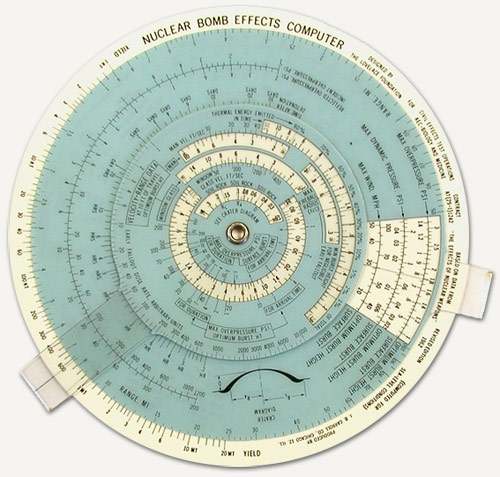
I must admit the very thought of some determined engineer brandishing one of these after a bomb blast, to calmly draw even a smidgeon of rational data out of the situation, is a heartening thought. Where as most of us would immediately set about trying to cobble together flying machines out of lawnmower parts or riot down at the sporting-goods store in covetous search of hockey masks and shoulder pads some among us might yet be able to do something useful.
Obviously the slide rule in general has largely become a outmoded technology with the coming of the scientific calculator and more recently, these, how-you-say, computronics. But as with all technological corpses there remains a fervent underground of admirers and collectors who keep a fire burning in the tomb. Which in the case of slide rules, nuclear themed specimens especially, is a blessing. After all with a few well placed electromagnetic pulses -care of some lovely nuclear explosions- they could very quickly return to state of the art, technophile coveted, status.
If you’re a true technology junky and want to get a jump on the apocalyptic gadget frenzy (sure to be kicked off in the pages of the mimeographed editions of endgadget and gizmodo) or would simply like to feel less stupid when all hell breaks loose, Fourmilab offers the Build Your Own Nuclear Bomb Effects Computer page as a public service.
Happy computing!
The images in this post were adapted from the following:
ORAU’s page on Nuclear Slide Rules
Cyberheritage.org’s Pounds House, Plymoth
For a bit more-
Micro-history of the slide-rule
Wiki history of the slide rule
Curious Lee
Lastly, I ought to mention that the slide rules pictured here were chosen not for their visual niftiness but strictly for their function. There are MANY handsome looking slide rules to be seen out there which would surely prove inspirational to purveyors of information graphics and retro-design lovers alike. I can recommend the following-
Rekeninstrumenten’s slide rule catalog
Sphere’s circular slide rules page and slide rule universe
Greg’s slide rules
Slide rule museum
Hope you enjoyed.
hide full text




I remember when I was a kid, coming across a circular joke generator my dad had. It ha several overlapping carboard discs, and the top disk had openings for ‘first character,’ ‘second character,’ location and so forth. All this is from vague memory, of course. Apparently, once you combined, say, an auto mechanic and a nun in a delicatessen, a joke about this situation was supposed to pop into your head. There were at least a couple of other variables; props, maybe.
So an auto mechanic goes to a deli, see, and there’s a nun buying a sausage. The auto mechanic says, “Save your money, I’ve got—” and then before he can finish the sentence the city is vaporised by a 3 megaton Russky warhead.