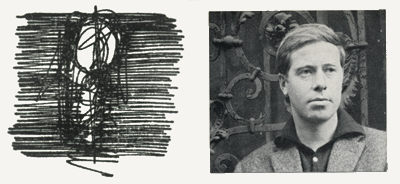
Picked up a slim little book today, on a lark, put out in 1962 by the New Art Center Gallery, for an exhibition of bronze reliefs by German artist Karl-Heinz Droste. The book contains no information about the work or the artist, just images and a few relevant quotes. A search revealed only that he was born in March 1931 in Benneckenstein and died on 22 October 2005 in Berlin Charlottenburg. The page with the most info on him is entirely in German, and web translations being what they are, I’ll forgo including any of it. See below for a small sampling of his sculpture which I, for one, like very much.
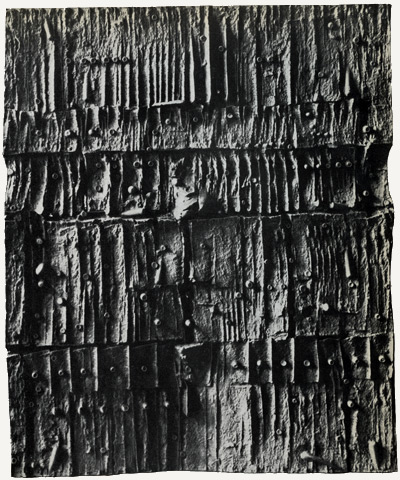
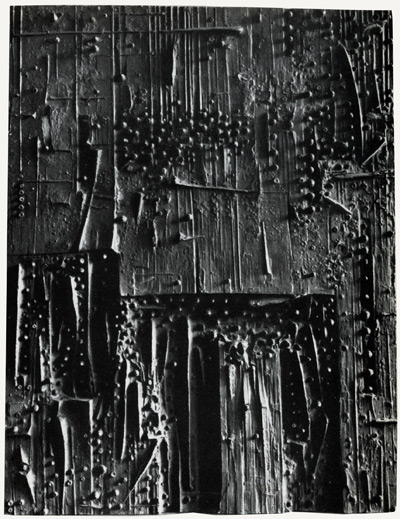
In 1960 the Moison de France in Berlin organized an exhibition of Droste’s and some of his contemporaries’ work. What struck me most then was his restraint. At this stage it would have been easier to seem more than he was by imitating some better established artist.
Droste’s reliefs remind one of an archaeological site. One can almost still feel the earth on his work. One feels his work slowly take shape, as if something man-made were gradually emerging from the earth. It looks geological and artistic at the same time. A phantastic fauna grows on this strange territory. Its surface is broken by humps, cuts, scars, and grooves. The whole microcosm is a delight not only for the eye but also for the sense of touch — its forms and material seem natural although they are an artist’s work.
-WILL GROHMANN
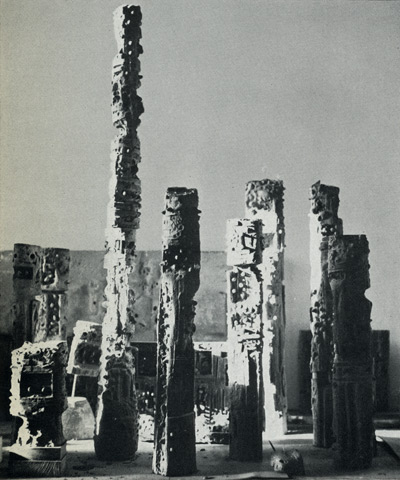
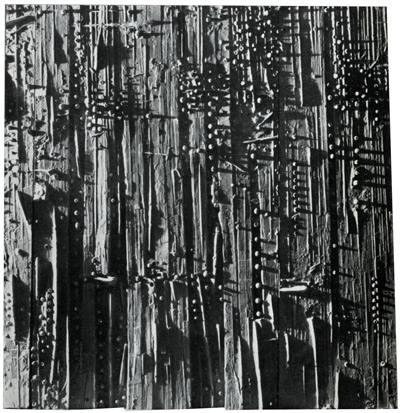
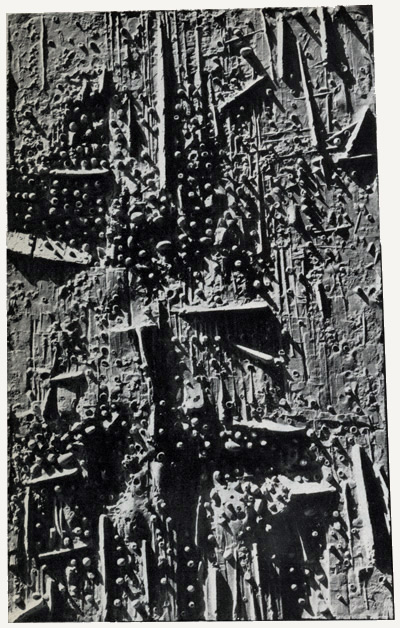
Every work of art bears the traces of its origins more or less clearly imprinted on it. Each stage of its growth can be read in the finished form. On first sight Karl-Heinz Droste’s reliefs seem to bee the result, not of calculating constructive intention, but of a long slow geological process. They remind one of the fossils of former beings. There are layers of silt, and the whole work gains its fascination through the strange processes of decay in successive layers of sediment.
Droste’s starting point is the relief, but he does not work on a neutral background, he incorporates it in a complex structure of different layers. The sense of space is so relativized that the subjective view of the work is constantly changing. This effect is intensified by the changing light, whose moving shadows alter its graphic pattern. These reliefs which keep changing their character have given up certainty in favour of an irrational changeability according to the viewer’s standpoint.
-EBERHARD ROTERS
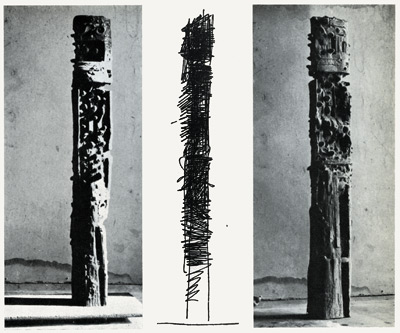
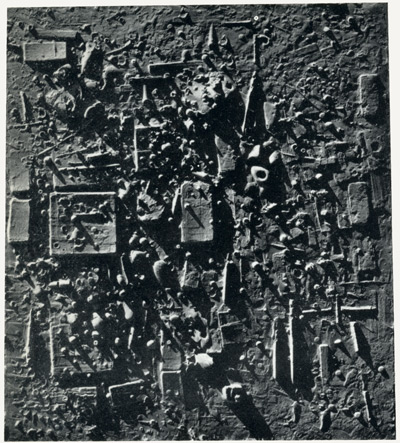
To me they look, more than anything else, like overhead shots of failed civilizations, or possibly the images now returned on a daily basis from the surfaces of distant moons and planets. Me Likey.
One final note: Discovering Droste today had extra punch for me, though not because of the sculpture pictured above. While looking for more info on him I came across his photography, which he evidently began dabbling in latter in his career. Take a look at these images and then take a look at these (especially those toward the bottom of the page) and it shouldn’t be hard to tell why.
Every so often I come across an artist who I’ve never heard of and am humbled to see (what I feel to be) my own aesthetic in evidence elsewhere, created long before I ever touched a camera or brush. In the case of Droste’s photographs I can see immediately what he was after. How many times have I stood by the edge of the lake in Central Park trying to capture the same kind of thing? Fascinating; for me anyway.
Hope you enjoyed. If anyone out there has further info on Droste please let me know.

