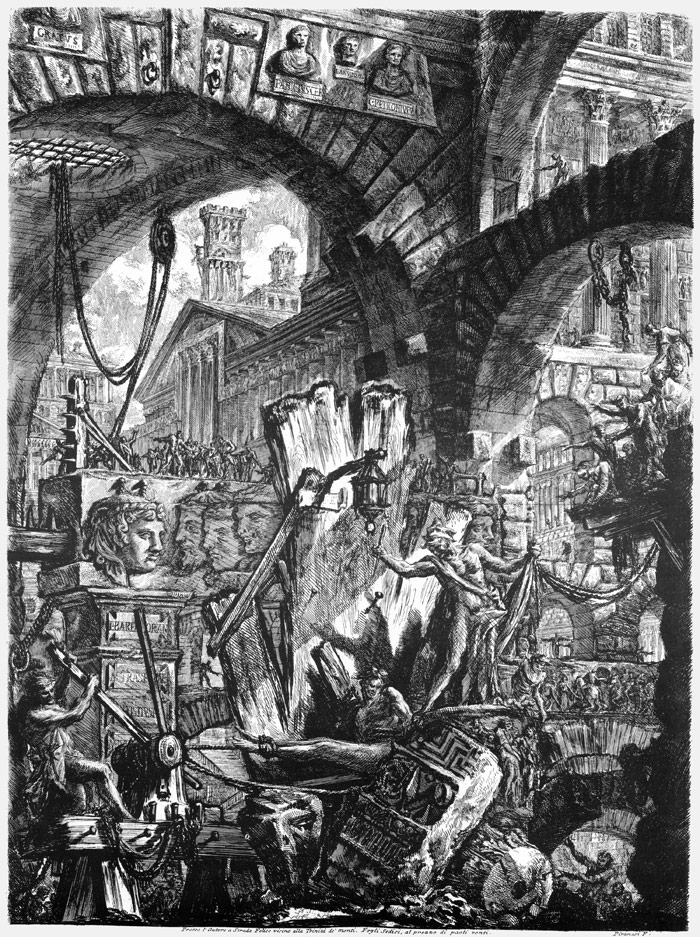
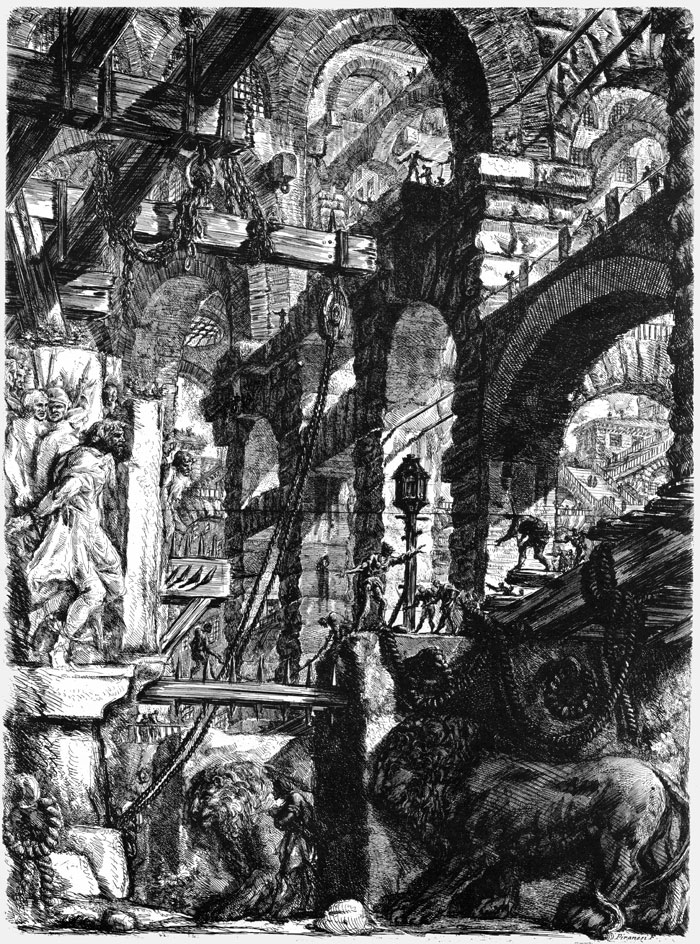
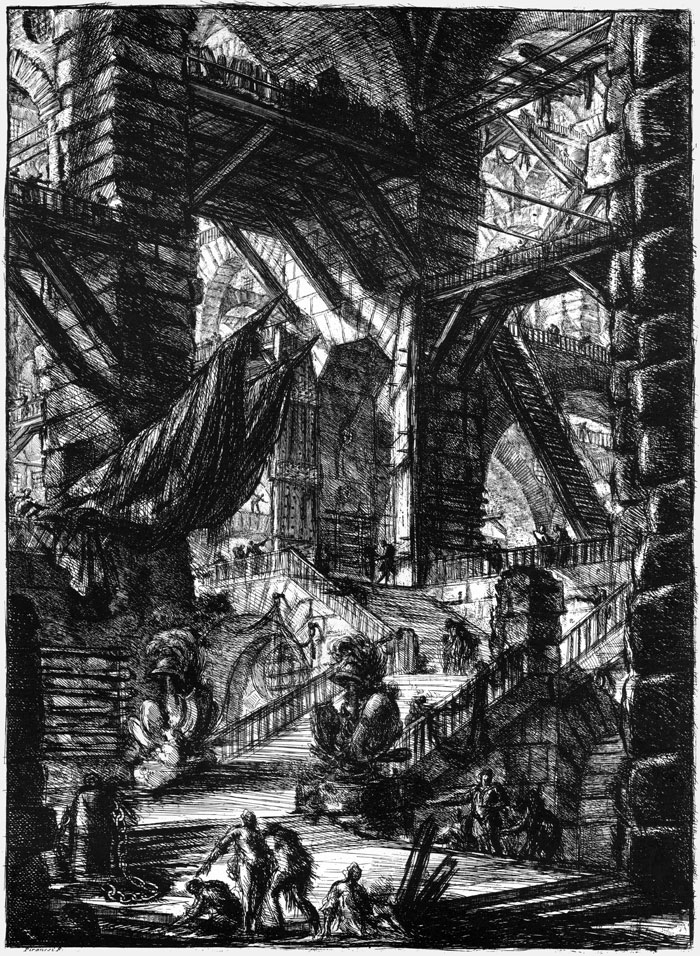
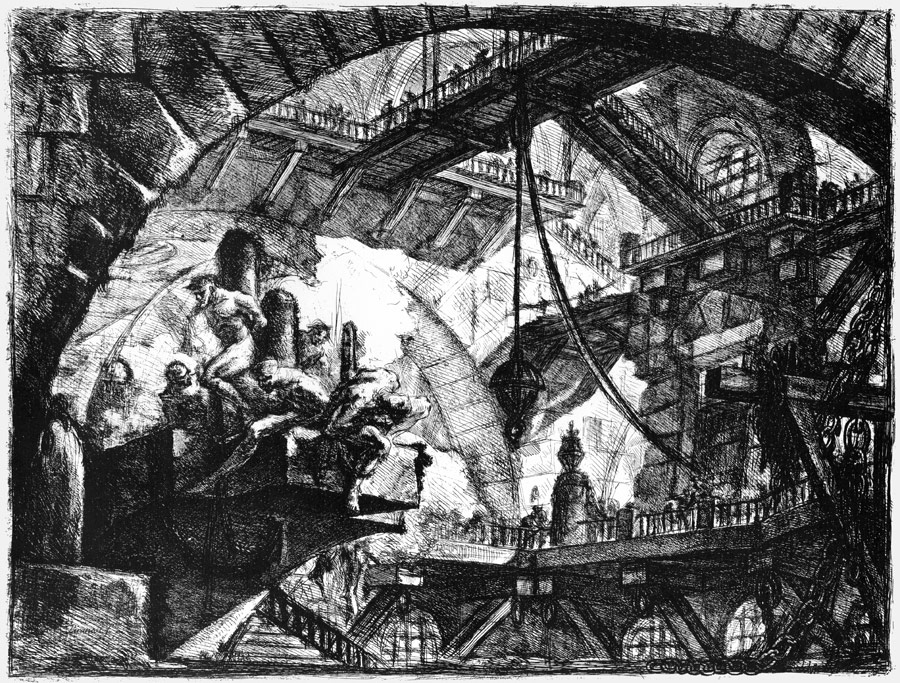
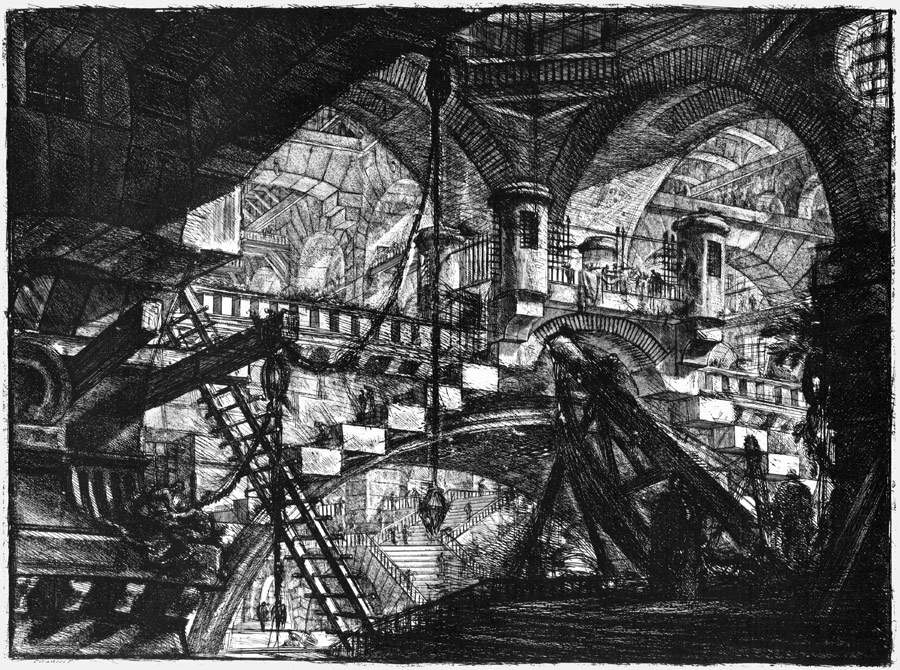
Picked up an oversized folio put out in 1973 reproducing a series of etching by Giovani Battista Piranesi. They depict a series of giant imaginary prisons. They are at once loose, layered, and complex, exhibiting a style not at all common in mid 18th century etching. Beyond this a quick read through the essay which begins the book shows Piranesi himself to be a somewhat tragic figure, not in any grand way, but rather in that he was unknown in his lifetime and to go a step further unfulfilled as well. You see even though these etchings of his are unmistakably beautiful Piranesi himself actually wanted to be an architect, a wish which, aside from a couple small commissions in the mid 1760’s completely eluded him. It didn’t help that the imaginary spaces he created were completely unbuildable, nor did it help that the lengthy original title of this series (which was etched in the frontispiece) was both grammatically incorrect and misspelled. Ah well, the guy might have died an unfulfilled wannabe architect but his etchings are quite something.
The Carceri etchings of Piranesi (1720-1778), who fruitfully combined in his vast work influences of Tiepolo, Bibiena and Rembrandt, have continued through two centuries to seem completely relevant and modern not merely in their formal aspects (which are prodigious), but also as unforgettable expressions of obscure and terrible psychological truths. In these works architectural fantasy strains and breaks tlie boundaries of human perception, creating a vast system ol visual frustration that seems to become co-extensive with the universe. Where do the innumerable staircases lead? What do the immense vaults support or enclose? The ambiguous structures are compounded with projecting beams, pulleys, wooden ladders, rickety catwalks and gangways, hanging ropes and chains, iron rings embedded in the walls, and, so insignificant as to be almost not there, a few faceless human figures haunting the shadows…
Click all for larger versions.
Detail
Detail
These etchings have had an ever-changing influence on our culture since the triumph of Romanticism— Coleridge, De Quincey, Victor Hugo, Turner and Melville are but a few of the figures that have praised them and written about them. One aspect, at least, of their relevance for our own time is apparent at a glance—as Aldous Huxley comments, linking The Prisons with the writings of Kafka: “Piranesi delineates with incomparable force the metiphysical prisons whose seal is within the mind, whose walls are made of nightmare and incomprehension, whose chains are anxiety and their racks a sense of personal and even generic guilt.” But a deeper look cannot fail to find the staggering formal achievement of Piranesi, an anticipatory genius who discovered in his own work tremendous formal devices that were to remain unnoticed until, in the early years of this century, they were to alter radically the entire concept of art.
Detail
Detail
Detail
Hope you enjoyed.