The Artist’s Dilemma
By Mark Rothko (probably written between 1940-41)
What is the popular conception of the artist? Gather a thousand descriptions, and the resulting composite is the portrait of a moron: he is held to be childish, irresponsible, and ignorant or stupid in everyday affairs.
The picture does not necessarily involve censure or unkindness. These deficiencies are attributed to the intensity of the artist’s preoccupation with his particular kind of fantasy and to the unworldly nature of the fantastic itself. The bantering tolerance granted to the absentminded professor is extended to the artist. Biographers contrast the artlessness of his judgments with the high attainment of his art, and while his naivete or rascality are gossiped about, they are viewed as signs of Simplicity and Inspiration, which are the Handmaidens of Art. And if the artist is inarticulate and lacking in the usual repositories of fact and information, how fortunate, it is said, that nature has contrived to divert from him all worldly distractions so he may be single-minded in regards to his special office.
This myth, like all myths, has many reasonable foundations. First, it attests to the common belief in the laws of compensation: that one sense will gain in sensitivity by the deficiency in another. Homer was blind, and Beethoven deaf. Too bad for them, but fortunate for us in the increased vividness of their art. But more importantly it attests to the persistent belief in the irrational quality of inspiration, finding between the innocence of childhood and the derangements of madness that true insight which is not accorded to normal man. When thinking of the artist, the world still adheres to Plato’s view, expressed in Ion in reference to the poet: “There is no invention in him until he has been inspired and is out of his senses, and the mind is no longer in him.” Although science, with scales and yardstick, daily threatens to rend mystery from the imagination, the persistence of this myth is the inadvertent homage which man pays to the penetration of his inner being as it is differentiated from his reasonable experience.
Strange, but the artist has never made a fuss about being denied those estimable virtues other men would not do without: intellectuality, good judgment, a knowledge of the world, and rational conduct. It may be charged that he has even fostered the myth. In his intimate journals Vollard tells us that Degas feigned deafness to escape disputations and harangues concerning things he considered false and distasteful. If the speaker or subject changed, his hearing immediately improved. We must marvel at his wisdom since he must have only surmised what we know definitely today: that the constant repetition of falsehood is more convincing than the demonstration of truth. It is understandable, then, how the artist might actually cultivate this moronic appearance, this deafness, this inarticulateness, in an effort to evade the million irrelevancies which daily accumulate concerning his work. For, while the authority of the doctor or plumber is never questioned, everyone deems himself a good judge and an adequate arbiter of what a work of art should be and how it should be done.
Let us not delude ourselves with visions of a golden age freed of this cacophony. This gilding is an artistic falsehood. We deal in fantasy ourselves and know how alive dreams can seem. And an age like ours, which demands so clear a facing of realities, will not allow us the pleasure of narcoticism. With the knowledge that man’s tribulations, at least, are always with him, we can safely say that the artist of the past had good reason, too, to play the mad fool—so as to salvage those moments of peace when the demands of the demons could be quieted and art pursued. And if nature, in fact, contrived to give him the appearance of a fool, so much the better. For dissimulation is an exacting art.
Ill hath he chosen his part who seeks to please
The worthless world,—ill hath he chosen his part,
For often must he wear the look of ease
When grief is at his heart;
And often in his hours of happier feeling
With sorrow must his countenance be hung,
And ever his own better thoughts concealing
Must he in stupid Grandeur’s praise be loud,
And to the errors of the ignorant crowd
Assent with lying tongue.
The lament is Michelangelo’s (a translation of this madrigal can be found in The Life of Michel Angela Buonarroti [1807]). Even this great man—who lived in an age when the rapport between the artist and the world seemed to have been ideal, and when fetes and processions celebrated the completion of works by the artists of renown, for whose services dukes, popes, and kings fought — even he bore his full share of calumny and disapproval. The principles of his art were constantly assailed; and, after parrying those criticisms, his morals were found wanting. Aretino attacked the nakedness of the nudes in the Last judgement as inconsistent with Christian piety. The reasonableness of Aretino’s point cannot be denied. Michelangelo’s vision of the Celestial Court can be easily mistaken for an orgiastic bout. These doctors and moralists, they are always right! Like our own social moralists and critics, their facts are so neat, and their reasoning so pretty: but what disastrous falsity to the cause of truth!
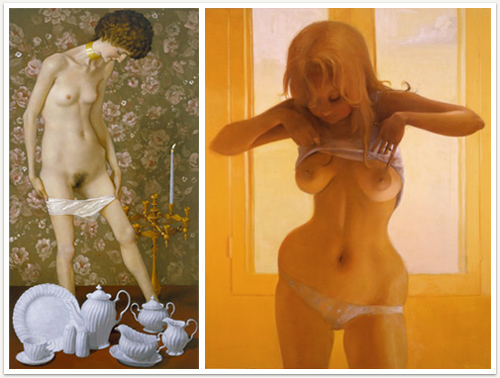
Most societies of the past have insisted that their own particular evaluations of truth and morality be depicted by the artist. Accordingly, the Egyptian artist had to produce a definitely prescribed prototype; the Christian artist had to abide by the tenets of the Second Council of Nicea or be anathematized or, like the monk of the iconoclast age, work in danger and by stealth. We should note that Michelangelo’s nudes were forced to wear, in the end, the appropriate panties and drapes. Authority formulated rules, and the artist complied. We shall not speak here of those whose daring periodically revitalized art, saving it from its narcissistic mimicry of itself. We can accurately say that, within these periods, the artist had to submit to these rules or simulate the appearance of submission, if he were to be permitted to practice his art.
It will be pointed out that the artist’s lot is the same today, that the market, through its denial or affording of the means of sustenance, exerts the same compulsion. Yet there is this vital difference: the civilizations enumerated above had the temporal and spiritual power to summarily enforce their demands. The Fires of Hell, exile, and, in the background, the rack and stake, were correctives if persuasion failed. Today the compulsion is Hunger, and the experience of the last four hundred years has shown us that hunger is not nearly as compelling as the imminence of Hell and Death. Since the passing of the spiritual and temporal patron, the history of art is the history of men who, for the most part, have preferred hunger to compliance, and who have considered the choice worthwhile. And choice it is, for all the tragic disparity between the two alternatives.
The freedom to starve! Ironical indeed. Yet hold your laughter. Do not underestimate the privilege. It is seldom possessed, and dearly won. The denial of this right is no less ironical: think of the condemned criminal who will not eat and who is fed by force, if need be, until his day of execution. Concerning hunger, as concerning art, society has traditionally been dogmatic. One had to starve legitimately—through famine or blight, through unemployment or exploitation—or not at all. One could no more contrive his own starvation than he could take his own life; and for the artist to have said to society that he would sooner starve than traffic with her wares or tastes would have been heresy and dealt with summarily as such. Within the dogmas of the totalitarian states of today, you may be sure, the artist must starve correctly, just as he must paint by the dictates of the State.
But here, today, we still have the right to choose. It is precisely the possibility of exercising choice wherein our lot differs from that of the artists of the past. For choice implies responsibility to one’s conscience, and, in the conscience of the artist, the Truth of Art is foremost. There may be other loyalties, but for the artist, unless he has been waylaid or distracted, they will be secondary and discarded in his creation of art. This artistic conscience, which is composed of present reason and memory, this morality intrinsic to the generic logic of art itself, is inescapable. Violate her promptings and she will ferret out the deepest recesses of thought and conjecture. Neither sophistries nor rationalizations can quiet her demands.
What did those artists of the past do about their conscience? The Law of Authority has this saving grace: it can be circumnavigated. One can pay lip service to the letter and with equanimity violate its spirit. One bows to necessity, then schemes to defeat it. We are told that there were times when the Truth of the Law coincided with the Truth of Art. Granted! But when the divergence became too great, what ingenuity the artist displayed in disguising one to have the appearance of the other. What guile and shrewdness in this seeming moron. One needs but but recall the great Apollo. How easily this Hellenistic deity, with all his draperies and trappings, was slipped into the niches of the Christian saints. He had merely to change his name, and to look much sadder than he really felt.
What abetted the artist in his little game was the dogmatic unity of his civilization. For all dogmatic societies have this in common: they know what they want. Whatever the contentions behind the scenes, society is allowed only one Official Truth. The demands made upon the artist, therefore, issued from a single source, and the specifications for art were definite and unmistakable. That, at least, was something: whether submission or deceit were intended, one master is better than ten, and it is better to know the size and shape of the hand that holds the whip. In a master, definiteness and stability are preferable to caprice.
Today, instead of one voice, we have dozens issuing demands. There is no longer one truth, no single authority—instead there is a score of would-be masters who would usurp their place. All are full of histories, statistics, proofs, demonstrations, facts, and quotations. First they plead and exhort, and finally they resort to intimidation by threats and moral imprecations. Each pulls the artist this way and that, telling him what he must do if he is to fill his belly and save his soul.
For the artist, now, there can be neither compliance nor circumvention. It is the misfortune of free conscience that it cannot be neglectful of means in the pursuit of ends. Ironically enough, compliance would not help, for even if the artist should decide to subvert this conscience, where could he find peace in this Babel? To please one is to antagonize the others. And what security is there in any of these wrangling contenders?
The truths of India, Egypt, Greece spanned over centuries. In matters of art our society has substituted taste for truth, which she finds more amusing and less of a responsibility, and changes her tastes as frequently as she changes her hats and shoes. And here might the artist, placed between choice and diversity, raise his lamentations louder. Never did his afflictors have as many shapes or such a jabbering of voices, and never did they exude such a prolixity of matter.
-
Hope you enjoyed.
hide full text