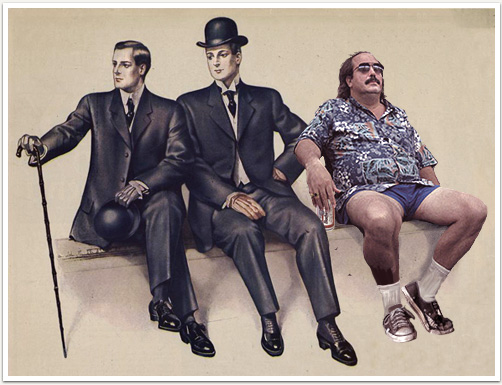
How is it that the average man of the 21st century has been raised up, in wealth, in holdings, in leisure time, in education, in rights, to levels on par with court members and landed gentry of earlier ages, but in respect to finery has sunk to the level of serf? Were even the least noble member of the humblest nation’s aristocracy of 5 centuries ago to meet a working man of today, though perhaps on par with him in wealth and below him in education, the noble would be forgiven for mistaking this average Joe⊕ for a barrowman.
On the one hand I’ve always thought that humanity would be best served by the absolution of fashion all together. If it were accepted that everyone, of every stripe, of every social standing and rank should simply wear a grey sweat-suit or a navy blue jumpsuit everyday, that would be fine with me. ⊕ It would save us all a lot of time and energy. ⊕ But on the other hand I understand that fashion is meant to be both a means of personal expression and a peacock feather of status. So why is it that the everyday uniform of modern man (and I am talking strictly about men here) has come to be the shapeless tan cotton pant, the artlessly cheap rubber-soled shoe, and the totally untailored (in most cases totally ill-fitting) woven shirt? ⊕ Is This the best we can muster? What has happened to us?
The assumption might be made that it’s all about comfort. That perhaps men of ages past would sigh longingly at our elastic-waisted pants, our stained, threadbare tees ⊕ our oversized polo shirts, our torn jeans, and think, “If only I could have such roomy pants to fart in! Such soft, tent-like garments to cover my huge belly!” But somehow I doubt it. I imagine rather they would do what they did best and snort derisively, looking down upon us as the slovenly rabble which we do, in fairness, appear to be.
Not one of us thinks that silk tights and brocade cod-pieces ought to make a comeback, of that I am sure and in total agreement, but there has been middle ground, certainly, between looking like a shakespearean actor, in drag, playing Desdemona and the style-less khaki-wrapped lumps we’ve become. Most men, I’ll assume, don’t give a Saturday-morning-crap about fashion, just as I’ve professed myself, and would much rather simply blend in with the crowd, not being noticed one way or the other. To “care” is not to be masculine. I get this. To some degree I agree with this. ⊕
Since making the transition from self-consciously clad art-school hipster to ordinary dude I’ve been of the opinion that the best style is the one that invited no preconceptions, that says almost nothing specific about you whatsoever. ⊕ The lack of affected “stance” or statement in ones dress is the preferred statement in my estimation.
If we men do not care an ounce about fashion and want simply to not to stand out then it is the fault of the accepted standards which leads us to look like such sloppy imagination-less douchebags all the time. Though I don’t want to expend any unnecessary mental energy on clothing I am none the less an aesthetic person. Hence I sometimes wish that the fashion landscape I would blend myself into would be one with a bit more… style. Or at very least a bit more nuance. Ask yourself: how is it that even when men wore little more than a single long piece of fabric folded about them and sandals on their feet that they still managed to carry it with more style than we do today?
Is it simply that we, as an enlightened culture, no longer care about superficial things like appearances? HA HA HAA! No fucking way.
The arguments could be made that this state of slovenly disarray has its roots in modern notions of masculinity, in the pure economics of manufacturing and population size, in the rise of the middle class, or in plain ol’ laziness. It’s likely a mixture of those factors and other more subtle ones I haven’t even guessed at. But then it wasn’t until the late 50’s that the final casting-off of finery really began in America ⊕ and there were at least 4 decades in which modernity and higher standards of dress overlapped.
I often wonder why dress-codes of the 10’s - 40’s ever went out of favor for men. Just too much of a hassle? After all who among us have not watched a noirish movie populated with smartly dressed guys in tailored suits, with cufflinks, and a fedora and thought, “Man, I’d look like cool in that!” But of course, you can’t dress in a three piece suit with a felt hat and watch fob dangling from your vest today can you? The social decorum which necessitated such snappy dress no longer exists and so you would stand out rather than blend in. Point is we guys don’t really have much to choose from today. If we want to maintain that blessed state of virtual invisibility we must do so in the sloppy cotton rags once set aside for hobos and men who pushed manure carts. I guess, in the end, I just think compared to all that came before we’ve settled into something very… boring. Ah well, time marches on and the grass is always greener.
hide full text