Electric light, Concrete, and Chewing Gum, what have they in common? Though, admittedly, both concrete and chewing gum can ultimately trace their roots to antiquity, all three of these items, in something akin to their modern form, entered the American stage in the 1870’s.
Edison invented the first commercially successful incandescent lamp around 1879. At the Centennial Exhibition in Philadelphia in 1876 David O. Saylor exhibited the first American made portland cement, though it was not until 1891 that the first concrete street in the United States was paved. Thomas Adams opened the first chewing gum factory in 1870, and a year later Adams’ chicle based New York Gum went on sale in drug stores for a penny apiece. By the beginning of the 20th century all three of these items had become popular and were on their way to being staples of American life.
This, however, is not a history lesson, and the particulars of each of these items does not interest me as such. What I’m interested in here is rather a result of their intersection, a confluence of forces, which though set in motion way back in the 1870’s, is as near to we moderns as the ground beneath our feet or the sky above our cities. I’m speaking, of course, about Ground Stars.
Let me explain.
The proliferation of electric light, typified by our big cities, has created a phenomena called Skyglow. Essentially Skyglow is simply Rayleigh scattering of artificial light, which is to say its the same atmospheric effect which makes the natural light of the daytime sky seem blue, only in this case diffusing and redirecting the light of our cities back down at us. The ultimate effect for we urban earthlings is, lamentably, a starless (though not bible-black) sky.
In the relative-dead of a New York City night, looking up (and in this city to see a patch of sky you need to look damn near straight up) is an effort with precious little reward. You can count yourself lucky to see the lights of a passing plane, or the underbelly of a helicopter, because even the brightest stars are washed out and absent. Forget about connecting the dots in your minds eye and seeing a giant scorpion, or bull, or lion. There are no dots.
As I’ve said here before this strikes me as a real shame. Especially in a city such as New York where where all manner of dreamer, goofball, curbside philosopher, and artistic-minded lout have chosen to congregate. We are effectively as divorced from our universe as we are from the suburbs and geographical armpits most of us fled from. We are people who could use the sense of natural scale a few trillion super-massive nuclear reactions in the sky would provide. We need something bigger, more crowded, and more charged with energetic possibility than ourselves.
Which brings me to Concrete and Chewing Gum.
While electric light was proliferating and radiating outward to blot our stars concrete and chewing gum were quietly spreading throughout the city as well, exhibiting their own unexpected side effect. It seems concrete and chewing gum have a natural attraction to one another. They stick together and stay together. Whether it is love or just a physical thing I can not say but their century old union offers us a solution, of sorts, to our star poverty.
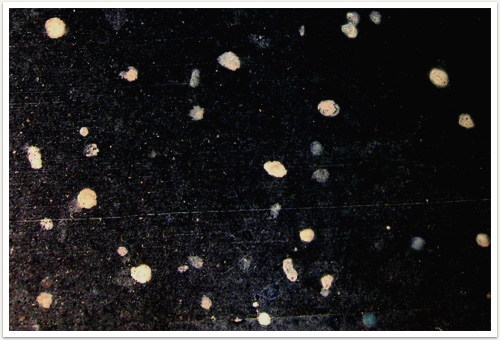
When a piece of spit-out gum takes the gravity-assisted leap to the ground it gets rolled over, and stepped on, and compacted, and stepped on, and compacted, and stepped on, and compacted. We sometimes curse at getting its sticky guts on our shoes, but more often than not we don’t even notice. Over time what was once a chicle-based, flavor infused, treat becomes nothing so much as a single dark point in the firmament of sidewalk. Now multiply this by millions, perhaps billions, and I think you’ll see where I’m going.
A century of this process has provided us with something huge and ambiguous we can call our own; if not a moody sparkling light by which to worship our lovers and unsheathe our knives, an endlessly shifting menagerie of single points all the same, between which we might string the iconography of our hopes and fears.
Think of it! Anti-Stars: small points of light-absorbing darkness dotting a reflective silica-mixed concrete field. Billions of DNA enriched points, all of indeterminate, time-lost origin, waiting only for the connecting lines which would infuse them with meaning; waiting always at perigee to feel the press of human imagination upon them rather than simply that of our boot heels. Look below your feet at any time while walking the 301 square miles of the city and it’s likely you trod upon a constellation, just waiting to be recognized and named.
In short what electric light hath denied concrete and chewing gum hath supplied. Ground Stars, Urban Constellations, a galaxy worth for our interpretation, in which we can do what we love best- see ourselves reflected.
“Sounds all very well in theory” I can hear you mustache-twirlers harumphing, “but does it work in practice? What might such replacement constellations look like?”
I’m glad you asked. I have taken it upon myself to explore this embryonic field of research a bit. Trips into the field have yielded some promising observations which I’m all too happy to share with you.
Below you will find a small cataloging of my findings thus far. I will name, describe, and illustrate the 10 Urban Constellations I’ve identified, and will even offer some slight illumination on each in the form of related quotations. What being born above these signs, or what their position in relation to your own may portend for you, your character, or your future, I will leave to the “geologers,” “odologers,” “topologers,” “despuologers,” or “humusologers” who will surely follow.
Behold!
Status Somnus (The Standing Sleep)
You see them, standing in the road, nodding, body never quite toppling, never quite standing straight. It’s like slapstick and tragedy mixed. You wonder, “Where can he/she be right now that’s so compelling it overrides the innate need to stave off death? Are they on a planet without cars? Are they floating weightless through space? Are they balancing on a pile of white spaghetti? What are they seeing?” You wonder, but are not curious enough to prick the skin and stand asleep in the road yourself.


I fellowed sleep who kissed me in the brain,
Let fall the tear of time; the sleeper’s eye,
Shifting to light, turned on me like a moon.
So, planing-heeled, I flew along my man
And dropped on dreaming and the upward sky.
I fled the earth and, naked, climbed the weather,
Reaching a second ground far from the stars;
And there we wept, I and a ghostly other,
My mothers-eyed, upon the tops of trees;
I fled that ground as lightly as a feather.
‘My fathers’ globe knocks on its nave and sings.’
‘This that we tread was, too, your fathers’ land.’
‘But we tread bears the angelic gangs,
Sweet are their fathered faces in their wings.’
‘These are but dreaming men. Breathe, and they fade.’
-Dylan Thomas
OR
“To achieve the impossible dream, try going to sleep.”
-Joan Klempner
Mercator Pudor (The Shame Trader)
You spot them from a block away, if you’re lucky. The fresh-faced guilt-trippers. Their questions like a slap. “Do you care about the environment?” “Do you have a second for gay rights?” “You don’t support animal cruelty do you?” “The children’s ribs are showing!” You look at them and despise them for trading in guilt. They ask every loaded question but the honest one you hear in your head instantly.
“They who have considered our nature, affirm that shame and disgrace are two of the most insupportable evils of human life: the courage and spirits of many have master’d other misfortunes and borne themselves up against them; but the wisest and best of souls have not been a match for these.”
-Laurence Sterne
Sepulcretum Umbellae (The Umbrella Graveyard)
The wind howls, the sun is gone, the rain hammers your brow. You turn a corner and see it. Mangled, torn, broken, abandoned. It’s a graveyard and you know it, even with your head down and your eyes half-blinded in the storm. You shiver to spite yourself.
And oh they bring to mind the grave,
so humble, so willing to be beat upon
with its awful lettering and
the body lying underneath
without an umbrella.
-Anne Sexton
Dissaepio Indocilis (The Rude Barrier)
The sidewalk so wonderfully wide. Room enough for street gangs to dance their grudges away. And yet here he/she comes. Straddling one edge, dog straddling the other. Between is a leash, strung taut across the entire walking width. You look at the leash and you yearn to tear it apart with your hands and stuff in his or her mouth, yelling, “Choke! Choke you self-involved misborn ass!” They must know you hate them, but they come ever closer. “So it’s a game of chicken is it?”
“It often happens that the real tragedies of life occur in such an inartistic manner that they hurt us by their crude violence, their absolute incoherence, their absurd want of meaning, their entire lack of style.”
-Oscar Wilde
Porthmeus Odiosus (The Hateful Ferryman)
You see it’s yellow flank flashing in the traffic. The light is on. You are about to be scooped up! You imagine the seats cradling your tired ass. You raise your hand, perhaps whistle through your teeth, or call out, “Taxi!” But the ferryman rejects you and rolls right by. “Why?” you wonder. “WHY!?” You swear, you doubt, you raise your fists to a deaf God, “Bastard!” Then shuffle on.
Hang out our banners on the outward walls;
The cry is still, “They come!” our castle’s strength
Will laugh a siege to scorn.
-Shakespeare
OR
“After rejection— misery, then thoughts of revenge, and finally, oh well, another try elsewhere.”
-Mason Cooley
Belua Cloaca (The Sewer Monster)
And what is under there anyway? Is it a filth-encrusted albino playground? Is it a dark orgy of disease and blindness held over the sewage-soaked bones of our forefathers? Are the stories true? Is it all alligators, and giant rats, and mole men? Walk a little faster and avoiding the wobbly grates.
“Society is held together by our need; we bind it together with legend, myth, coercion, fearing that without it we will be hurled into that void, within which, like the earth before the Word was spoken, the foundations of society are hidden.
-James Arthur Baldwin
Mendicus Beneficiarius (The Privileged Beggar)
Young and sound of body. You look at them and their sign, scrawled with pleas for beer-money or bus fare. You look at their clothes, their accessories, their hair. You make a snap judgement and far off, on some tax sheltered-island, their trust funds accrue interest.
“The privilege of absurdity; to which no living creature is subject, but man only.”
-Thomas Hobbes
OR
“At any street corner the feeling of absurdity can strike any man in the face.”
-Albert Camus
OR
“When you are not physically starving, you have the luxury to realize psychic and emotional starvation.”
-Cherrie Moraga
Aquatoris Indifferentis (The Indifferent Water-Carrier)
It’s 8 AM. Foot-traffic rush-hour on a weekday morning. No one smiles because making it to your destination is painful enough. Another day of wage slavery is beginning and no one’s exactly thrilled. Everyone knows this. You know it, the old lady you just elbowed knows it, and so does the guy with the fucking hose. He sees you coming. He does not care. The water flows like your own shin-level Potomac.
“And, therefore, indifference is always the friend of the enemy, for it benefits the aggressor - never its victim, whose pain is magnified when he or she feels forgotten.”
-Elie Wiesel
OR
“Nature is not cruel and pitiless but indifferent. This is one of the hardest lessons for humans to learn. We cannot admit that things might be neither good nor evil, neither cruel nor kind, but simply callous—indifferent to all suffering, lacking all purpose.”
-Richard Dawkins
Cumulus Arcanus (The Mysterious Pile)
It is waiting around damn near every corner. It is horrid and putrid smelling and the color is indescribable. Flesh colored crayons melted over spinach linguini and scabs. It is nebulous and gut wrenching and even the thought of it’s origin makes your skin crawl. It’s a pile and you must not look at it too closely!
“I don’t believe in evil, I believe only in horror. In nature there is no evil, only an abundance of horror: the plagues and the blights and the ants and the maggots.”
-Isak Dinesen
Hostis Dementis (The Demented Stranger)
He approaches. Perhaps you smell him before you see him. Perhaps his madness digs into your ear. It’s one of that most feared tribes, the demented ones. What will he do with his grill fork? What’s that poking out of the hole in his clothes? Is something moving in his bag? Nothing frightens the rational, time-obsessed, grid-walking, metropolitan mind like the demented ones staggering toward you.
“Who knows what true loneliness is— not the conventional word, but the naked terror? To the lonely themselves it wears a mask. The most miserable outcast hugs some memory or some illusion. Now and then a fatal conjunction of events may lift the veil for an instant. For an instant only. No human being could bear a steady view of moral solitude without going mad.”
-Joseph Conrad
OR
“The distance between insanity and genius is measured only by success.”
-Ian Fleming
There you have it my friends. I hope I’ve inspired you to connect the dots, or brought even a sliver of relief to your poor, addled, star-starved mind.
If you identify any urban constellations of your own feel free to pass them along. The adventure continues.
hide full text