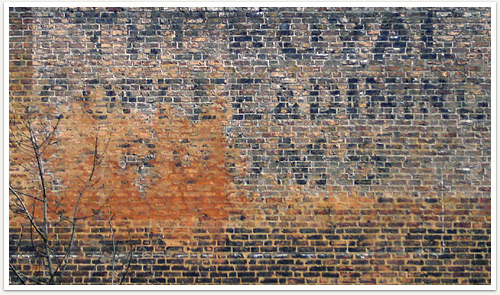
You walk the grid and are faced in the dark alleys, the back streets, the main drags, with those who have come before you. Looking up you see the work of their hands, the words which once enlivened their lips. Valiant signs try to hold on to the boldness of their pronouncements. They labor against the flow of time to go on advertising products and businesses long forgotten. Bent arrows point to non-existent locations. Fonts and faces of real and imagined ideals struggle against the inevitable fade; These artifacts and artifices long torn from their intended contexts, they are the blood of the hustle coagulated to stone.
You are descended from mortal men whose mortality can be glimpsed beneath all the fresh coats of enamel and giant pixelated printouts which seek to guide your purchases and reassure your mind. You are mortal as well. You know this. Walking the grid you can feel time as if it were a physical force, a gusting wind or a punishing wave. You look at the strange messages left by your ancestors, the ads, the architecture, the signs, the photos, the tints, the scrawl, the sum-partial of their choices, and you realize that though they are familiar they are at the same time foreign, and you, the modern mover-and-shaker, can never really understand their meaning.
The beauty of the eroding, the fading, the disappearing is that of reinvigoration. As counterintuitive as it sounds, things which are half-lost, torn from their original contexts are in a certain way given new life. Stripped as they are of their intended meaning and divorced from their real purpose they are open to interpretation. In reclaiming obscurity they reclaim mystery, and hence, beauty for those with eyes to see it.
In New York when something dies the corpse is often left out to rot, slowly and fragrantly, in the public eye and nostril. The American ideal of progress overrunning all sentiment. No time for mourning or last rights! A penny kept from an eyelid is a penny saved! Left out and ignored long enough these things become strangely vital again, moving in their death-throes, with none of the living remembering quite how they came to be, or why.
If only my own remains could be left out on the street, to first bleach in the heat-wave sun, and then blacken in the taxi-exhaust. To be kicked into some corner and piled willy-nilly for passersby to wonder at; a hundred years from now becoming fodder for the imagination of observant romantics with an abundance of internal chop and too little weight to their anchors. I would smile at them and wink from a forgotten hollow, a ghost sign of bone, signifying nothing.
(The image for this post was adapted from the beautiful ghost signs flikr group.)
hide full text
C6H14O5

• Philip Cola is an award winning nature photographer and natural history writer whose work centers mainly on the water-dwellers among us. Have a browse though about 16,000 of his photos at Ocean Light.
• Space cadets: check out Sven Grahn’s site full of space history, space radio, and space tracking. Everyone else: listen to his fine collection of space sounds.
• Jennifer Ouellette talks Jack Chick at 3 Quarks Daily: Heart of Darkness.
• The search is on for the original high-quality, unbroadcast, Apollo 11 Footage which was only beamed to three tracking stations in 1969.
• Enjoy the 1999 pilot of Heat Vision and Jack, Starring Jack Black as a super intelligent Astronaut. A show with too much potential to be allowed on the air.
• Did you know only four Shakers are left in the world, all living in southern Maine?
• The Angry Astronomer on some common misconceptions about the Big Bang .
• Enjoy Perry Farrell’s long video interview with Shepard Fairey: Parts 1, 2 and 3.
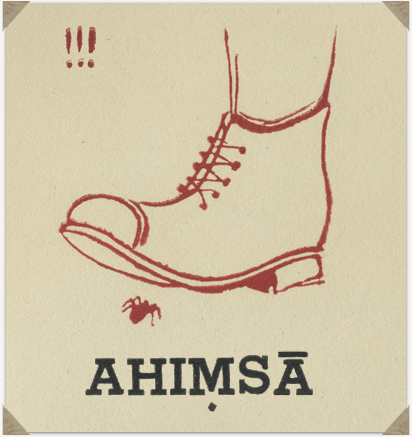
Ahimsa is a religious concept which advocates non-violence and a respect for all life. Ahinsa is Sanskrit for avoidance of himsa, or injury. It is interpreted most often as meaning peace and reverence toward all sentient beings. Ahimsa is an important doctrine of Hinduism, Jainism, and Buddhism (pdf). I think if it has made any inroads into the modern westerner’s mind they have likely been through its connection to yoga. I will not comment on the concept itself here, becuase in truth I am by no means sure of my own opinion toward the “do not swat a fly” brand of radical pacism, but rather will offer up a few images from an interesting book I picked up a long while ago called Chinese Poems and Pictures on Ahimsa by Raghu Vira, published in 1954. As for the sentiment they express, well, decide for yourself the value.
For the past two thousand years China has been in close association with some of the highest thoughts of India.
Chinese records have given 61 A.D. as the date when Ming-ti, the Emperor of China, dreamt of a golden man flying into his palace. This was interpreted by the sages of the age as Lord Buddha entering China and bringing peace and solace to the Middle Kingdom.
Since then Indian Pandits and wise men have collaborated with Chinese men of letters in transmitting scriptures and philosophies to the Chinese race in a continuous flow of translations from Sanskrit to Chinese.
Indian thought has permeated every part of Chinese life which has been enlivened in manifold ways.
In the following pages we reproduce a unique set of Chinese poems and pictures on Ahimsa. The sensitivity of the calligraphed words and the power of the simple drawings on the pages opposite are unparalleled in India. Neither the Buddhists, nor the Jainas, nor the Vaishnavas have anything similar to offer. It was left to the Chinese genius to catch the cruelty that is being perpetrated on the poor creatures, whether for food, fun or sport, wittingly or unwittingly, and to portray the same with the power and refinement of a gentle and magnanimous soul.

To The Rescue
One crab has lost its legs.
Two crabs come to its rescue,
And carry it on their sympathetic backs.
These tiny creatures have the sense
Of love and compassion.
Of this why does man not take notice?
The Bereaved mother
Even the beasts have feelings of mother an child.
A dog knows how to protect its young.
And a cow how to caress its calf,
The mother hen closely watched and protects her fledgelings.
And it is said that an eel is always precautions to ward off
The danger that may entangle its young ones.
But men, merely to gratify their tongue,
Kill and separate others’ dear ones.
All dumb creatures suffer the pinch of pain as much as men.
The only difference is that men cry with tears.
For Pity’s Sake, Look Out!
The giraffe is said to be a very kind animal.
Endowed with divine intelligence,
It neither walks on growing grasses not steps on living insects.
Oh We all ought to take notice
That when we walk, we be ever careful,
Lest, knowing or unknowing,
Tiny creatures be tramples under our feet.
By so doing we can keep our kind heart
And guiltless conscience growing.
Heedless Torture
(the victim is a dragon-fly)
Teach the children carefully,
When they are young,
To cultivate a good heart,
And harm nobody.
And when a sympathetic heart is being enlarged,
One has paved the way to the sages.
A Painful Parting
The flower has fallen from its stalk.
The sun is about to plunge into darkness.
The cry of a painful parting is heard.
It makes me feel my heart breaking.
A Harrowing Spectacle
The spectacle is too lamentable to withstand,
Viewing it one’s heart breaks.
There are no words for it,
But only tears.
Last Night’s Catch
You said it was the success of the last night!
It was merely a crime.
You should repent and confess your misdeed.
Your prime obligation is to have a good soul,
And the virtue of kindness to all.
“They Are The Eyes Of Equals”
-Turginev
Compare and observe:
Your flesh is the same as mine.
The difference lies only in name:
I am a dog and you a man,
The distinction between us is in our form.
In essence we are comrades,
We possess a common soul.
Unfortunately I can’t offer any more info on the illustrations or original author of the poems because the text included at the beginning of the post was pretty much the only info offered. Hope you enjoyed.
hide full text
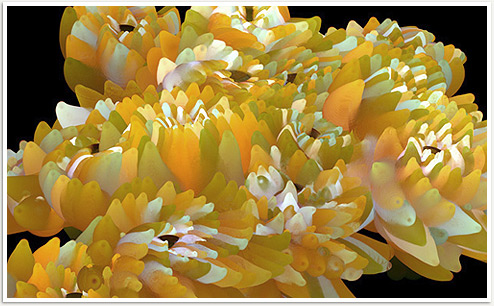
• Spam continues to inspire. Quote: “A collection of junk email messages is parsed, including subject lines, headers & footers, to detect relationships between that data.” The result: Spam Plants like the one shown in detail above. Neat. Via. In related linkage: Look Around You A visual exploration of complex networks.
• Acupuncture Without Needles By J.V. Cerney. 1974. Aw yeah. Via.
• Hungry for some philosophical gristle? Chew on the contents of The Proceedings of the Friesian School, Fourth Series. Yum.
• Why do we like music? What might we discover if we were to study musical thinking? Music, Mind, and Meaning by Marvin Minsky Via.
• Why is it that alien abductors are always such hunks? Intergalactic Service with a Smile, a short bit about Elizabeth Klarer and her alien paramour. More here, here, here, and here.
• There appears to be energy of empty space that isn’t zero. This flies in the face of all conventional wisdom in theoretical particle physics. A Talk with Lawrence Krauss over at edge.
• Enjoy a stroll through the the neglected books page where forgotten books are remembered. While away the day and blame Jeff.
• And lastly, why not explore space via air balloon? Yeah, why not? Via.
07.29. filed under:
Google Voyage
From arborsculpture to footbinding
This morning a link on Metafiler sent me off on a very nearly round trip google voyage. My iternerary was as follows: Set sail from How To Grow A Chair, about arborsculpture (1, 2, 3, 4, 5.) which docked at Dan Ladd’s Molded gourds. Evidently his gourds are modern equivalents of Paoqi traditional chinese artifacts created mostly to hold crickets. So next up were cricket cages (1, 2, 2, 3, 4, 5, 6, 7, 8, 9, 10, 11, 12.) and cricket boxes. From here my ship docked at the beautiful and rich port of Chinese cricket culture, located in the land of cultural etymology. Seems insects in Chinese culture are quite important. Crickets for example did more than just sing. Which brought me to cricket fighting (1, 2.) From there it was only a short trip to China the beautiful which lead directly into the port of oracle bone script (1, 2.) Interesting trip so far. The next stop featured 300 Tang Poems. This in turn lead me somehow to Confucius, specifically his Analects, The Great Learning, and The Doctrine of Man. From there I jaunted over to portraits of Chinese emperors and portraits of Chinese physicians... and without even realizing it my trip was on its last leg. Chinese medicine inevitably brought me to the ancient practice of footbinding (1, 2, 3, 4, 5, 6.) which if you think about it, is really almost exactly the same thing as arborsculpture, only practiced on the human foot rather than a tree. I had come very nearly full circle. My voyage was over.
Hugh Ferriss: Delineator of Gotham
Or rendering “The Vertical Sublime”
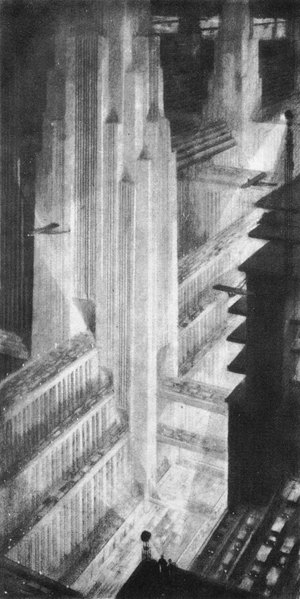
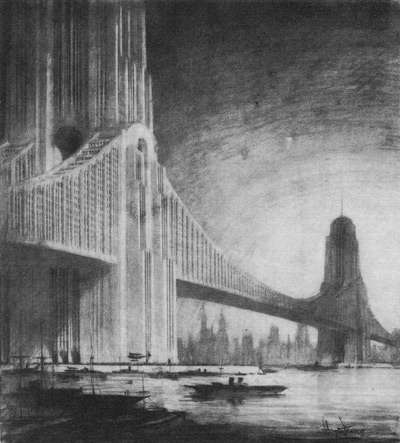
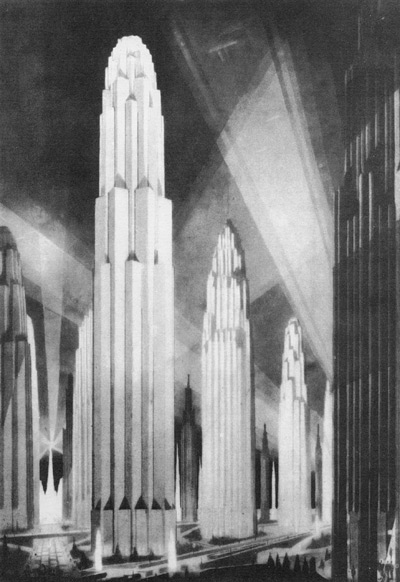
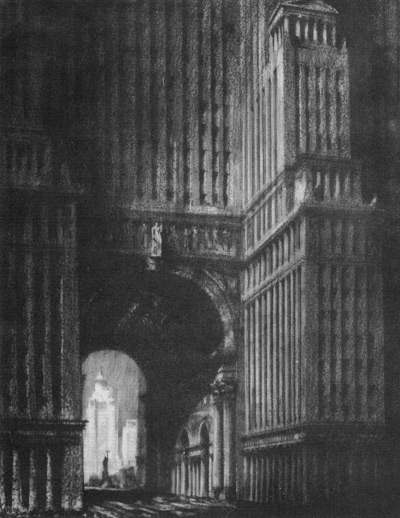
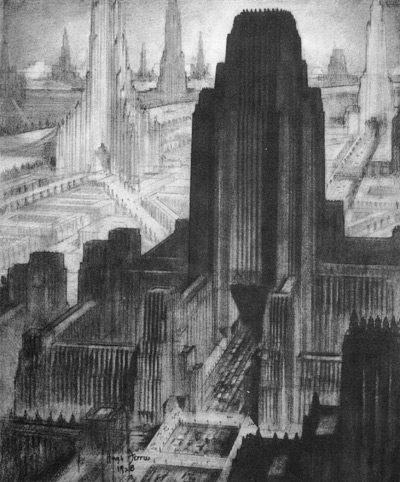
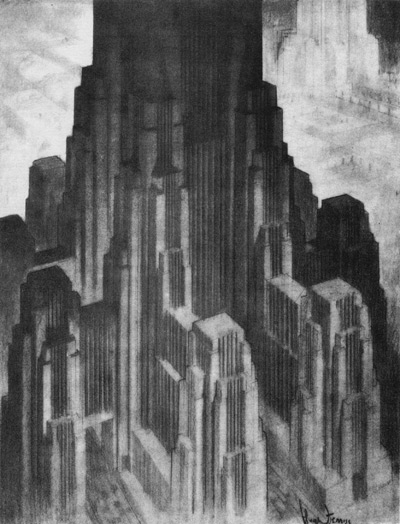
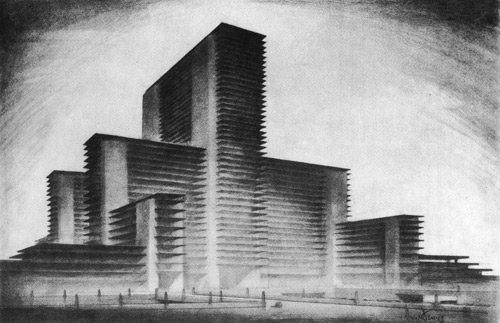
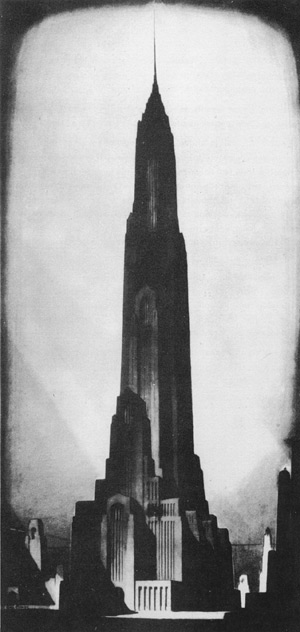
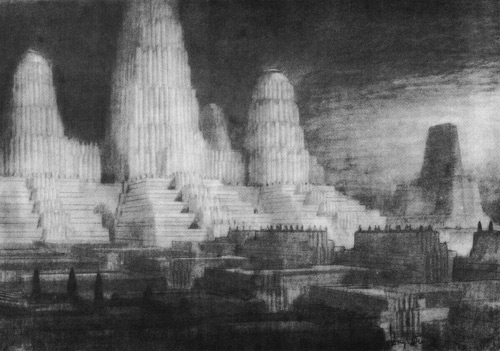
Picked up a reprinting of a 1929 book by Hugh Ferriss titled The Metropolis of Tomorrow. Ferriss was the preeminent architectural draftsman of his time who through his moody chiaroscuro renderings of skyscrapers virtually inventing the image of Gotham visitors came to the city to see and residents identified with so fondly. As Michael Mallow puts it: “By the mid-twenties, renderings by Ferriss had become almost de rigeur for successful competition projects; countless skyscrapers waited their turn to be bathed in the dark monumentality emanating from his drafting table. In these works a blasé department store appears as a giant lording over its block. Stodgy hotels cease to be stodgy hotels and become looming silhouettes emerging from the urban haze like shipwrecks. Ferriss went to grand new lengths in suppressing detail for mood, and clients loved it.”
Evidently Ferriss never designed a single noteworthy building, but after his death a colleague said “he influenced my generation of architects more than any other man.” With The Metropolis of Tomorrow it’s easy to see why. It’s beautiful with idealistic and poetically expressed ideas about the then current state of urban architecture (including the only recently enacted zoning laws) and a fond hope that architects to come would put concept, human experience, and emotional response before mere capitalistic considerations.
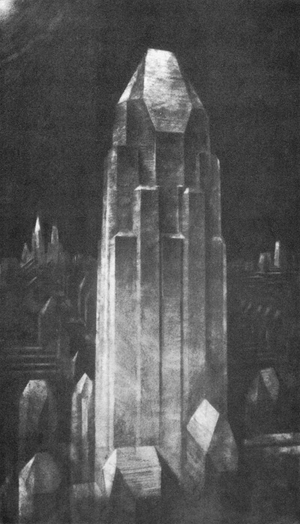
The book is broken up into three sections titled, Cities of Today, Projected Trends, and An Imaginary Metropolis. In choosing which images to post I’ve decided to leave aside the first chapter with its renderings of real buildings of the period, and focus instead on a few examples from the last two chapters, all of which were imagined by Ferriss to illustrate the key concepts of his text.
Hope you enjoy.
A first impression of the contemporary city, let us say, the view of New York from the work-room in which most of these drawings were made. This, indeed, is to the author the familiar morning scene. But there are occasional mornings when, with an early fog not yet dispersed, one finds oneself, on stepping onto the parapet, the spectator of an even more nebulous panorama. Literally, there is nothing to be seen but mist; not a tower has yet been revealed below, and except for the immediate parapet rail (dark and wet as an ocean liner’s) there is not a suggestion of either locality or solidity for the coming scene. To an imaginative spectator, it might seem that he is perched in some elevated stage box to witness some gigantic spectacle, some cyclopean drama of forms; and that the curtain has not yet risen.
There is a moment of curiosity, even for those who have seen the play before. since in all probability they are about to view some newly arisen steel skeleton, some tower or even some street which was not in yesterday’s performance. And to one who had not been in the audience before—to some visitor from another land or another age—there could not fail to be at least a moment of wonder. What apocalypse is about to be revealed? What is its setting? And what will be the purport of this modern metropolitan drama?

Crowding Towers
Overhead Traffic-Ways
Churches Aloft (In which Ferriss imagines churches, the once dominant members of the skyline, revitalized by placing them atop apartments or offices.)
Apartments On Bridges
Verticals On Wide Avenues (In which the buildings footprints are shrunk and spaced further apart to allow for maximum street level traffic flow.)
Vista Through A Two-Block Building
Broadly speaking, it has been our habit to assume that a building; is a complete success if it provides for the utility, convenience and health of its occupants and, in addition, presents a pleasing exterior. But this frame of mind fails to appreciate that architectural forms necessarily have other values than the utilitarian or even others than those which we vaguely call the aesthetic. Without any doubt, these same forms quite specifically influence both the emotional and the mental life of the onlooker. Designers have generally come to realize the importance of the principle stated by the late Louis Sullivan, “Form follows Function.” The axiom is not weakened by the further realization that Effect follows Form.
It can be recalled that there have been periods in the past when architects must have been quite aware of the influence of Architecture and consciously employed it for a specific object. Moreover, it is precisely these periods that are still spoken of as the “great periods” of Architecture.
The Art Center
The Science Center
Vista In The Business Zone
Looking West From The Business Center
Night In The Science Zone
Buildings like crystal.
Walls of translucent glass.
Sheer glass blocks sheeting a steel grill.
No Gothic branch.
No Acanthus leaf.
No recollections of the plant world.
A mineral kingdom.
Gleaming stalagmites.
Forms as cold as ice.
Mathematics.
Night in the Science zone.
Finance
Technology
Industrial Arts
Philosophy
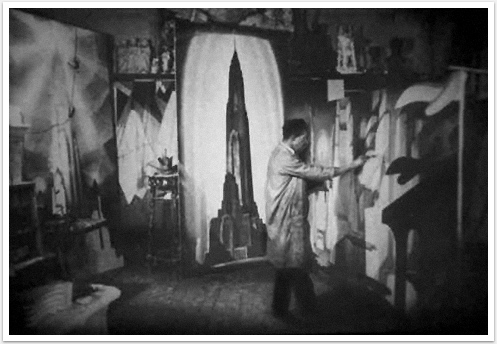
Religion (Notice the first image in this post, which shows Ferris in his studio, to get an idea of scale for these charcoal illustrations.)
Are not the inhabitants of most of our American cities continually glancing at the rising masses of office or apartment buildings whose thin coating of architectural confectionery disguises, but does not alter, the fact that they were fashioned to meet not so much the human needs of the occupants as the financial appetites of the property owners? Do we not traverse, in our daily walks, districts which are stupid and miscellaneous rather than logical or serene—and move, day long, through an absence of viewpoint, vista, axis, relation or plan? Such an environment silently but relentlessly impresses its qualities upon the human psyche.
The contemplation of the actual Metropolis as a whole cannot but lead us at last to the realization of a human population unconsciously reacting to forms which came into existence without conscious design.
A hope, however, may begin to define itself in our minds. May there not yet arise, perhaps in another generation, architects who, appreciating the influence unconsciously received, will learn consciously to direct it?
But we may postpone more general conclusions until we have examined, at closer view, the existing facts. Let us go down into the streets ...
For a few more bits on Ferris see the following:
Place, Power, and the Human Being.
Tangible Futures example: Hugh Ferriss’s delineations.
High Priest of the New York Skyscraper Sex Cult.
Lastly The ASAI happens to offer an annual award for the best architectural illustrators which is named for Ferris. See here for past winners.
hide full text

• Graffiti + Sarajevo + Krylon + Michelangelo = Sistine Chapel in Iowa. Via.
• “A new idea for the exploration of Mars may be less of a scientific leap forward than a hop.” hardy-har-har. Next to Mars: Jumping, Baseball-Size Robots?
• In 1900, Eva Downing Corey undertook a “Grand Tour” to the Holy Land, and the Continent. She kept a journal. (And evidently a glue-stick or two.) Beautiful. Via.
• Just in time to deflect Global Warming questions directed at them “to understand and protect our home planet” is dropped from the NASA mission statement.
• Headline reads: Vampire sea spiders suck on prey. The horror! Someone alert Tony Bourdain, he’ll be wanting to nibble on this thing.
• Cassini’s radar eye has begun to reveal the true geological features of Xanadu. Faults, deeply cut channels, valleys, porous water ice… a rainy land where rivers flow down to a sunless sea. Nasa offers this nifty vid. The feathered hair once thought to float in the atmosphere has yet to be spotted however.
• On the saddest lowliest coin of all: Give a Penny, Take a Penny .
• Fifteen years from now, amid the rubble of a war-torn city in a distant land, a strange creature lurks in the dark (cue the ominous music)... the soldier of the future. These stories keep coming. “Soldier of the future!!!” Yet we can’t even perfect decent body armor. I’d like to think the future would not require such perfect killing machines anyhow. Ah well.
What’s so funny anyway?
I find myself less amused by the opening segments of Comedy Central’s weeknight double-punch of fake news lately. I can’t help but wonder whether programs like The Daily Show and The Colbert Report, which have us laughing at the ineptitude, corruption, war mongering, and profiteering of our Government, are in some way diffusing what ought to be a steadily building anger; an anger which by all rights ought to be seeking a vent right about now.
The post-modern ability the culture at large has adopted which has us giggling over abuses of power, sniggering at lies, whooping at war, and chortling at all the terrifying evidence of a country coming apart at the seems strikes me as irresponsible somehow. It’s not that the shows ought not to be pointing out the absurdities, or that we ought not to be grabbing some laughter wherever we can find it, but when the “actual” press has stopped doing its job and the only dissenting voices with heavy airtime are those of comedy shows… well, it’s scary.
While we all sit around laughing things off, a list of offenses, which in ages past might have provoked a revolution among the populous, scrolls away to the horizon, unchecked. Where is the real outrage? Why aren’t we up in arms? Why is this government still in power? What is wrong with us?
If you think this is a maudlin observation, maybe you’re right, but if so today’s state of affairs still seems to beg the question: when did public opinion become so impotent as to be very nearly meaningless? Who among us want to be where we are or headed where we are headed? Who thinks endless conflict and death and debt and corruption are acceptable? Who’s happy?
Sure the world is complex, there are no easy answers, but somehow, after 5 years, laughing at those in power no longer feels like the appropriate reaction. Unless there are pitchforks involved.
Course, I’ve never, ever, attended a protest, let alone been on the inside of an angry mob, so what the hell do I know? Anyone have an opinion?
hide full text

• In Japan unimaginably large spaces underneath ground-level lives exist. Even beyond the high walls of nuclear power stations, incineration plants, or energy research organizations, futuristic cities that we thought only to exist in science fiction movies unfold. All this is captured by photographer Joe Nishizawa.
• Scientists believe they have found a way to probe the mysterious phenomenon of feeling you have witnessed something before: Deja vu recreated in laboratory.
• Why is the sky blue? It is a question children ask. Yet it also intrigued Leonardo da Vinci and Isaac Newton, among many other legendary thinkers. As late as 1862, the great astronomer John Herschel called the colour and polarization of skylight “great standing enigmas.” Even today, our perception of sky blue is little understood by laymen.
• Umberto Eco speaks. Outlandish theories: Kings of the (hollow) world.
• Photographic construction of alternative selves: Photography and Solipsism Via.
• In a few years, it will be hard for us to believe that we lived amongst people like these. Photographs of India’s poor, many of whom had never even seen a camera before. Take care to look at the links below as well. Via.
• The largest tear in the Earth’s crust seen in decades, if not centuries, could carve out a new ocean in Africa, according to satellite data. Wow.
• Misconceptions about samurai in Japanese pop culture. Misconceptions about Medieval armor. And with those in mind- The Medieval European Knight vs. The Feudal Japanese Samurai?