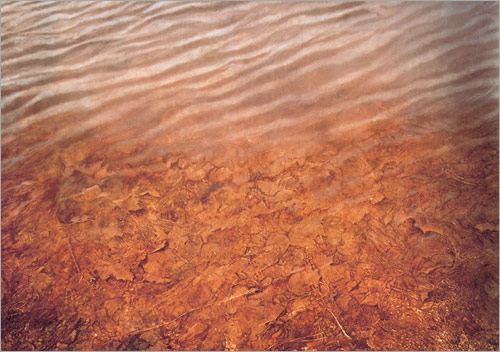
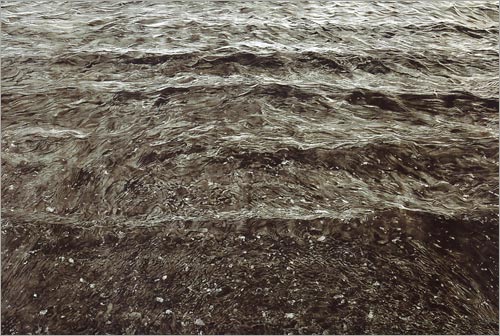
When I came upon the images which I’m about to share with you, I was a bit slack-jawed, standing there in the book store. They were of dead leaves, pond-bottoms, sticks in snow, the edges of lakes, and other such humble subjects. Those of you who are at all familiar with my photographs will know that these are just the subjects I’m drawn to myself. Turning through the pages of the book, a catalog from an exhibit, I was agape because these photos were so very in line with my own; Creepily so. After taking a moment to read some of the accompanying text I was handily slapped around and had any egoistic notions of similarity dispelled- they were not photographs. They were paintings.
Whenever I was obliged to say something, in the past, about the photographs I’d been taking, I always tried to explain that my aim was essentially to capture the quality of an abstract painting, something mysterious and decontextualized but ultimately about itself. When I printed the shots I did so as large as I could afford to and presented them without frames. Looking at them on the wall I thought of them almost as canvases. I’d been painting abstracts before I started shooting film but I realized at some point that in the puddles and garbage heaps and mud piles and gutters I could find little odd and overlooked tableaus more beautiful and complex and affecting in some way than anything I was likely to put down with paint. All I needed to do was frame them.
Coming upon Mary Mito’s paintings was a bit unsettling (and more than a bit humbling) because here was someone who saw what I saw, but then took the trouble to recreate it all, in paint, with her own hands. Initially, when I thought her images were photographs, I could, to some degree, compare and contrast her decisions to what my own might have been. By the internal ranking system I employ to judge the relative value of artworks, however, the fact that they were paintings made such comparisons moot.
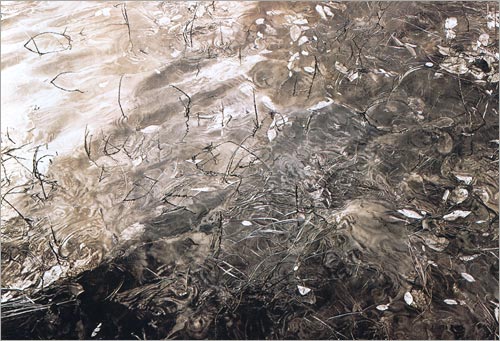
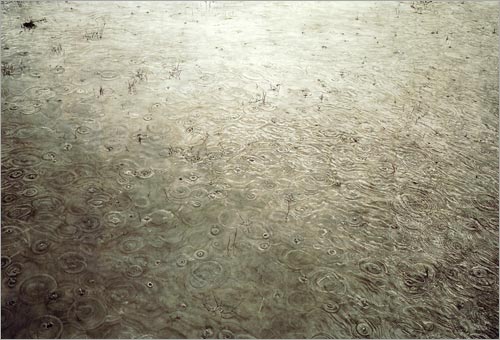
My one problem with the kind of photography I was doing was always its ease. I never felt as though I’d really done much. Completing a painting, regardless of its success, always leaves you feeling as though you’ve accomplished something. It’s true that Art is, at base, a way of communicating aspects of an individual consciousness to others incommunicable any other way. This is true for poetry and painting and music as well. In that my photographs were a record of my way of seeing they fulfilled this imperative, and so I’d never argue over their value as Art. Their value as experience, however, was always at issue for me.
Mito’s paintings please me aesthetically because they are of subjects I’m sympathetic to, subjects which interest me and which I find beautiful. (In the same way people are sometimes heard to say that they feel a song is being sung “just for them,” because of the way it resonated with their own feelings, I might say that Mito’s paintings resonate for me because they so accurately reflect back at me my own way of seeing.) Her work impresses me though, rather than simply pleasing me, because they exhibit such a high level of skill. This is something I require of Art, and goes a long way in explaining why so much work, lauded and applauded, does not necessarily impress me. It’s important for me to see an artist display a skill beyond my own. That, not cleverness, wins my respect. Mito has certainly done that.
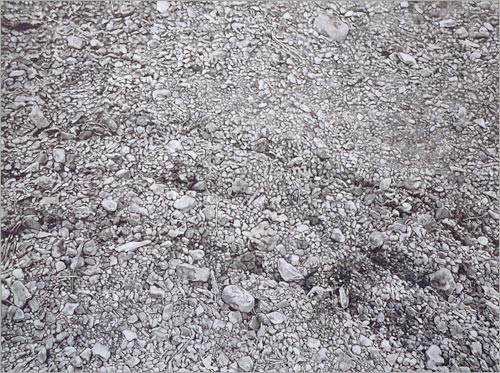
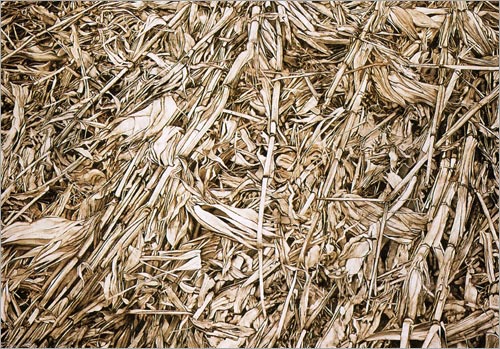
A bit about her work-
“Dirt. Grass. Dried leaves. Muddy water. Mary Neumuth’s paintings and drawings elevate what is underfoot and unnoticed to the walls of elegant rooms. They accomplish this transmutation of the mundane into the magnificent with paint and canvas via The long tradition of The “big important painting.” While Neumuth’s canvases are often large in size and pristine in execution, they are not concerned with theatrical BIGNESS. These paintings do not grab you by the lapel and shout in your face, as does so much art of our era. Neumuth’s canvases never insist, are never bombastic. Think of that discreet person who stands aside in a crowded room: such a person can create a pool of calm on a bustling public street, or in the middle of a raucous art opening. However, to really engage such quietude needs time alone… together. Mary Neumuth’s paintings make such a proposal. They invite an extended one-on-one conversation that promises to get more subtle as familiarity increases.” -MaLin Wilson, July 1998. From the essay beginning the catalog for the show “No On Spoke” at Gerald Peters Gallery in Santa Fe New Mexico.
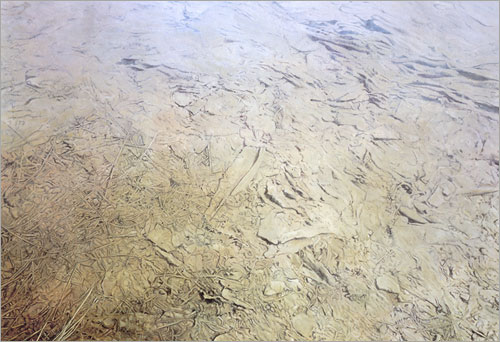
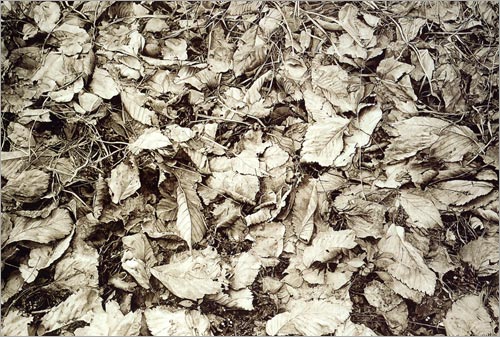
I wont include any more of Wilson’s lengthy essay because frankly I think too many descriptors and historical counterpoints and metaphors actually detract from work like this. It requires no explanation. Perhaps that’s simply me projecting my own goals and biases, but I could hardly do anything else in this particular case, could I?
Hope you enjoyed.
(To avoid any confusion for anyone attempting to search out more info on the artist: The work pictured here is actually credited to “Mary Neumuth” I refer to her instead as “Mary Mito” because her name has between then and now changed. To confuse matters further there seems to be a Pedigree horse by the name Mary Mito, who dominates google searches, as well.)
Mito’s most recent show was “Passage to China” which opened this past July at Gerald Peters Gallery.
For a bit more “descriptors, historical counterpoints and metaphors” concerning Her work see this Art in America piece by Michael Amy.
hide full text