Zengraving
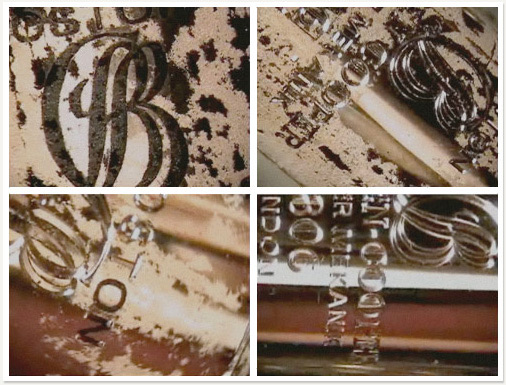
Came across this hypnotic video of master hand engraver Steve Lindsay completing an engraving from start to finish. It’s pretty amazing. As a designer (with the prerequisite appreciation of typography) watching someone carve perfect, beautiful letter forms from metal, and so handily, is both humbling and fun. As a (lapsed) painter I can certainly appreciate the brute hand-skill involved. Beyond that there is a definite Zen quality inherent, I’d say, to any work which denies the luxury of an eraser or undo button. Pour yourself a glass of something (the vid is accompanied by an urbane soundtrack of classical and jazz) and enjoy.
For more videos, images, and information on hand engraving see the following:
Engraving School.com, Lindsay Engraving.com, and Master Engraver.com.
Beautiful Specimens
Wikipedia tells us: “A microscope slide was originally a ‘slider’ made of ivory or bone, containing specimens held between disks of transparent mica. These were popular in Victorian England until the Royal Microscopical Society introduced the standardized microscope slide in the form of a thin sheet of glass used to hold objects for examination under a microscope.”
I’d like to add the following: Antique microscope slides, looked at from a strictly aesthetic standpoint (egged on by a design obsessed brain obviously) are some of the most elegant and perfectly beautiful human artifacts on planet earth. You can quote me on that. See below for irrefutable
scientific aesthetic evidence.


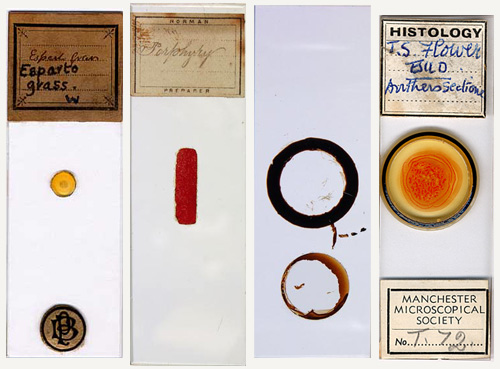


So simple, so elemental, so tiny and gorgeous. The fact that so many of these survive came as a bit of a surprise to me, delicate as they are. That so many of them are for sale and can be bought, greedily, by yours truly amazes me. I plan to build a back-lit display in my office, or alternately take a few prized samples, scan them at ultra-high res, and reproduce them huge… voila! perfectly modern art for the discerning, science lovin, design dork. (Coudal swap meat here I come.)
The majority of the samples above were taken from the following sources:
Darwin Country.
The Gemmary.
The Manchester Microscopical Society.
ebay.
For a bit more see:
Ars Mechanica
Microscopy UK.
Hope you enjoyed.
hide full text
Nature Vs. Art
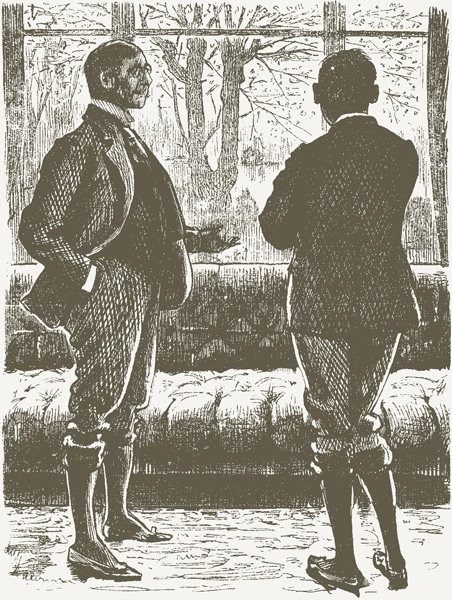
Æsthetic Friend: “Yes, This room is rather nice, All but the window, with these large blank panes of plate glass! I should like to see some sort of pattern on them—Little squares or lozenges or arabesques…”
Philistine: “Well, but those lovely cherry blossoms, and the lake, and the distant mountains, and the beautiful sunsets, and the purple clouds—isn’t that pattern enough?”
(Taken from Punch, or the London Charivari, Vol. 102. June 4, 1892. which, along with many other volumes, can be found on Gutenberg, listed for your ease here.)


The work of master goldsmith Giovanni Corvaja is a fascinating mixture of the ancient and the cutting edge. His pieces are strikingly modern in form, clean geometries encasing staggering complexities, but the techniques employed to create these works are in fact the re-imagining of 3000 year old Etruscan methods (filigree and granulation) largely forgotten until very recently.
In trying to rediscover these ancient processes (specifically granulation) Corvaja has become an interesting mixture of ancient and cutting edge artisan himself. Though he alloys all his own metal for example and manufactures his own ingots, the studio equipment he uses is decidedly modern including a microscope, a super-charged water torch, and a host of self-designed items like a graphite crucible and a sapphire hammer and anvil. This combination of modern technology and ancient technique has allowed him to create work which in many ways outdoes his Etruscan predecessors and evidently pushed his materials to their limit. I’m fond of it in any case. For more images and info see: Galerie-Slavik, V&A collection, V&A audio, Abovo Gallery, and The Scottish Gallery.
hide full text
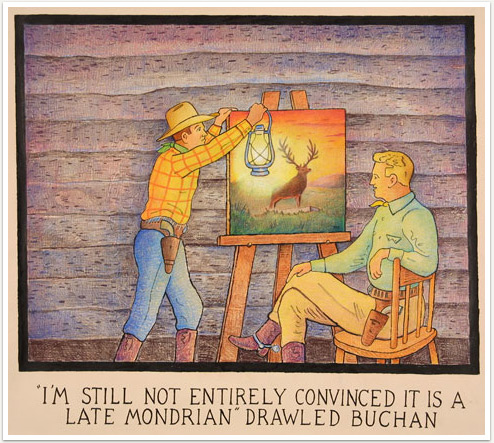
Quote, “Rockets, canoes, bagpipes, fish, good old chaps with patches on their elbows and jokes about Derrida: Glen Baxter’s world is always instantly recognizable. Blunt, innocent-looking lines tether its extravagant surrealism to the page like guy ropes, the economy of those pen strokes undermined by the accompanying text, blocked out in hand-written capitals, which sheds often surprising light on the dummy-blank expressions of the characters.” from an old Guardian article called King of the surreal. Anyone whose work contains multiple Giacometti jokes, or indeed a constant stream of art gags, gets the nod in my book. So let me ask you, are you, like myself, an admirer of this Glen Baxter by any chance? Well, you are about to become one.
Links: Glen’s homepage, Thorogood, Modernism Inc, The Tate, Flowers East, Int. Herald Tribune piece, and a short audio interview.