In 1846 Dr. Andrew Comstock, proprietor of one of the oldest commercial language schools in America, called Dr. Comstock’s Vocal Gymnasium and Polyglot Institute, published his Treatise on Phonology. In 2008 I came across it on google books and, reading its simultaneously bitchy and braggadocios full title– A Treatise on Phonology: Comprising a Prefect Alphabet for the English Language; a Specimen Exhibition of the Absurdities of Our Present System of Orthography, I laughed. Reason enough to whip-up a quick post, so far as I’m concerned.
Well, as you might expect, it turns out that the “perfect alphabet” of the title, which the book sets forth as remedy to the “absurdities” of English, also mentioned in the title, is a phonetic alphabet created by Comstock himself.
Quote: “It is generally admitted that our orthography is more complicated than that of any other language. Various attempts have been made by different individuals to simplify it. The author of this treatise, however, proposes not only to simplify it, but to perfect it.”
Before you go off half-cocked mocking and scoffing Dr. Comstock for pomposity, first remind yourself that he invented his more-perfect-than-English alphabet at a time when religious and philosophical outlooks on causality were giving way to scientific ones, which is to say that the prevailing feeling among the educated was that with some properly focussed brain-power any “problem” could be “solved” by scientific means, that this was the age of the elocution movement, and that there had already been, before he ever set overconfident pen to paper, at least a century’s worth of individual efforts to overhaul English. Benjamin Franklin had made his own attempt as early as the 1760’s after all, and you wouldn’t mock old Ben now would you?
Then there is the little matter which, being so far removed from grammar school, you have likely forgotten- English is a weird and knotty frankensteinian creature.
(After many paragraphs to back up the statement) Comstock puts it this way: “Our language is hedged about with difficulties which can hardly be overcome even by years of laborious study. The young student is obliged to waste much precious time in learning to spell and read our crooked words, and the adult foreigner is appalled by obstacles which seem to be insurmountable. Now, all these difficulties would be entirely removed by the adoption of a perfect alphabet — an alphabet which should represent language phonetically.”
Of course, now that you’ve reminded yourself of these things, you can go ahead and laugh anyway.
I personally find myself amused, not so much by the seemingly quixotic quest to just put on the brakes and change the course of a living language, but by the obvious galled irritation Dr. Comstock felt.
Quote: “...the 38 elementary sounds of the English language are represented in 336 different ways, which may be considered equivalent to three hundred and thirty-six different letters! Is it possible to conceive of a more complicated, absurd, unphilosophical, and barbarous system of orthography?”
Barbarous?! Hahaha.
We, all of us, find aspects of our own vocations thorny and annoying. The convolutions and abstruseness and wrong-mindedness which seem to permeate every human endeavor formulated or informed by any consciousness other than our own can exasperate; but imagine if your vocation was language! Imagine if it were English itself that stuck in your craw. Talk about fighting windmills.
Anyhow, if you are interested, Comstock’s phonetic alphabet broke down essentially as follows-
Quote: “This Alphabet comprises all the letters of the Phonetio Alphabet for the English Language, with additional ones to represent sounds peculiar to foreign languages. Comstock’s Phonetic Alphabet is the common, or Boman alphabet, not only so extended, by the addition of new letters, that there is a character for every articulate sound, but so improved by the introduction of signs for the various modifications of the voice in speech, that there is a character for every accent, inflection, intonation, etc. Hence it must be considered a perfect alphabet.”
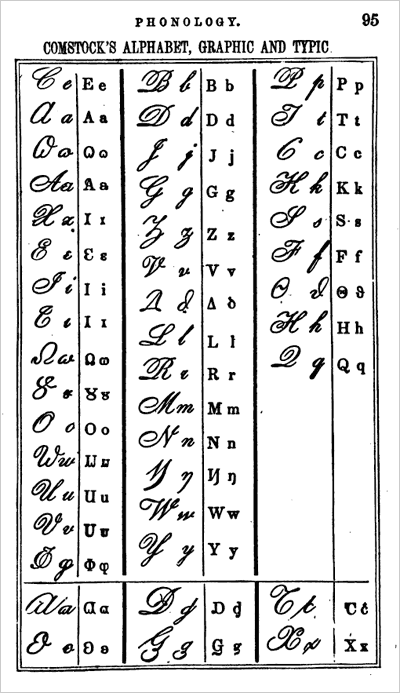
Including all 44 characters and 16 tone marks Comstock’s perfect alphabet looked like this-

If you were enthusiastic about the alphabet and wanted to set about immediately hand-writing a letter to your dear old mother, or your betrothed in Niagara Falls, you could refer to this chart as a guide-
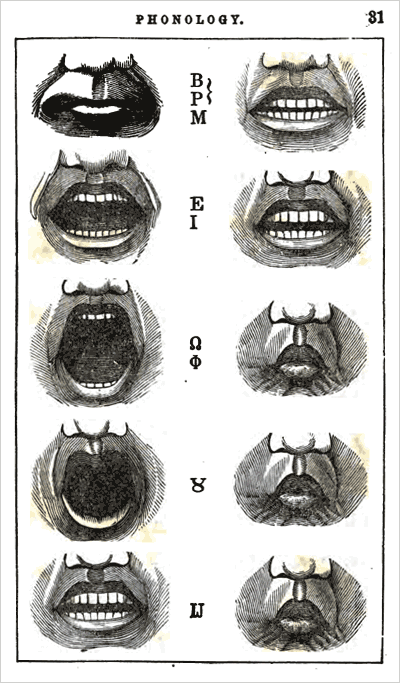
Meanwhile if you wanted to set about teaching the gents down at the club or the fellows at the beer garden this new method, some charts depicting mouth articulations, grouped by phoneme, would be helpful. Luckily Comstock furnished these, saying-
Quote: “An accurate knowledge of the positions which the organs of articulation should assume in the formation of the several elements of vocal language, is very important to those who would speak with ease and elegance. To aid the reader still further in the acquisition of this knowledge, he is furnished with the various postures of the mouth, required in uttering the elements energetically, and singly.”
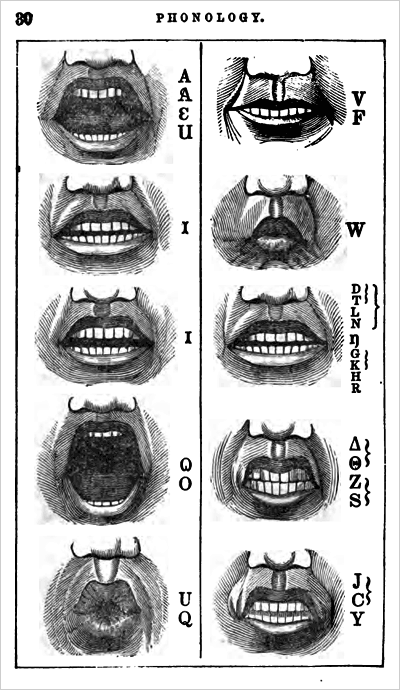
“The pupil should exercise his organs of speech, in the most forcible manner, every day, on all the elements. The vowels should be exploded from the throat, both interrogatively and affirmatively, in every range of pitch.”
Certainly, even armed with logic and charts and enthusiasm, there would be some doubters. To them, leaving aside stability and ease of use, you could quote a few of the many benefits Comstock himself lists, like, say-
3. It would enable one to spell and read in one-twentieth the time required by the present absurd and barbarous orthography.
4. It would render the teaching and the learning of the English language, which, by the old theory, are extremely irksome, highly interesting.
7. It would interdict provincialisms; because, according to this theory, all words are spelled as they are pronounced, and, consequently, pronounced as they are spelled, every graphic word being a perfect Daguerreotype of the vocal word which it represents.
10. As, in phonetic spelling, most of the words have fewer letters than are employed in our present orthography, this alphabet would enable a writer to put more matter upon the same page.
13. The adoption of this alphabet would not only be the means of greatly advancing the cause of science and literature, but would be invaluable to the missionary in disseminating a knowledge of the gospel among the heathen.
How can you argue with that? Comstock certainly couldn’t see any way.
Quote: “The Author feels confident that no one who peruses this treatise understandingly, will desire to cling any longer to the old system of orthography, unless he prefers chaos to order, —discord to harmony, —darkness to light. Hence, he sends forth his Alphabet to the world with the most sanguine expectation that it will meet the entire approbation of the public, and be speedily adopted.”
I might wonder weather, having seen his countrymen choose chaos, discord, and darkness over his perfect alternative, he died sanguine as well… were it not for the obvious linguistic contradiction of it.
Anyhow, hindsight being smug and sadistic as it is, we know his grandiloquent claims and aims came to naught. We know also that the scores of other contrived alphabets which came before and after his met similar fates. I don’t believe there has ever been a constructed script, in the history of the world, which has supplanted a “naturally” evolved predecessor by dint of logic and force of will.
Perhaps it’s the fact that, as in Comstock’s case, a switch might benefit 3rd graders and immigrants but would effectively render the entire adult population of the country illiterate in the bargain?
Perhaps it’s because, ever since learning as ankle-biters what the characters MOMMY added up to, our alphabet is so intertwined with our language, and hence, our thoughts, our minds, our being, that we would never and could never willingly replace it?
Perhaps it’s because language is a vibrant and living and evolving thing which has never, not even in or present “barbarous” orthography, been truly tamed and finally codified?
Or perhaps it’s just that the overwhelming majority of us are not elocution teachers, or linguists, or grammarians, and so the quirks of English just simply do not stick in our craws enough to warrant, in any of our minds, a “solution?”
Hell, I don’t know.
Though his perfect alphabet is all but forgotten, I would like to thank Dr. Comstock, none the less, for not only affording me a chuckle (which I suppose I ought to be offering apologies for rather than thanks) but more importantly for occasioning circumstances in which the letters “Phonemenon” could be put together, in that exact order, and be something other than a misspelling.
So in his honor, finally, let me offer the following, may it live on in the minds and mouths of we who have choosen chaos, discord, and darkness:
Pho·nem·e·non [fo-neem-uh-non]
noun. plural: phonemena.
1. A vocalization, or sound made with the mouth, that is perceptible by the senses.
2. A remarkable or outstanding utterance.
Hope you enjoyed.
hide full text