Though the term “shadow play” might bring to mind some sort of salacious fetish practiced by overzealous goths and pre-teen wickans, it is, of course, no such thing. Shadow play refers instead to one of the more ancient forms of theater, one whose roots are so old as to be, beyond a certain point, seemingly untraceable, whose practice can be found, in varying incarnations and distinct traditions, all across the world, and whose contrivances account for some of the most gorgeous puppets to ever to cavort, skulk, vault, or swoon across a stage.
A Chinese legend traces shadow play to 121 BCE.
“Emperor Wu of the Han-dynasty placed his affections on the lady Li; she departed this life and his thoughts were with her incessantly. Then a native of Ts’i, versed in occult arts, named Li Shao-weng, told him he could make her shen (ghost) appear. That night he stretched a curtain across the room, lighted lamps and torches, and told the Emperor to sit down by another curtain, and look from some distance. Then within the curtain a beauty appeared, whose form was that of the lady Li.” - As reported by the sinologist Gustave Schlegel.
To cite the legend of Emperor Wu as the actual origin of shadow theater would be a stretch, however, in that it would be a century yet before the practice really took hold.
Quote: “Shadow shows did not appear until about 1,000 years later, during China’s Sung Dynasty (960-1279 AD). Popular across all social classes, these shows were performed at court, in homes, along roadsides, and between military battles.
The popularity of shadow play spread across cultures and continents. By the 18th century, shadow shows could be seen in Indonesia, Malaysia, Thailand, Cambodia, India, Egypt, Iran, Turkey, and Western Europe, each with a distinct style, look, and function.
Traditionally, puppets were made from animal skins such as buffalo, donkey, and fish that were stretched, dried, colored, and treated until translucent. Now they are made with just about anything from strong card to thin plywood to plastic, wire, and zinc.” - ARTSLEDGE: Playing With Shadows.
On that note (having offered you only the barest bit of background information possible to introduce an art form thousands of years old, in a transparent attempt to elevate this post out of the realm of pure gawk-fest) I offer you a slew of poorly notated but exceptionally handsome examples.
“Step right up! Step right up! See the pretty puppets!”


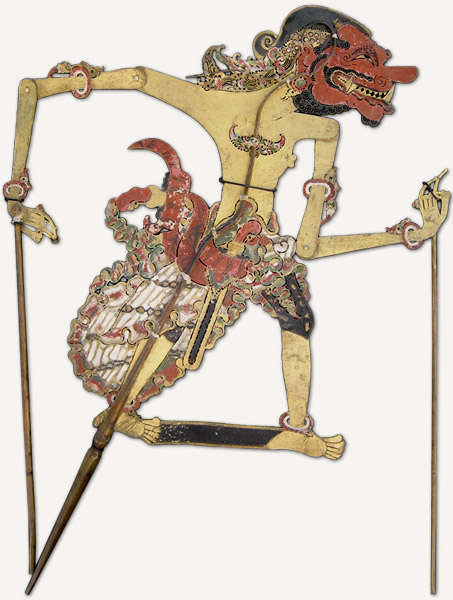


From Indonesia (found here)


Pretty nifty. Though most of us now watch our culture’s grotesque figures on television screens rather than screens made of fabric, shadow play remains a vital form in many parts of the world. Most of the examples above are actually comparatively modern examples.
For anyone interested in learning more about the various incarnations of shadow play I offer the following key to more pointed searches:
China - “Pi Ying” (shadows of hides)
India - “Chhaya Natak”
Indonesian - “Wayang Kulit” (leather shadows)
Thailand - “Nang Yai”
Egypt - “Khayal al-zill” (shadows of fancy)
Turkey - “Karagoz” (Named for the protagonist of all Turkish shadow theater)
Greece - “Karagiozis” (see Turkey)
France - “Ombres Chinoises” (Chinese shadows) and later “Ombres Francaises”
Meanwhile here are some related links:
Playing with shadows
Shadow play at wikipedia
Chinese shadow puppetry
Chinese shadow theater
Scenic shades
Puppet India
Thai shadow puppets
Wayang Kulit of Indonesia
Javanese traditions in Suriname
Wayang resources
Wayang Kulit
Wayang at discover-indo
Wayang at wikipedia
Wayang at YouTube
Shadows of fancy
Kargoz, Turkish shadow theater
Kargoz video
Shadow puppets at Flickr
Shadow plat at YouTube
And let’s not forget The Allegory of the Cave.
Lastly I wanted to offer this tidbit which I found interesting–
Quote: “The expression ‘Silhouette’ is comparatively new. It was coined in France in 1759 for cheap and easily produced articles after the name of the French minister of finance of that time, Etienne de Silhouette. The term was used in mockery of his stern and unpopular economic laws.” - Alphabets & Ornaments by Ernst Lehner.
Take that Kara Walker! Haha. Just Kidding.
Hope you enjoyed.
hide full text