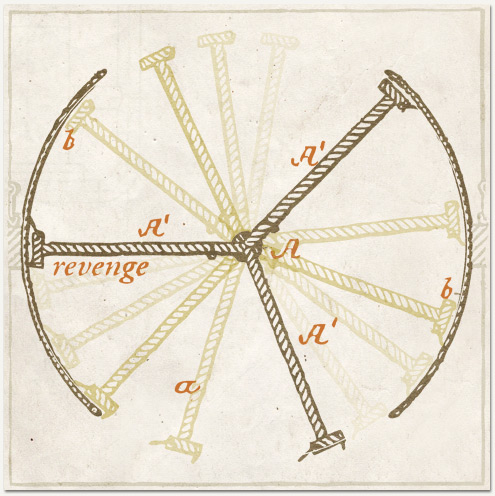
The revolving door is most often thought of today, if at all, in connection to the various forms of workplace-related dread it has come to be associated with. As the entranceway to office buildings it’s the cause of pavlovian groans (Christ! Here I am again at this hell-hole). As metaphoric short-hand it’s a stand-in for conflicts-of-interest, matters of ethical oversight, and corruption. Like snapshots from your last colonoscopy, or a multi-million dollar Damien Hirst painting, the images conjured aint pretty. The revolving door has, of course, not always been saddled with such negative connotations. There was a time, not so very long ago, when it was a shining symbol of modern man’s ingenuity- evidence of an energized drive toward the future. Yet surprisingly, even in the glow of the revolving door’s youth, when it was being enthusiastically installed in buildings the world over, few people were aware of its true origins.
Any telling of the revolving door’s story must begin with the name Bockhacker, though the length of the tale which follows it varies considerably. German door historians, or “Türherstellers” as they are reverently called, will, to a man, offer the following information as regards the revolving door-
• H. Bockhacker of Berlin was granted German patent 18349 on December 22, 1881 for “thür ohne luftzug” or “door without draft of air.”
And… well, that’s about as far as their interest in the subject goes.
Outside of Germany the tale is different. All the great door histories (like De Grote Geschiedenis van Deuren and Il Glory dei Portelli) mention Bockhacker, of course, but then shift focus to one Theophilus Van Kannel, of Philadelphia, who in 1888 was granted US patent 387,571 for a “storm-door structure.” The true story of the revolving door, both known and forgotten, is more than anything the story of Van Kannel.
Some commonly known facts about Van Kannel and his revolving door include:
• It is perfectly noiseless.
• It effectually prevents the entrance of, snow, rain or dust.
• It cannot be blown open by the wind.
• It excludes street noise.
• Persons can pass both in and out at the same time.
• It prevents a direct path between the interior and exterior of a structure, making it useful as a partial airlock, minimizing heat-loss.
• It circumvents all that annoying “You first” “No, you first” stuff.
• The world’s first revolving door was installed at Rector’s, a restaurant in Manhattan’s Times Square, located on Broadway between west 43rd and 44th streets, in 1899.
Some largely forgotten facts about Van Kannel and his revolving door include:
• The original slogan for his door was “always closed.”
• It was marketed (in the Victorian manner) as helping to avoid “noxious effluvia” and “baleful miasmas.” Van Kannel himself authored a pamphlet which included the following: “It will save life, by preventing those deadly lung and throat diseases which are sure to overtake the unfortunate salesman, cashier, or clerk whose duty keeps him near the constantly opening front door.”
• Van Kannel was an irritable sort. In response to the initial reaction to his door he had this to say: “Just like a turn-stile, so say nine out of ten persons who first see it. As well may we say a tea-kettle is like a locomotive boiler.”
• Van Kannel originally intended his invention to be installed not only in public buildings but in private homes as well.
Which brings us to the crux of things-
That Van Kannel’s invention turned out to be useful, in the ways we consider it to be so today, is something of a happy accident. That’s not to say the inventor didn’t have a purpose in mind, he spent years perfecting his idea after all, but if you were to run down the list of its touted benefits you’d be forgiven for never coming upon the intended one.
More than anything the world owes the invention of the revolving door to revenge.
It seems that when Van Kennel was a boy, still in the care of his mother but just on the cusp of cultural manhood, he found the lingering rules of chivalry rather bothersome. In particular he refused to accept that he was expected to open the door for women and allow them to cross the threshold before him.
A silly sort of quirk to our minds, certainly, but it was taken seriously enough by his mother that after numerous warnings and threats she eventually felt compelled to take action. Van Kennel family histories have it that at some point in his twelfth year she administered a savage bare-bottomed spanking, during a salon in the family’s drawing room, in full and explicit view of 37 local mothers and daughters.
This very public shaming over what amounted to a matter of chivalry stuck with Van Kannel (no wonder- “Spankophilus” being a whisper that seemed to dog his steps for years afterward) and, far from teaching him a lesson, embittered him even further toward the “gentlemanly” behavior polite society required.
Had this been the only episode the world may have never had a revolving door to shuffle through. As it so happens, however, Theophilus Van Kennel married a woman who, though beautiful and slyly clever, had an odd and stubborn quirk of her own.
Young Abigail Van Kennel, it seems, refused to pass from one room of their apartments to another without the assistance of Theophilus. As a biographer later explained: She was willing to make many concessions to the new modern ways, but her mother had taught her to take matters of chivalry very seriously indeed. “Manners are the measure of a man!” she’d said “More so than his inseam, rest assured!”
Needless to say Theophilus was unaware of this outlook when he took Abigail as his wife, and was none to pleased at finding it out on their honeymoon. The result amounted to a battle of wills, fought atop a mountain, which to onlookers looked suspiciously like a mole-hill.
Theophilus had on one occasion tried to put his foot down on the matter, telling his wife in the morning, “all this opening doors twaddle just will not do! I can not be rushing around my own home to usher you from room to room! You are a grown woman and can locomote perfectly well on your own.” after which he stormed out of the house. He returned home in the evening only to find Abigail sitting defiantly just inside the bedroom door, right where he’d left her.
With the ugliness of Fate’s sense of humor now blindingly apparent, Van Kennel, incensed and stubborn as an ill mannered he-goat, devoted his full focus to finding some way to sidestep this rule of chivalry, or even, perhaps, create cause for a complete revision of the rules. 3 years and $9,837 later he found his answer in what we now call “the revolving door.”
You see, contrary to what you might think, the revolving door was not designed to keep out snow, or to minimize heat loss (though that it does both certainly lead to its success). Theophilus had something different in mind.
The revolving door was designed specifically so that whomever enters the door first is obliged to do all the pushing! This was Theophilus’ breakthrough. He saw immediately that with his design it would actually be most chivalrous for the man to proceed through the door first. He hoped that, without being reduced to stating it baldly, people would recognize this fact, and that when they did, presto! door-holding would be relegated to the stinking, festering, and massive compost heap of history.
He did not count on this eventuality of course, having learned by then that traditions could, and traditionally did, prove irrationally tenacious. His design addressed this, however, and he was satisfied by the private knowledge that with his door at least, the act of obliging women first passage would be, in point of fact, the act of obliging them to open the door for you!
His own home, as well as the home of his mother, were outfitted with the first 14 revolving doors ever assembled.
In the years that followed, after his invention had taken root, though the tiresome rules of chivalry showed no sign of adapting, the loophole he’d so cleverly engineered amused him to no end. He’d walk past buildings in which his doors had been installed and laugh. He thought of the women all over New York being ushered dutifully into revolving doors by browbeaten sons and husbands, all proclaiming with a twinkle in their eyes, “No, no, after you!”
And that my friends is the true, very nearly forgotten, secret history of the revolving door.
-
Disclosure: Most factual bits of this post were gleaned from James Buzard’s piece Perceptual Revolution while all untruths are, I assure you, my own. I’ll leave it to you to sort out which is which.
Hope You enjoyed.
-
Note: This post is in a series of reworkings of old posts which date from before the redesign of The Nonist. The links have been updated, the text has been reworked, and the images are all new. I will be periodically adding these reworkings into the flow of new content in an effort to eventually remove all the old pages from circulation.
hide full text