No matter how hard we humans play at ideas like open-mindedness, reservation of judgement, and rationality we can’t help ourselves but to make instantaneous snap-judgments about things. That’s no damnation, it’s just the way our brains work. We see something new and our industrious little minds seek connections and corollaries. If our minds find acceptably concrete evidence lacking, they simply move down a tier, from direct experience to indirect, and make whatever connections seem most likely. Our minds have no qualms about simply guesstimate and making the closest match they can manage. It’s how we categorize the world around us and make sense of reality.
About
(i)
Contact (i)
Search (i)
Annex (i)
Special Projects (i)
Downloads (i)
Shop (i)
Archives (i)
Links (i)
Feeds: rss2 | atom (i)
Contact (i)
Search (i)
Annex (i)
Special Projects (i)
Downloads (i)
Shop (i)
Archives (i)
Links (i)
Feeds: rss2 | atom (i)

Trickle-down affections
Or: do celebrity archetypes inform our snap-judgments?
06.23. filed under: !. inquiries. life. people.
3



Some ramblings about American culture.
What would you call something which, having become poisoned and yet dominant, seems to impede, in its way, the further forward development of human culture at large, the hard won notions of the enlightenment, the happiness of individuals everywhere, and possibly the advancement of the species as a whole? I call it American culture.
After a discussion I had this morning here are a few points to consider and kick around, in no particular order:
American culture, meaning the culture, not the government, of the United States of America, was nurtured under puritanical principles, which we have yet, in our 230 years of existence, to shake off. Today’s so called “culture wars” are just another in the long line of skirmishes in which one group of people, lets call them “those who wish to move forward and evolve” attempts to throw off the suffocating and muscle numbing yoke of the old guard, let’s call them “those that wish to take globs of warm amber into their lungs and become fossilized forever in the continually outmoded past of human experience.”
American culture is one fed on repression. Our notions and experiences of sex, the most universal and natural of human experiences, are warped, from our puritanical upbringing, in ways no other culture (save perhaps the Japanese) could even begin to comprehend. For us everything must be hidden and secret. For us everything must be dirty and guilty. For us pleasures of the flesh can never be trusted and so never completely enjoyed. We are a land of philosophical eunuchs, even the best of us, when it comes to human sexuality. We skulk around feeling guilty, averting our eyes when we are supposed to, masturbating in secret places with the memories of what we’ve seen. The worst of us would have vagina’s sewn up with consecrated threads, only to be cut on a wedding night, with saintly scissors; penises lopped off, only to be attached again for the purpose of overpopulation. Every man, woman, and yes- child, knows the deceitful unworkability of this. But we are cowed by those with the loudest mouths. We nod and pretend. We must deny everything and sublimate our yearnings into lies and violence.
Other cultures, with the good fortune to have existed for thousands of years, in one place, look at us and shake their heads. “How can they be so childish?” they must wonder. “How can they be so full of shit?!” And I wonder as well. How?
How, in the year 2006, can so many of us still be so ignorant of the obvious? Heads can be cut off on 80 foot screens, bowels torn from bellies to slap against thighs, bullets can enter bodies from 10 different angles, but the word “fuck” can not be permitted on the airwaves. A breast can never be glimpsed. A fully nude body must be accompanied with a warning which tells us: “This is very naughty and bad for you!” The peoples who descend from ancient Romans, who walk the same avenues as their ruined forefathers, look at us and laugh as they slap one another on the asses without benefit of a lawyer’s council.
We despise the old. We cringe at their wrinkles and bellow behind their slow motions. We put them in cheap rooms to die while doing every ineffective thing we can to fend off age in ourselves. Knives slip between our skin and bones to artificially tighten, firm-up, enlarge, and slim down. We inject poison into our faces to remove our hard-won wrinkles. We dress in children’s clothes and pretend at child-like freedom. We buy a never ending succession of “toys” we don’t need. In short we make vulgar monsters of ourselves. Everyone sees this but no one admits to the ugliness of it all.
We see the fake breasts creasing and bulging on the sides, we see the faces pulled back into masks, we see the wigs shift, we watch the artificially plumped lips move, we see the huge heads, like baubles, of those who had the fat vacuumed from them, we watch the starving women making excuses and we pretend this is beauty. We pretend we are fooled and celebrate it on every magazine cover and television screen. We pretend the glow of youth dwells on a knife edge, in a needle, in a cream, in a wish.
We blame and repent and pass judgement, never for a second doing the only thing required of adults: taking responsibility. We sue, and we go on talk shows, and we tell all, and we accuse, and we weep, and we “self-help,” and we take our medicine, and stuff our fat faces, and stuff our pockets, and we congratulate ourselves, and we pamper ourselves, and we turn our culture into a infantile embarrassment fit not for men and women but for children whose development is forever arrested.
“We must do it for the children!” What better sentiment for a culture that endlessly caresses and fondles and probes the tight anus of youth! Our culture, from our music to our “literature” to our entertainments is all unsophisticated and childlike. Every market salivates over the youth dollar and every decision must take the children into account. Nothing legal seems to exist anymore for the benefit of adults. We idolize vapid celebrities. We make millionaires of game playing man-children. We elect intellectually stunted buffoons because they remind us of ourselves, because they are “average” and visibly flawed, as though that were a selling point. The stories of our leaders are always coming of age stories in which mistakes must be made in order to be learned from, but each leader is temporary, and each lesson must be learned anew.
We worship youth both in our rhetoric and in our degradation. But not for the actual youth of our population, to them we are happy to leave cesspit of waste and debt and ecological ruin. “The children” we so adore are ourselves. Our young country is full adolescents, awkward and uncertain, always looking to their invisible father figure in the sky for approval, always fueled by a bottomless undercurrent of fear at facing any reality.
Some of us defer to our invisible father figure in the sky whenever we are made uncomfortable, whenever we are unsure, whenever we would rather not be responsible. We honor him in public, always, saying the things that must be said, but in private we are compelled to push the boundaries and see just what we can get away with. We are rebellious in all matters where his “law” does not serve our purpose, but relent when caught. After all the power to invoke daddy’s name is the greatest power of the weakling child.
These among our number will always stand at daddy’s pant leg. It is only his perceived power that allows them to cover their ears and shake their head chanting “la la la la I can’t hear you la la la…” when things like science and facts and logic threaten. It is the weakling child’s last defense when those among us who want change and progress and betterment attempt to speak up.
It is my feeling that American culture, as it stands today, is very nearly a kink in the evolution of human culture on the whole. (We are by no means the only kink, but a kink in the smooth flow none the less.) It’s dominance is troublesome when elsewhere in the world there are more mature cultures who by turns seem willing to celebrate life, to enjoy themselves, to love, and most of all to learn. If those among us who want further enlightenment here on earth do not eventually shake loose of the yoke which keeps America backward and fearful, if we don’t grow up and punch the schoolyard bully square in the mouth as it were, then we are part of the problem and not at all the shining light which we’ve always assumed ourselves to be.
In any event we have some serious fucking issues.
Discuss.
hide full text
06.18. filed under: !. criticism. inquiries. observations. people. politics.
12
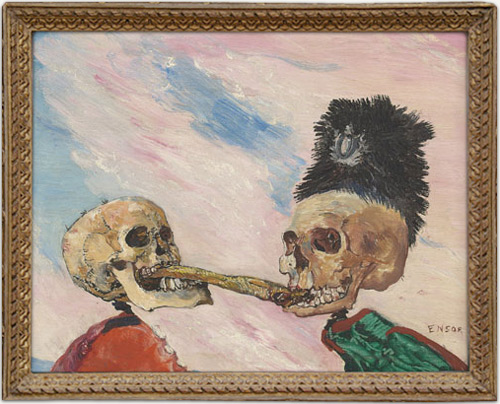
Squelettes se disputant un hareng-saur by James Ensor
Translated as “Skeletons Fighting for a Smoked Herring.” The herring was Ensors personal symbol for his own art, appearing in many paintings. It is sarcastic word-play. In French “Hareng-saur” sounds like “Art Ensor.” Here, the two skeletons represent two critics who, fighting over Ensor’s art, want to literally tear it apart, each wanting to be the one who does him in. His first major exhibition, in Paris in 1898, was a failure you see, with the critics calling him “mad, foolish and nasty.” More here.

Instructing the young, reforming the old, correcting the town, and castigating the age.
In October 0f 2001 a small-format newspaper appeared at book and magazine stores across at least 4 of the 5 boroughs of New York. Copies showed up in coffee houses. Copies were seen on benches. The occasional copy was perhaps taken aloft by a discerning wind. Amid the lunatic crush of printed bombast and color-glossed offal, literate residents of the great city might certainly be excused for having missed its arrival and subsequent departure completely. But if you did it’s a shame, because for its year-long run Three Weeks was without doubt the best written publication the city had to offer.
The title, Three Weeks, did not constitute some snickering school-chum in-joke, nor was it plucked, between clever forefinger and aping thumb, from some Borges or Beckett quotation. No, the title Three Weeks was an simple admission: This will be quite possibly the only paper which intentionally adheres to a tri-weekly publication schedule.
It seems significant to us that in our lives and in our language we have demarcated ‘days,’ and ‘weeks,’ and ‘months,’ and some of the dodgier individuals present will even pay homage to the ‘fortnight,’ but that the intermediate period of twenty-one days is left without a single worshiper. And that, ever devoted to this vestigial influence of the Mayan, Egyptian, Arabic, and Hindu calendars, our modern American commentators, publishers, and literary trendsetters all adhere to a publication schedule that is either overwhelmingly too frequent, or else, agonizingly, too precious.
Not so lazy as a monthly, not quite so incessant as a weekly, and never as precious and obsessive as one of those capitalized Reviews, THREE WEEKS will appear, to the best of its editor’s abilities, in that last gap of the information continuum after which it is named - careful and thoughtful, and also carefree, and impulsive. - From the First issues introduction.
For 18 issues, three-weeks-in, three-weeks-out, the editor Henry William Brownejohns, delivered a stylish, funny, and highly intelligent paper, which believe it or not was free, or effectively so, in that the asking price (after issue #3) was “two cents, voluntary.”
In a 2001 piece titled High-Button News New York Press columnist John Strausbaugh took notice and conducted what I believe to be the one and only official interview with Brownejohns, beginning:
Since it began last October, Three Weeks has been very quietly infiltrating New York City bookstores and coffee shops with a look as old-fashioned as celluloid collars and an eloquent writing style that consciously evokes a more genteel epoch in American letters. Lede stories of the 16-page newsprint journal have had titles like “On Hope: Whether It Is Worth Having Any,” “On Sleep: A Universal Human Vice Examined” and “On Pigeons, Rats, and Cockroaches: A Worthy Cogitation Upon Our Most Ubiquitous Companions.” There’s a regular column on “The Weather,” in which the editors take turns discoursing upon such subjects of weight as those vexing gusts of wind that knock a gentleman’s hat off when he is innocently reading his paper on a park bench…
The paper also featured a column called The Eavesdropper which transcribed interesting overheard conversations and predates Overheard in New York (and its book deal) by a good long stretch.
In all the paper followed its spirit guides admirably, they being a beaming Washington Irving and a scowling H.L. Mencken.
I had the good fortune of having been acquainted with Mr. Brownejohns. We would occasionally share a libation on MacDougal street or browse the nearby record shops. (I remember distinctly that we disagreed on the musical merits of Steely Dan.) This was before The Nonist existed and though he seemed amenable to the idea of my contributing something to Three Weeks I was at that time still focussed mainly on the visual arts and didn’t posses the discipline to be a contributor to any undertaking of even moderate import, let alone a wonderful paper such as Three weeks. It’s a missed opportunity I regret to this day.
Since the last issue of the paper was published in October of 2002, I’ve lost contact with Brownjohns. He was nice enough to hand over a small package containing a complete run of the paper as a birthday gift that year, after which he seemed to disappear utterly. A shame.
I’d always intended on doing a post about Three Weeks here in that I admire it greatly, but I could never decide how to approach it in such a way to do it justice. Short of transcribing every issue there didn’t seem a way. Well I’m happy to say only recently I was dumbfounded to find that some other enterprising soul had done every groaning moment of the heavy lifting for me:
BROWNEJOHNS.ORG The Henry William Brownejohns Appreciation Page contains transcriptions of all 18 issues as well as cover scans and a few subsequent pieces written by the paper’s staff after its cessation.
I think it’s wonderful that those who were not around New York during the small window of the paper’s existence can now enjoy Three Weeks online. I heartily recommend that any of you with a love for the written word bookmark the site and begin reading straight away. You will not be disappointed, I promise.
Lastly, on the off-chance that Brownjohns has finally made the begrudging leap into cyberspace, or at very least randomly logs on for the guilty pleasure of a “vanity google search” and happens upon this post, let me direct a statement directly to him:
Do get in touch. I’m curious to know what has happened in the intervening years. It’s been too long.
hide full text
Gargantua the Great
Or: Buddy, the gorilla who was scared of lightning.
I came across a few photos of a lowland gorilla in a book about the history of the circus which piqued my interest. I’m a big fan of the primate you see (some being dearer to my heart than others) and I went searching the web to find out more. The Ringling Brothers Barnum & Bailey Circus billed him as “Gargantua The Great, the world’s most terrifying creature” but as it turns out a previous owner had dubbed him Buddy, short for Buddha, and he had a very sad past. Not only that but he was scared of lighting. What follows are a few brief notes on Buddy’s story and some related images.
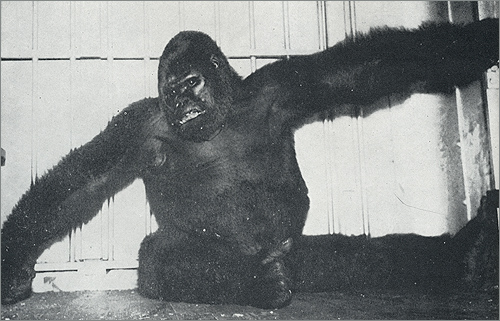
This is Buddy or Gargantua the Great as the world would come to know him.
Essentially the story of Buddy goes like this: In the Mid-30’s a baby gorilla was offered to a freighter captain as a gift from some friends who were African missionaries. The Captain accepted and brought the gorilla aboard his ship, naming him Buddy. He was adopted by the crew and became the darling of the ship being given specially prepared foods, taught to preform seaman duties, and otherwise adored.
A sailor aboard the ship took exception to the discipline doled out by the Captain and knowing how fond the captain was of the baby gorilla threw nitric acid in Buddy’s face as a means of vengeance. Buddy was nearly blinded and forever disfigured. Buddy hid himself refusing food, shrieking, and attacking anyone who came near. The sailors, at a loss for what to do, urged the captain the euthanize Buddy, but the captain knew a wealthy woman in Brooklyn who cared for sick animals and decided instead to bring Buddy to her.
Her name was Mrs. Gertrude Lintz and she was a bit of an eccentric.
She had won national attention by proposing to the scientific community that apes, specifically chimpanzees, needed proper mothering to survive and thrive. She dressed the chimps in human attire, taught them to eat at table, and allowed them to live as children might under similar circumstances. Her most famous protégé, Captain Jiggs, a highland chimpanzee of unusual intelligence and patience, became a well known national figure. Mrs. Lintz divided chimpanzees into three classes, depending on eye brightness, and anthropomorphized the animals to such a degree that she blurred the line between animal and human. She particularly enjoyed posing the animals in the car seat beside her, driving her roadster with an immaculately dressed chimp navigating from the passenger side.
Under Mrs. Lintz care Buddy grew to a huge 600 lbs. A plastic surgeon attempted to repair his disfigured face but left him with a permanent terrifying sneer otherwise out of character with his gentle nature.
Evidently one night it was stormy out. Buddy was frightened by the thunder and lighting and broke out of his cage. He crawled like a frightened child into bed with Mrs. Lintz. She decided then and there to give the 600 lb. eight year old lowland gorilla to the circus. She contacted John Ringling in 1937 who came to Brooklyn to see Buddy. He was later quoted as saying:
“From behind the bars glowered the most fearful face I have ever looked upon,” said Ringling. “A tremendous hairy head, great dripping fangs, and the horrible sinister leer of the acid-twisted mouth.”
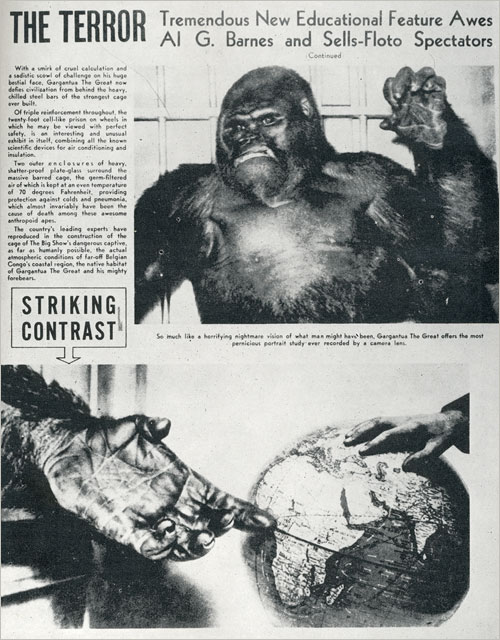
Top image caption: So much like the horrifying nightmare of what man might have been, Gargantua The Great offers the most pernicious portrait study ever recorded by a camera lens. Bottom image caption: The massive hand of Gargantua The Great and that of a normal sized man, emphasize the almost unbelievable concentrated power behind the giant gorilla’s which point to his approximate place of origin in the dim forests of western equatorial Africa.
Ringling bought Buddy on the spot, and renaming him (at his wife’s suggestion) Gargantua, after Rabelais’ giant king of Gargantua and Pantagruel, launched an advertising campaign centered around the gorilla which hailed him as “the largest gorilla ever exhibited” and “the most terrifying living creature.” Millions flocked to see Gargantua. He was a huge success as an attraction which single handedly helped rebound Ringling Brothers & Barnum and Bailey from the ruinous period of the Great depression.
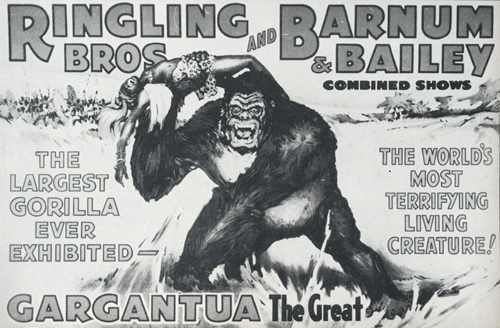
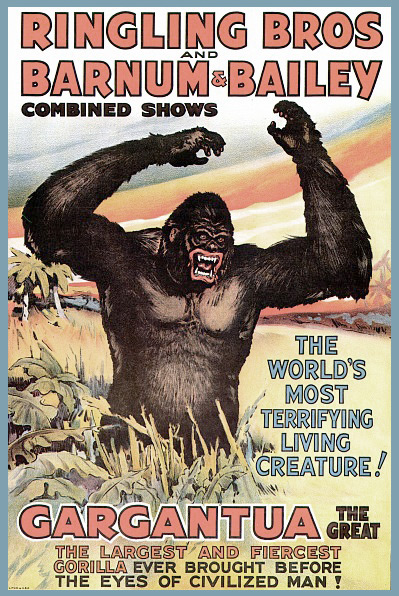
The circus built Gargantua his own special air-conditioned cage on wheels and toured him successfully for years.
From Time magazine, 1938-
Ringling Bros.-Barnum & Bailey Circus’ gorilla Gargantua the Great, wrote Gargantuan Columnist Heywood Broun three weeks ago, “is the fiercest looking thing I have ever seen on two legs. And probably his power and truculence were all the more impressive because he did look a good deal like a distant relative. No one was allowed to go close to his cage, because Gargantua can reach about five feet through the bars and get a toe hold on a visitor whom he dislikes.” Gargantua may not be the world’s biggest captive gorilla—since the death of Berlin Zoo’s monster, many zoos have claimed that honor for their gorillas—but he is one of the most vindictive.

June of 1938 saw one of the few comical aspects of the gargantua story when former heavyweight boxing champion Gene Tunny revived the age old Ape vs. Man argument with an article in the Connecticut Nutmeg in which he wrote the following:
It is my firm conviction that any fairly good heavyweight boxer could put the great Gargantua to sleep or to rout within two minutes. You must remember that a boxer stepping into the ring to defend or seek a championship is, muscularly speaking, quite a different person than is the spectator who watches him. Years of specialized calisthenics have put a tough layer of hard muscle over the boxer’s stomach and solar plexus. Punches that would knock the ordinary man out instantly or injure him internally, bounce off the hardened body of a well conditioned boxer without making him gasp. That protective layer of muscle absorbs punches just as shock absorbers on your car assimilate the bumps… Gargantua is a big boy but a Dempsey left hook landing on his stomach might figuratively tear the poor animal in two and leave him paralyzed on the canvas or jungle.
In 1941 as a publicity stunt a “marriage ceremony” took place as Gargantua took a female gorilla named Mitoto as his wife. Called “Toto” for short. (Toto had also been property of an affluent woman who during tea with the gorilla had her both her wrists snapped.) Mitoto, Swahili for “Little One,” became known as simply “Mrs. Gargantua.” Ringling had hoped to mate the gorillas. Their first meeting was romanticized in a time Magazine article in March of 41-
M’Toto (a she-gorilla) met Gargantua (a he-gorilla) last week. Their cautious introduction took place out behind the machine shop at the Ringling Brothers and Barnum & Bailey’s winter quarters in Sarasota, Fla. The two giant gorillas whom John Ringling North hopes to mate were wheeled up face to face in their separate cages. Attendants and newsmen watched. Scarfaced, 550-lb. Gargantua turned a curious look upon the first gorilla he had seen since he left Africa. Apparently he liked what he saw. He threw her a bouquet of celery tops. Uppishly, 438-lb. M’Toto tossed it back. He tried a head of lettuce. M’Toto shuffled coyly across her cage and played with her black & white kitten Principe. Gargantua sulked. To Circusman North so far was so good. Said he: “Gargantua is infatuated. Naturally M’Toto was modest and bashful.” When he is reasonably sure that they will not tear each other apart, he will let the couple share the same cage.

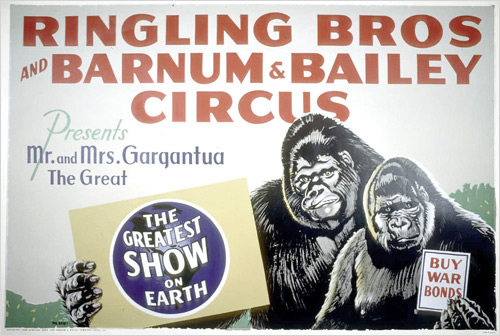
In point of fact all that really happened was Gargantua threw some rotten vegetables at his intended mate. Though they toured together for many years they never mated or had offspring.

When in 1949 it became obvious that he was not well, no one dared approach him to find out what the trouble was. He died that November of double pneumonia. Gorillas in captivity often live for 40 years or more, Gargantua, however, was only 20. Newspapers announced his passing with prominent headlines and in 1950 Gargantua’s skeleton was donated to the Peabody Museum where it is still on display.

Buddy’s actual skull.
A sad story if you ask me, one which was later desecrated further in the 1997 flick Buddy. Poor ol’ Buddy.
hide full text