Looking back on the visual legacy of the American Eugenics movement is quite fascinating. Aside from the historical photographs (always of interest) you are faced with a seemingly endless array of statistical data, a prospect which you’d intuit to be a rather dry affair. In looking, however, you find yourself alternately offended, amused, repulsed, empathic, and generally engaged. When was the last time a powerpoint pie chart made you uncomfortable or the bar graph in the margins of a trade magazine pissed you off?
The lingering power in much of the Eugenics material can be attributed to the fact it was aimed at a “general” audience. A large swath of it was created in an effort to sway the general populace toward its position. In as much there is often a strange marriage of dispassionate math with the visual language of tabloid journalism. The result being a surprising kind of statistical provocation that feels more akin to propaganda than science.
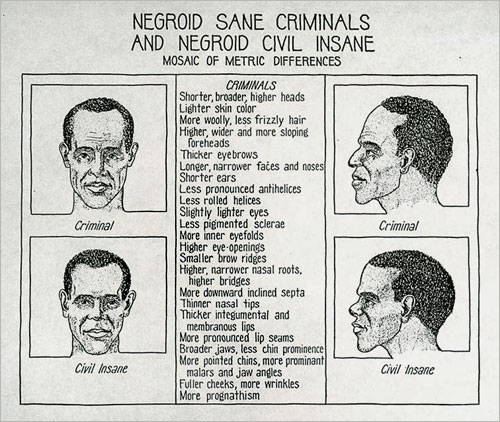
The diagrams and brochures and flash cards, meanwhile, which were not necessarily designed for public consumption, having been drawn up in a time well before our current notions of political correctness, seem to jump off the page in their bluntness, challenging our accepted decorum. In other cases the notions of heredity being explored, in this age prior to advances in genetic research, often juxtapose traits and classifications which illicit involuntary guffaws.
In few cases are the materials simply bland.
At bottom I’d say this is because the materials are always focussed on the one subject we, none of us, can ignore, which we all have opinions and ideas about- ourselves. Our favorite subject, and by extension our second favorite subject as well, how others are different from ourselves.
In any case having come across the mother load of visual material that is The Eugenics Archive I thought I’d draw your attention to just a few representative items in their collection for your offense, amusement, repulsion and engagement-
Text: Close scrutiny of these blended photographs (truthful and authentic beyond all denial) must convince every intelligent person that they represent one and the same man.
Hmmm… could this be suggesting some sort of implication in Mendel’s cross of light and dark colored pea pods beyond the vegetable world?
Some of the classifications in this “instructions” chart, which is representative of the whole pedigree charting practice, are as follows: Very musical. Athletic. Inventor of note. Epileptic. Sculptor of merit. Remarkable memory. Neurotic. Sex offender. Natural leader of men. Wanderer. Feebleminded. Alcoholic. Keen sense of humor. Natural ventriloqual power. Criminalistic. Insane.
At this point, so many years later, these items fascinate not particularly because of the data they convey but because of their method of conveyance- surely a failing from a statistical standpoint, but not from an ideological one. Which it could be argued was really the whole aim of the enterprise anyway. They sure push all the age old buttons don’t they? The same ones which our politicians and ideologues, not coincidentally, are still pushing.
Taken on the whole, with the parade of references to insanity, albinism, neurosis, sex crimes, feeblemindedness, gigantism, larceny, “pauperism,” schizophrenia, “idiocy,” achondroplasia, promiscuity, murder, epilepsy, hypertrichosis, and “natural ventriloqual power,” immersion for any period of time in these materials makes you feel as though you were wandering through an Hieronymus Bosch painting. ‘Course, I always thought Bosch had an almost preternatural talent for capturing the reality of humanity in his fantasy, so perhaps that’s as it should be.
Hope you… enjoyed?
hide full text