Quote, “Have you ever considered the possibility that God might be a crazy woman? Or that John Dillinger died for you? Do you think there might be a secret technique by which the Enlightened can literally get Something for Nothing? Could the Martians have the true religion while Earthians are lost in superstitious darkness? Can a cup of coffee be a sacrament, and if not, why not? Does the mathematics of six-dimensional space-time and philosophy of Multi-Ego Pantheistic Solipsism explain the universe?” Intro to the 1986 piece Religion For the Hell of It by the revered Robert Anton Wilson.
About
(i)
Contact (i)
Search (i)
Annex (i)
Special Projects (i)
Downloads (i)
Shop (i)
Archives (i)
Links (i)
Feeds: rss2 | atom (i)
Contact (i)
Search (i)
Annex (i)
Special Projects (i)
Downloads (i)
Shop (i)
Archives (i)
Links (i)
Feeds: rss2 | atom (i)

Quote, “In the beginning was the Word. There was a little pond and in the pond was a little letter “O”, a word. Soon the pond was full of trillions of O’s, happily mouthing their meaning. And the word was fruitful and multiplied. Then something happened. An “O” changed to an “I”. Another changed to an “A”. (Others changed to “x” and “p”, but these were not fruitful and were, sadly, deselected.) Soon, the pond was swimming with O’s and A’s and I’s. The I’s, in particular, thought they were something special, but the O’s were happy just to be noticed…” Zachriel’s Sea of Beneficence, part of the larger Word Mutagenation.
12.02. filed under: bits&bytes. ideas.
∅ 
Night of the Ground Stars
Or: urban shoe-gazing finds a purpose
Electric light, Concrete, and Chewing Gum, what have they in common? Though, admittedly, both concrete and chewing gum can ultimately trace their roots to antiquity, all three of these items, in something akin to their modern form, entered the American stage in the 1870’s.
Edison invented the first commercially successful incandescent lamp around 1879. At the Centennial Exhibition in Philadelphia in 1876 David O. Saylor exhibited the first American made portland cement, though it was not until 1891 that the first concrete street in the United States was paved. Thomas Adams opened the first chewing gum factory in 1870, and a year later Adams’ chicle based New York Gum went on sale in drug stores for a penny apiece. By the beginning of the 20th century all three of these items had become popular and were on their way to being staples of American life.
This, however, is not a history lesson, and the particulars of each of these items does not interest me as such. What I’m interested in here is rather a result of their intersection, a confluence of forces, which though set in motion way back in the 1870’s, is as near to we moderns as the ground beneath our feet or the sky above our cities. I’m speaking, of course, about Ground Stars.
Let me explain.
The proliferation of electric light, typified by our big cities, has created a phenomena called Skyglow. Essentially Skyglow is simply Rayleigh scattering of artificial light, which is to say its the same atmospheric effect which makes the natural light of the daytime sky seem blue, only in this case diffusing and redirecting the light of our cities back down at us. The ultimate effect for we urban earthlings is, lamentably, a starless (though not bible-black) sky.
In the relative-dead of a New York City night, looking up (and in this city to see a patch of sky you need to look damn near straight up) is an effort with precious little reward. You can count yourself lucky to see the lights of a passing plane, or the underbelly of a helicopter, because even the brightest stars are washed out and absent. Forget about connecting the dots in your minds eye and seeing a giant scorpion, or bull, or lion. There are no dots.
As I’ve said here before this strikes me as a real shame. Especially in a city such as New York where where all manner of dreamer, goofball, curbside philosopher, and artistic-minded lout have chosen to congregate. We are effectively as divorced from our universe as we are from the suburbs and geographical armpits most of us fled from. We are people who could use the sense of natural scale a few trillion super-massive nuclear reactions in the sky would provide. We need something bigger, more crowded, and more charged with energetic possibility than ourselves.
Which brings me to Concrete and Chewing Gum.
While electric light was proliferating and radiating outward to blot our stars concrete and chewing gum were quietly spreading throughout the city as well, exhibiting their own unexpected side effect. It seems concrete and chewing gum have a natural attraction to one another. They stick together and stay together. Whether it is love or just a physical thing I can not say but their century old union offers us a solution, of sorts, to our star poverty.
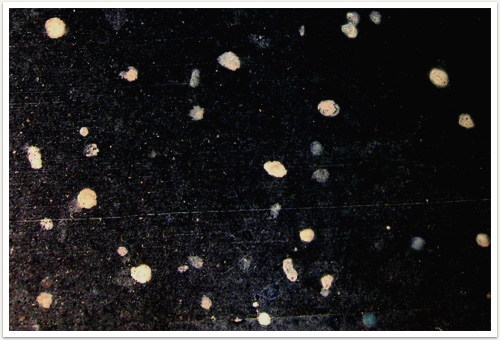
When a piece of spit-out gum takes the gravity-assisted leap to the ground it gets rolled over, and stepped on, and compacted, and stepped on, and compacted, and stepped on, and compacted. We sometimes curse at getting its sticky guts on our shoes, but more often than not we don’t even notice. Over time what was once a chicle-based, flavor infused, treat becomes nothing so much as a single dark point in the firmament of sidewalk. Now multiply this by millions, perhaps billions, and I think you’ll see where I’m going.
A century of this process has provided us with something huge and ambiguous we can call our own; if not a moody sparkling light by which to worship our lovers and unsheathe our knives, an endlessly shifting menagerie of single points all the same, between which we might string the iconography of our hopes and fears.
Think of it! Anti-Stars: small points of light-absorbing darkness dotting a reflective silica-mixed concrete field. Billions of DNA enriched points, all of indeterminate, time-lost origin, waiting only for the connecting lines which would infuse them with meaning; waiting always at perigee to feel the press of human imagination upon them rather than simply that of our boot heels. Look below your feet at any time while walking the 301 square miles of the city and it’s likely you trod upon a constellation, just waiting to be recognized and named.
In short what electric light hath denied concrete and chewing gum hath supplied. Ground Stars, Urban Constellations, a galaxy worth for our interpretation, in which we can do what we love best- see ourselves reflected.
“Sounds all very well in theory” I can hear you mustache-twirlers harumphing, “but does it work in practice? What might such replacement constellations look like?”
I’m glad you asked. I have taken it upon myself to explore this embryonic field of research a bit. Trips into the field have yielded some promising observations which I’m all too happy to share with you.
Below you will find a small cataloging of my findings thus far. I will name, describe, and illustrate the 10 Urban Constellations I’ve identified, and will even offer some slight illumination on each in the form of related quotations. What being born above these signs, or what their position in relation to your own may portend for you, your character, or your future, I will leave to the “geologers,” “odologers,” “topologers,” “despuologers,” or “humusologers” who will surely follow.
Behold!
Status Somnus (The Standing Sleep)
You see them, standing in the road, nodding, body never quite toppling, never quite standing straight. It’s like slapstick and tragedy mixed. You wonder, “Where can he/she be right now that’s so compelling it overrides the innate need to stave off death? Are they on a planet without cars? Are they floating weightless through space? Are they balancing on a pile of white spaghetti? What are they seeing?” You wonder, but are not curious enough to prick the skin and stand asleep in the road yourself.


I fellowed sleep who kissed me in the brain,
Let fall the tear of time; the sleeper’s eye,
Shifting to light, turned on me like a moon.
So, planing-heeled, I flew along my man
And dropped on dreaming and the upward sky.
I fled the earth and, naked, climbed the weather,
Reaching a second ground far from the stars;
And there we wept, I and a ghostly other,
My mothers-eyed, upon the tops of trees;
I fled that ground as lightly as a feather.
‘My fathers’ globe knocks on its nave and sings.’
‘This that we tread was, too, your fathers’ land.’
‘But we tread bears the angelic gangs,
Sweet are their fathered faces in their wings.’
‘These are but dreaming men. Breathe, and they fade.’
-Dylan Thomas
OR
“To achieve the impossible dream, try going to sleep.”
-Joan Klempner
Mercator Pudor (The Shame Trader)
You spot them from a block away, if you’re lucky. The fresh-faced guilt-trippers. Their questions like a slap. “Do you care about the environment?” “Do you have a second for gay rights?” “You don’t support animal cruelty do you?” “The children’s ribs are showing!” You look at them and despise them for trading in guilt. They ask every loaded question but the honest one you hear in your head instantly.


“They who have considered our nature, affirm that shame and disgrace are two of the most insupportable evils of human life: the courage and spirits of many have master’d other misfortunes and borne themselves up against them; but the wisest and best of souls have not been a match for these.”
-Laurence Sterne
Sepulcretum Umbellae (The Umbrella Graveyard)
The wind howls, the sun is gone, the rain hammers your brow. You turn a corner and see it. Mangled, torn, broken, abandoned. It’s a graveyard and you know it, even with your head down and your eyes half-blinded in the storm. You shiver to spite yourself.


And oh they bring to mind the grave,
so humble, so willing to be beat upon
with its awful lettering and
the body lying underneath
without an umbrella.
-Anne Sexton
Dissaepio Indocilis (The Rude Barrier)
The sidewalk so wonderfully wide. Room enough for street gangs to dance their grudges away. And yet here he/she comes. Straddling one edge, dog straddling the other. Between is a leash, strung taut across the entire walking width. You look at the leash and you yearn to tear it apart with your hands and stuff in his or her mouth, yelling, “Choke! Choke you self-involved misborn ass!” They must know you hate them, but they come ever closer. “So it’s a game of chicken is it?”


“It often happens that the real tragedies of life occur in such an inartistic manner that they hurt us by their crude violence, their absolute incoherence, their absurd want of meaning, their entire lack of style.”
-Oscar Wilde
Porthmeus Odiosus (The Hateful Ferryman)
You see it’s yellow flank flashing in the traffic. The light is on. You are about to be scooped up! You imagine the seats cradling your tired ass. You raise your hand, perhaps whistle through your teeth, or call out, “Taxi!” But the ferryman rejects you and rolls right by. “Why?” you wonder. “WHY!?” You swear, you doubt, you raise your fists to a deaf God, “Bastard!” Then shuffle on.


Hang out our banners on the outward walls;
The cry is still, “They come!” our castle’s strength
Will laugh a siege to scorn.
-Shakespeare
OR
“After rejection— misery, then thoughts of revenge, and finally, oh well, another try elsewhere.”
-Mason Cooley
Belua Cloaca (The Sewer Monster)
And what is under there anyway? Is it a filth-encrusted albino playground? Is it a dark orgy of disease and blindness held over the sewage-soaked bones of our forefathers? Are the stories true? Is it all alligators, and giant rats, and mole men? Walk a little faster and avoiding the wobbly grates.


“Society is held together by our need; we bind it together with legend, myth, coercion, fearing that without it we will be hurled into that void, within which, like the earth before the Word was spoken, the foundations of society are hidden.
-James Arthur Baldwin
Mendicus Beneficiarius (The Privileged Beggar)
Young and sound of body. You look at them and their sign, scrawled with pleas for beer-money or bus fare. You look at their clothes, their accessories, their hair. You make a snap judgement and far off, on some tax sheltered-island, their trust funds accrue interest.


“The privilege of absurdity; to which no living creature is subject, but man only.”
-Thomas Hobbes
OR
“At any street corner the feeling of absurdity can strike any man in the face.”
-Albert Camus
OR
“When you are not physically starving, you have the luxury to realize psychic and emotional starvation.”
-Cherrie Moraga
Aquatoris Indifferentis (The Indifferent Water-Carrier)
It’s 8 AM. Foot-traffic rush-hour on a weekday morning. No one smiles because making it to your destination is painful enough. Another day of wage slavery is beginning and no one’s exactly thrilled. Everyone knows this. You know it, the old lady you just elbowed knows it, and so does the guy with the fucking hose. He sees you coming. He does not care. The water flows like your own shin-level Potomac.


“And, therefore, indifference is always the friend of the enemy, for it benefits the aggressor - never its victim, whose pain is magnified when he or she feels forgotten.”
-Elie Wiesel
OR
“Nature is not cruel and pitiless but indifferent. This is one of the hardest lessons for humans to learn. We cannot admit that things might be neither good nor evil, neither cruel nor kind, but simply callous—indifferent to all suffering, lacking all purpose.”
-Richard Dawkins
Cumulus Arcanus (The Mysterious Pile)
It is waiting around damn near every corner. It is horrid and putrid smelling and the color is indescribable. Flesh colored crayons melted over spinach linguini and scabs. It is nebulous and gut wrenching and even the thought of it’s origin makes your skin crawl. It’s a pile and you must not look at it too closely!


“I don’t believe in evil, I believe only in horror. In nature there is no evil, only an abundance of horror: the plagues and the blights and the ants and the maggots.”
-Isak Dinesen
Hostis Dementis (The Demented Stranger)
He approaches. Perhaps you smell him before you see him. Perhaps his madness digs into your ear. It’s one of that most feared tribes, the demented ones. What will he do with his grill fork? What’s that poking out of the hole in his clothes? Is something moving in his bag? Nothing frightens the rational, time-obsessed, grid-walking, metropolitan mind like the demented ones staggering toward you.


“Who knows what true loneliness is— not the conventional word, but the naked terror? To the lonely themselves it wears a mask. The most miserable outcast hugs some memory or some illusion. Now and then a fatal conjunction of events may lift the veil for an instant. For an instant only. No human being could bear a steady view of moral solitude without going mad.”
-Joseph Conrad
OR
“The distance between insanity and genius is measured only by success.”
-Ian Fleming
There you have it my friends. I hope I’ve inspired you to connect the dots, or brought even a sliver of relief to your poor, addled, star-starved mind.
If you identify any urban constellations of your own feel free to pass them along. The adventure continues.
hide full text
Been reading the 1968 book Camp Concentration by Tomash M. Disch and have been enjoying it very much, more, in truth, than I expected to. It sat in my to-read pile for a long while before I actually got up the interest to crack it open. Perhaps it was the ‘72 cover illustration? The cracked spine? I don’t know. In any case, having never heard of Disch, I figured perhaps you had not either, and thought I’d share a few paragraphs to get you acquainted. The following is a snippet from a conversation between the protagonist, Louis Sacchetti (a poet, and conscientious objector to some conflict or other who has been sent, as an objective chronicler, to a military instillation where patients are injected with a modified strain of syphilis which makes them brilliant before eating away their brain and killing them) and Dr. Aimee Busk (an icey doctor at said military instillation.) Hope you enjoy.
——————————————————-
“It is all a question, finally, of the nature of genius. The best explanation of genius that I know, the one that incorporates most of the facts we have, is Koestler’s — that the act of genius is simply the bringing together of two hitherto distinct spheres of reference, or matrices — a talent for juxtapositions. Archimedes’ bath is a small instance. Till him no one had associated measurements of mass with the commonplace observation of water displacement. The question is, for a modern investigator, what actually takes place in the brain at the moment that an Archimedes says, ‘Eureka!’ It seems clear, now, that it is a sort of breakdown — literally, the mind disintegrates, and the old, distinct categories are for a little while fluid and capable of re-formation.”
“But it’s just that,” I objected, “the re-formation of the disrupted categories, in which the act of genius consists. It’s not the breakdown that counts, but the new juxtapositions that follow. Madmen can break down just as spectacularly as geniuses.”
Dr. Busk smiled, enigmatic in her veil of cigarette smoke. “Perhaps that thin line that is said to separate genius from madness is only fortuitous. Perhaps the madman simply has the bad luck of being wrong. But your point is taken, and I can reply to it. You would suggest, I take it, that genius is only one per cent inspiration, that the process of preparing for the moment when the ‘Eureka!’ comes is what is crucial in the formation of genius. In short, his education, by which he becomes acquainted with reality.
“But doesn’t that just beg the question? Education, memory itself, is but the recapitulation of all the moments of genius in that culture. Education is always breaking down old categories and recombining them in better ways. And who has a better memory, strictly speaking, than the catatonic who resurrects some part of the past in all its completeness, annihilating the present moment utterly? I might go so far as to say that thought itself is a disease of the brain, a degenerative condition of matter.
“Why, if genius were a continuous process, instead of what it is — a fluke — it would be of no value to us whatsoever! Geniuses in a field like mathematics are usually played out by thirty, at the very latest. The mind defends itself against the disintegrative process of creativity. It begins to jell, notions solidify into inalterable systems, which simply refuse to be broken down and re-formed. Consider Owens, the great anatomist of the Victorian age, who simply wouldn’t understand Darwin. It’s self-preservation, pure and simple.
“And then think of what happens if genius doesn’t reign itself in but insists on plunging on ahead into the chaos of freest association. I’m thinking of that hero of you literateurs, James Joyce. I know any number of psychiatrists who could, in good conscience, have accepted Finnegan Wakes [sic] as the very imprimatur of madness and had its author hospitalized on its evidence alone. A genius? Oh yes. But all we common people have the common sense to realize that genius, like the clap, is a social disease, and we take action accordingly. We put all our geniuses in one kind or another of isolation ward, to escape being infected.”
-Thomas M. Disch, Camp Concentration, pg.62-64. 1968.
——————————————————-
In related linkage How Stuff Works takes on (in less verbose and dramatic form) the subject of how genius works.
hide full text
Mark Rothko on The Artist’s Dilemma
I’ve been making my way through the collection of Mark Rothko’s Writings titled, The Artist’s Reality, Philosophies of Art in fits and starts for a while now and have wanted to post some snippet of the text in order to share what I regard as some very beautiful and cogent writing. Problem is this isn’t sound-byte type material. I’ve decided therefore to simply take the plunge and transcribe the first piece in the book, titled, The Artist’s Dilemma, in full. (Hopefully Mark’s son, and editor of the book, Christopher, will look upon this as the loving tribute [and incentive for those unfamiliar with the volume to pick it up] which it is, and not merely a copywrite infringement, which… it also unquestionably is.) Though the public persona of “the artist” has certainly changed since Rothko’s heyday as a member of the artistic intelligencia - particularly in the wake of Warhol’s savvy marketing blitz - this piece is, I believe, still relevant in many ways and beyond that it is a beautifuly written and precious artifact from what many of us would surely consider “better days” in the history of painting. See below.
The Artist’s Dilemma
By Mark Rothko (probably written between 1940-41)
What is the popular conception of the artist? Gather a thousand descriptions, and the resulting composite is the portrait of a moron: he is held to be childish, irresponsible, and ignorant or stupid in everyday affairs.
The picture does not necessarily involve censure or unkindness. These deficiencies are attributed to the intensity of the artist’s preoccupation with his particular kind of fantasy and to the unworldly nature of the fantastic itself. The bantering tolerance granted to the absentminded professor is extended to the artist. Biographers contrast the artlessness of his judgments with the high attainment of his art, and while his naivete or rascality are gossiped about, they are viewed as signs of Simplicity and Inspiration, which are the Handmaidens of Art. And if the artist is inarticulate and lacking in the usual repositories of fact and information, how fortunate, it is said, that nature has contrived to divert from him all worldly distractions so he may be single-minded in regards to his special office.
This myth, like all myths, has many reasonable foundations. First, it attests to the common belief in the laws of compensation: that one sense will gain in sensitivity by the deficiency in another. Homer was blind, and Beethoven deaf. Too bad for them, but fortunate for us in the increased vividness of their art. But more importantly it attests to the persistent belief in the irrational quality of inspiration, finding between the innocence of childhood and the derangements of madness that true insight which is not accorded to normal man. When thinking of the artist, the world still adheres to Plato’s view, expressed in Ion in reference to the poet: “There is no invention in him until he has been inspired and is out of his senses, and the mind is no longer in him.” Although science, with scales and yardstick, daily threatens to rend mystery from the imagination, the persistence of this myth is the inadvertent homage which man pays to the penetration of his inner being as it is differentiated from his reasonable experience.
Strange, but the artist has never made a fuss about being denied those estimable virtues other men would not do without: intellectuality, good judgment, a knowledge of the world, and rational conduct. It may be charged that he has even fostered the myth. In his intimate journals Vollard tells us that Degas feigned deafness to escape disputations and harangues concerning things he considered false and distasteful. If the speaker or subject changed, his hearing immediately improved. We must marvel at his wisdom since he must have only surmised what we know definitely today: that the constant repetition of falsehood is more convincing than the demonstration of truth. It is understandable, then, how the artist might actually cultivate this moronic appearance, this deafness, this inarticulateness, in an effort to evade the million irrelevancies which daily accumulate concerning his work. For, while the authority of the doctor or plumber is never questioned, everyone deems himself a good judge and an adequate arbiter of what a work of art should be and how it should be done.
Let us not delude ourselves with visions of a golden age freed of this cacophony. This gilding is an artistic falsehood. We deal in fantasy ourselves and know how alive dreams can seem. And an age like ours, which demands so clear a facing of realities, will not allow us the pleasure of narcoticism. With the knowledge that man’s tribulations, at least, are always with him, we can safely say that the artist of the past had good reason, too, to play the mad fool—so as to salvage those moments of peace when the demands of the demons could be quieted and art pursued. And if nature, in fact, contrived to give him the appearance of a fool, so much the better. For dissimulation is an exacting art.
Ill hath he chosen his part who seeks to please
The worthless world,—ill hath he chosen his part,
For often must he wear the look of ease
When grief is at his heart;
And often in his hours of happier feeling
With sorrow must his countenance be hung,
And ever his own better thoughts concealing
Must he in stupid Grandeur’s praise be loud,
And to the errors of the ignorant crowd
Assent with lying tongue.
The lament is Michelangelo’s (a translation of this madrigal can be found in The Life of Michel Angela Buonarroti [1807]). Even this great man—who lived in an age when the rapport between the artist and the world seemed to have been ideal, and when fetes and processions celebrated the completion of works by the artists of renown, for whose services dukes, popes, and kings fought — even he bore his full share of calumny and disapproval. The principles of his art were constantly assailed; and, after parrying those criticisms, his morals were found wanting. Aretino attacked the nakedness of the nudes in the Last judgement as inconsistent with Christian piety. The reasonableness of Aretino’s point cannot be denied. Michelangelo’s vision of the Celestial Court can be easily mistaken for an orgiastic bout. These doctors and moralists, they are always right! Like our own social moralists and critics, their facts are so neat, and their reasoning so pretty: but what disastrous falsity to the cause of truth!
Most societies of the past have insisted that their own particular evaluations of truth and morality be depicted by the artist. Accordingly, the Egyptian artist had to produce a definitely prescribed prototype; the Christian artist had to abide by the tenets of the Second Council of Nicea or be anathematized or, like the monk of the iconoclast age, work in danger and by stealth. We should note that Michelangelo’s nudes were forced to wear, in the end, the appropriate panties and drapes. Authority formulated rules, and the artist complied. We shall not speak here of those whose daring periodically revitalized art, saving it from its narcissistic mimicry of itself. We can accurately say that, within these periods, the artist had to submit to these rules or simulate the appearance of submission, if he were to be permitted to practice his art.
It will be pointed out that the artist’s lot is the same today, that the market, through its denial or affording of the means of sustenance, exerts the same compulsion. Yet there is this vital difference: the civilizations enumerated above had the temporal and spiritual power to summarily enforce their demands. The Fires of Hell, exile, and, in the background, the rack and stake, were correctives if persuasion failed. Today the compulsion is Hunger, and the experience of the last four hundred years has shown us that hunger is not nearly as compelling as the imminence of Hell and Death. Since the passing of the spiritual and temporal patron, the history of art is the history of men who, for the most part, have preferred hunger to compliance, and who have considered the choice worthwhile. And choice it is, for all the tragic disparity between the two alternatives.
The freedom to starve! Ironical indeed. Yet hold your laughter. Do not underestimate the privilege. It is seldom possessed, and dearly won. The denial of this right is no less ironical: think of the condemned criminal who will not eat and who is fed by force, if need be, until his day of execution. Concerning hunger, as concerning art, society has traditionally been dogmatic. One had to starve legitimately—through famine or blight, through unemployment or exploitation—or not at all. One could no more contrive his own starvation than he could take his own life; and for the artist to have said to society that he would sooner starve than traffic with her wares or tastes would have been heresy and dealt with summarily as such. Within the dogmas of the totalitarian states of today, you may be sure, the artist must starve correctly, just as he must paint by the dictates of the State.
But here, today, we still have the right to choose. It is precisely the possibility of exercising choice wherein our lot differs from that of the artists of the past. For choice implies responsibility to one’s conscience, and, in the conscience of the artist, the Truth of Art is foremost. There may be other loyalties, but for the artist, unless he has been waylaid or distracted, they will be secondary and discarded in his creation of art. This artistic conscience, which is composed of present reason and memory, this morality intrinsic to the generic logic of art itself, is inescapable. Violate her promptings and she will ferret out the deepest recesses of thought and conjecture. Neither sophistries nor rationalizations can quiet her demands.
What did those artists of the past do about their conscience? The Law of Authority has this saving grace: it can be circumnavigated. One can pay lip service to the letter and with equanimity violate its spirit. One bows to necessity, then schemes to defeat it. We are told that there were times when the Truth of the Law coincided with the Truth of Art. Granted! But when the divergence became too great, what ingenuity the artist displayed in disguising one to have the appearance of the other. What guile and shrewdness in this seeming moron. One needs but but recall the great Apollo. How easily this Hellenistic deity, with all his draperies and trappings, was slipped into the niches of the Christian saints. He had merely to change his name, and to look much sadder than he really felt.
What abetted the artist in his little game was the dogmatic unity of his civilization. For all dogmatic societies have this in common: they know what they want. Whatever the contentions behind the scenes, society is allowed only one Official Truth. The demands made upon the artist, therefore, issued from a single source, and the specifications for art were definite and unmistakable. That, at least, was something: whether submission or deceit were intended, one master is better than ten, and it is better to know the size and shape of the hand that holds the whip. In a master, definiteness and stability are preferable to caprice.
Today, instead of one voice, we have dozens issuing demands. There is no longer one truth, no single authority—instead there is a score of would-be masters who would usurp their place. All are full of histories, statistics, proofs, demonstrations, facts, and quotations. First they plead and exhort, and finally they resort to intimidation by threats and moral imprecations. Each pulls the artist this way and that, telling him what he must do if he is to fill his belly and save his soul.
For the artist, now, there can be neither compliance nor circumvention. It is the misfortune of free conscience that it cannot be neglectful of means in the pursuit of ends. Ironically enough, compliance would not help, for even if the artist should decide to subvert this conscience, where could he find peace in this Babel? To please one is to antagonize the others. And what security is there in any of these wrangling contenders?
The truths of India, Egypt, Greece spanned over centuries. In matters of art our society has substituted taste for truth, which she finds more amusing and less of a responsibility, and changes her tastes as frequently as she changes her hats and shoes. And here might the artist, placed between choice and diversity, raise his lamentations louder. Never did his afflictors have as many shapes or such a jabbering of voices, and never did they exude such a prolixity of matter.
-
Hope you enjoyed.
hide full text