• Graffiti + Sarajevo + Krylon + Michelangelo = Sistine Chapel in Iowa. Via.
• “A new idea for the exploration of Mars may be less of a scientific leap forward than a hop.” hardy-har-har. Next to Mars: Jumping, Baseball-Size Robots?
• In 1900, Eva Downing Corey undertook a “Grand Tour” to the Holy Land, and the Continent. She kept a journal. (And evidently a glue-stick or two.) Beautiful. Via.
• Just in time to deflect Global Warming questions directed at them “to understand and protect our home planet” is dropped from the NASA mission statement.
• Headline reads: Vampire sea spiders suck on prey. The horror! Someone alert Tony Bourdain, he’ll be wanting to nibble on this thing.
• Cassini’s radar eye has begun to reveal the true geological features of Xanadu. Faults, deeply cut channels, valleys, porous water ice… a rainy land where rivers flow down to a sunless sea. Nasa offers this nifty vid. The feathered hair once thought to float in the atmosphere has yet to be spotted however.
• On the saddest lowliest coin of all: Give a Penny, Take a Penny .
• Fifteen years from now, amid the rubble of a war-torn city in a distant land, a strange creature lurks in the dark (cue the ominous music)... the soldier of the future. These stories keep coming. “Soldier of the future!!!” Yet we can’t even perfect decent body armor. I’d like to think the future would not require such perfect killing machines anyhow. Ah well.
What’s so funny anyway?
I find myself less amused by the opening segments of Comedy Central’s weeknight double-punch of fake news lately. I can’t help but wonder whether programs like The Daily Show and The Colbert Report, which have us laughing at the ineptitude, corruption, war mongering, and profiteering of our Government, are in some way diffusing what ought to be a steadily building anger; an anger which by all rights ought to be seeking a vent right about now.
The post-modern ability the culture at large has adopted which has us giggling over abuses of power, sniggering at lies, whooping at war, and chortling at all the terrifying evidence of a country coming apart at the seems strikes me as irresponsible somehow. It’s not that the shows ought not to be pointing out the absurdities, or that we ought not to be grabbing some laughter wherever we can find it, but when the “actual” press has stopped doing its job and the only dissenting voices with heavy airtime are those of comedy shows… well, it’s scary.
While we all sit around laughing things off, a list of offenses, which in ages past might have provoked a revolution among the populous, scrolls away to the horizon, unchecked. Where is the real outrage? Why aren’t we up in arms? Why is this government still in power? What is wrong with us?
If you think this is a maudlin observation, maybe you’re right, but if so today’s state of affairs still seems to beg the question: when did public opinion become so impotent as to be very nearly meaningless? Who among us want to be where we are or headed where we are headed? Who thinks endless conflict and death and debt and corruption are acceptable? Who’s happy?
Sure the world is complex, there are no easy answers, but somehow, after 5 years, laughing at those in power no longer feels like the appropriate reaction. Unless there are pitchforks involved.
Course, I’ve never, ever, attended a protest, let alone been on the inside of an angry mob, so what the hell do I know? Anyone have an opinion?
hide full text


• In Japan unimaginably large spaces underneath ground-level lives exist. Even beyond the high walls of nuclear power stations, incineration plants, or energy research organizations, futuristic cities that we thought only to exist in science fiction movies unfold. All this is captured by photographer Joe Nishizawa.
• Scientists believe they have found a way to probe the mysterious phenomenon of feeling you have witnessed something before: Deja vu recreated in laboratory.
• Why is the sky blue? It is a question children ask. Yet it also intrigued Leonardo da Vinci and Isaac Newton, among many other legendary thinkers. As late as 1862, the great astronomer John Herschel called the colour and polarization of skylight “great standing enigmas.” Even today, our perception of sky blue is little understood by laymen.
• Umberto Eco speaks. Outlandish theories: Kings of the (hollow) world.
• Photographic construction of alternative selves: Photography and Solipsism Via.
• In a few years, it will be hard for us to believe that we lived amongst people like these. Photographs of India’s poor, many of whom had never even seen a camera before. Take care to look at the links below as well. Via.
• The largest tear in the Earth’s crust seen in decades, if not centuries, could carve out a new ocean in Africa, according to satellite data. Wow.
• Misconceptions about samurai in Japanese pop culture. Misconceptions about Medieval armor. And with those in mind- The Medieval European Knight vs. The Feudal Japanese Samurai?

The Old Musician by Edouard Manet, 1862.
Extrapolation: The Old Musician
The old musician sat amongst the beggars. Many passersby on the afternoon streets would certainly make no distinction, and call his playing for coin begging as well. For him this was respite though. Sunday among the despised. He would play among these people for a time and forget about coin. Much like the saying “you can’t bullshit a bullshitter” there isn’t much use in “begging a beggar.” Among them he could play whatever pleased him, the childhood favorites of his homeland, the dirges, the sad songs, things the people on the street wouldn’t pay a soda-cracker to hear.
On the streets the shortest path to coin was all. Here, among the beggars, he could be welcomed rather than tolerated, a violinist rather than a fiddler. The girls and the children would enjoy it, though the men would need more drink, drink they didn’t have, to slacken their scowls. Music alone wasn’t nearly enough to salve their problems. The man in the top-hat had only just recently found himself among their number. He clung to that hat the way a tick clung to a mongrel’s skin, as though a few inches of good quality felt were all that stood between him and final heartbreak. Today the old musician would play for him. He’d play a bit from “The Beggar’s Opera,” a piece he’d learned while in England all those years ago. Yes, today he’d play for the man in the top hat but he’d sing for himself-
Through all the Employments of Life
Each Neighbour abuses his Brother;
Whore and Rogue they call Husband and Wife:
All Professions be-rogue one another:
The Priest calls the Lawyer a Cheat,
The Lawyer be-knaves the Divine:
And the Statesman, because he’s so great,
Thinks his Trade as honest as mine.
Facts: The Old Musician
From a 1984 edition of the hardcover devoted to the collections of The National Gallery in Washington-
“The principal pleasure to be gained from Manet comes from the beauty of his brushwork. He mixed on his palette the exact tone he needed and with swift and certain dexterity delineated on the canvas each area of light and shadow. In The Old Musician this virtuosity of handling can be seen most clearly in the trenchant strokes that define the folds in the shirt and trousers of the boy with the straw hat, or in the more caressing feather touch on the shawl of the girl holding the baby.
Manet’s method of direct painting caused him to suppress the transitional tones of modeling which particularly suggest volume. Like Velazquez, who was also a master of brushwork, he chose an illumination which would flatten form as much as possible. Thus the light falls directly on the figures from behind the artist’s head, and the shadows are reduced to a minimum. Through this arbitrary elimination of shadow Manet was able to state local color more freely. He attained, especially in such early works as The Old Musician, the most subtle harmonies of yellowish white and faded blue, here contrasted with warm browns and blacks and soft grays. This color scheme was as far as possible from the high intensities and broken colors of the Impressionists, which he adopted at the end of his life.
For Manet, in spite of a strong instinct for the traditional, became a leader of the Impressionists’ revolt. The public attacked his pictures, as they attacked the other Impressionists, but less because of his method of painting than because of a certain outre quality in his subject matter. In The Old Musician, for instance, what is the meaning of the brooding octogenarian on the extreme right, who is bisected so unconventionally by the frame? Perhaps he was put there simply to balance the composition, for Theodore Duret, who knew Manet well, said he painted this troupe of beggars merely because it pleased him to preserve a record of them and for no other reason. And yet one senses a significance which just escapes, a hidden meaning which is baffling. In Manet’s pictures these recurrent and tantalizing affectations infuriated his contemporaries and were in part the reason he never attained the popular admiration which he so desperately desired.”
hide full text

Tom Sachs is exactly the kind of artist I’d expect to shrug my shoulders at, and perhaps mumble a “ho-hum” to anyone who brought him up. His work has in large part embraced the irony so common in contemporary art, much of it incorporating brand logos (the Chanel Guillotine or the Prada Deathcamp for example) and winking reproductions of the banal. the Sperone Westwater site says: “Tom Sachs takes his inspiration from the collective American imagination, borrowing his subjects from among the status symbols of mass culture: weapons, fast food, hip hop, surfing, and skateboarding, and he mixes them with the symbols of American wealth that sees in luxury, conformism, and designer labels a reinforcement of their elite social status.” Exactly the kind of thing which I’d expect to bore my pants off.
However
On seeing his two most recent pieces, a life sized blue whale and a reconstruction of the command area on the bridge of an aircraft carrier… well, I’ve gotta give it up to him. These pieces are fantastic, not least of all because they are made of his trademark “low” materials. The whale, Balaenoptera Musculus, for example, is made mainly from foam core and hot glue, a conservator’s nightmare and in as much a flagrant “fuck you” to his own legacy, and by extension, Art history.
You can see them, and the rest of his most recent show, here, for more check out his homepage or at the following: 1, 2, 3, 4, 5, 6.
hide full text
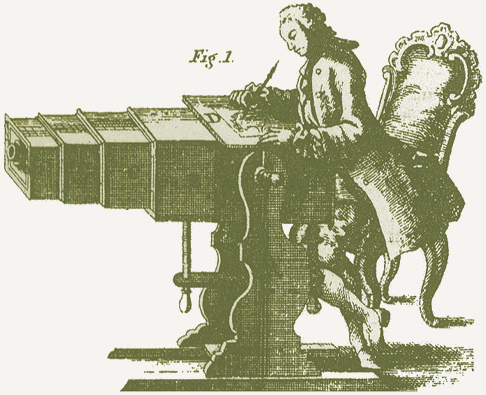
• Have a nagging feeling I’ve linked this before but what-the-hey, it’s a good one. The Magic Mirror of Life an appreciation of the camera obscura.
• The complete works of Wolfgang Amadeus Mozart analyzed based on the audio content with the result being a map with different regions showing distinct categories of Mozart’s music: Map of Mozart. Via.
• Interesting. Open-Ended Utopia: The art of Rirkrit Tiravanija.
• Sharing a bed with someone could temporarily reduce your brain power - at least if you are a man. I (or my girlfriend) could have told you that!
• Some Dark Thoughts on Happiness. More and more psychologists and researchers believe they know what makes people happy. But the question is, does a New Yorker want to be happy? Answer: Fuck you.
• The Urban Pantheist catalogues the myriad species in the city. Via.
• Some historic info on the real Deadwood South Dakota.
Mutagen
Updated
You’ve noticed the sound of your questioning voice resonate and echo longer as the depth of the empty space here has grown with each passing day. “Why is The Nonist so quiet?) quiet?)) quiet?)))” In answer I can offer a single word from the back of my lair which ought to go far in explaining my absence: Promotion.
A couple of weeks ago I was promoted at the office
and having to devote more of my mental energies toward work I’ve found I have less to devote to the site. This may be temporary, an adjustment period in which my stress and annoyance gradually return to acceptable levels. And then again it may not. In either case I’ve decided to take the advice of some friends and fellow bloggers and make a small change here at The Nonist.
From here on out, or for the foreseeable future at least, I will be changing to a regular publishing schedule. New content can be expected on Sundays and Thursdays. I hope that by pulling back from the possible 7 to the concrete 2 I’ll be able to stretch out a bit and craft even better content with less filler, and, I guess it goes without saying, less needless stress on yours truly.
Though this need not be anything other than a minor scheduling change I am choosing to consider it a mutagen and as such am feeling compelled to rethink and refocus.
Mutation
As obliquely hinted at in this post I am feeling artistic… stirrings. I find the act of blogging as it stands to be less and less interesting. I feel almost as if it amounts to little more than reportage. “Tonight’s big story- Guy in living room finds something which interests him on internet! A few explanatory paragraphs at 11.” As I hope you’ve noticed I do my best to crosscut all the links and bald reportage with completely off-topic writing and original content. But even this partial retreat from the flow of what’s “topical” does not seem quite enough. After all as more bloggers ensconce themselves in their specialized niches everything begins to fit comfortably into the fold. I always find myself wondering, “How can a blog go beyond what it is, however artistic, and cross-over into the a space where it is itself Art?” I have as of yet not been able to form a satisfactory reply, so I won’t even pretend at having an answer.
What I do know is this: I long ago made the first “mistake” of blogging, which is offering broad and eclectic content. Avoiding a focus and eschewing a niche is a sure fire way to relegate yourself to confused obscurity. You are continually in the act of disappointing people, of failing to meet their expectations, of changing where people seek the familiar. Having chosen right at the outset to do this, to let my online space mimic my own mental state, there is little reason why I shouldn’t at this point just commit total blog-suicide and descend into even more abstract, opaque, complex, and unmarketable forms of expression. In doing so I may alienate yet more of you who stop by simply to see what “neat” things I’ve dug-up and linked, but then that’s a price I am willing to pay. If I never see another referer-log entry for the posts on chindogu, the erotic coloring book, making love in 1975, or any other trifle I did little else but report on, well, all the better.
What changes are coming? I can’t say exactly, perhaps none. Perhaps this mode of simply curating is the natural order and I can not escape it within the confines of the blog form. But then again perhaps I will go months without a single outgoing link? Perhaps I’ll do nothing but write a serialized bit of fiction about an amnesiac autodidact? Perhaps I’ll post… well, as I’ve said, I really don’t know. But I am formally announcing my intent right now to do my best to cast-off the yoke I took up voluntarily and look for something new with the tiny slice of time I have.
Thus freed I feel both giddy and confused, the infusion of possibility enlivening, its uncontrolled flow a chaotic crush. How might I utilize the stretched time? What will I do with the thrice erased surface? I have no idea. My hope, however, is that what follows will satisfy deeper cravings in myself and, terrifically unlikely as it might be, some of yours as well.
So consider this a gentleman’s warning that what The Nonist is may henceforth change.
In Summation
From here on out I will (generally) be posting two days a week only, Sundays and Thursdays. In that my time has become if anything even more valuable to me, and I feel compelled to make a choice between spending that time doing that which satisfies me and that which merely distracts me, what I choose to post on those two days may very well veer away from what we have gotten used to here. Or perhaps not. I may be in the first stages of blog-suicide or blog-rebirth. We shall see. Hope in either case to see you all around.
And rather than being a whiny little douchebag about it I will do my best to continue posting as always. I only mention it so that if I go a few days here and there without updating you will know why without my having to post some longwinded self-involved explanation. Alright? Business as usual commencing now.
hide full text
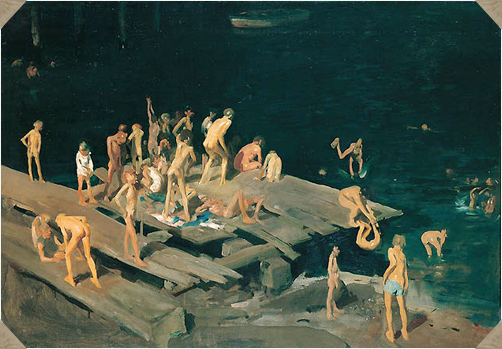
George Wesley Bellows, Forty-two Kids, 1907
For God was as large as a sunlamp and laughed his heat at us and therefore we did not cringe at the death hole. -Anne Sexton
Or
If you saw a heat wave, would you wave back? -Stephen Wright.

• Dig into the Instruments for Science (1800-1914) pages which reproduce for your geeky pleasure the scientific trade catalogs in the Smithsonian collections. Includes, but is by no means limited to: levers, pulleys, manometers, balances, air pumps, barometers, drawing instruments, electric machines, extensometers, telescopes, spectroscopes, photometers, tuning-forks, dissecting instruments, metallurgical equipment, galvanometers, turbines, electromagnets, theodolites, sextants, microscopes, globes, and glass prisms. Pictured above is Amslers Polar Planimeter. Enjoy… you big dork.
• The online world of linguistics is fast, funny, and bears no resemblance to hours spent in a classroom. Linguists and wordsmiths (including Grant Barret from Double Tongued Word Wrester) talk about new words, new blogs and new usage. NPR audio: How the Web Is Changing Language. Via.
• “A picture must be painted in such a way that the viewer can understand its meaning. If the people who see a picture cannot grasp its meaning, no matter what a talented artist may have painted it, they cannot say it is a good picture.” -Kim Jong-il. Art in North Korea.
• Card Culture. On the design impact of credit cards and “affinity” cards. Via.
• An interesting paper on: Life (Briefly) Near a Supernova (pdf). Via.
• Proverbial wisdom from around the world in the form of 12,000 proverbs from 300 different countries. Search by keyword or browse by country.
• The Olduvai Theory: Sliding Towards a Post-Industrial Stone Age, circa 1996, and The Olduvai Theory: Energy, Population, and Industrial Civilization (pdf) circa 2006. Can’t wait for post-industrial civilization.
Rembrandt the Quadracentenarian
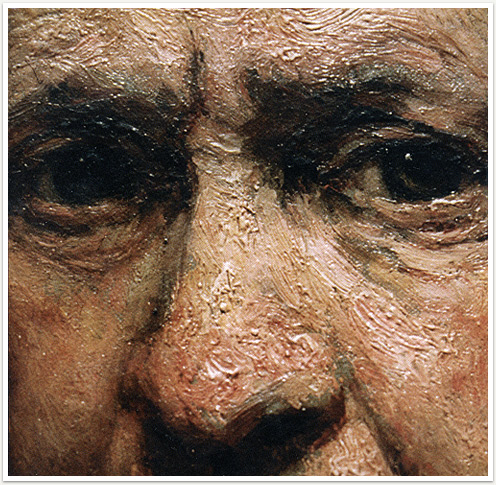
Today marks the 400th birthday of my homie Rembrandt Harmenszoon van Rijn. In celebration I offer a couple of paragraphs from a favorite book of mine, What Painting Is by James Elkins, which happens to touch on the physicality of Rembrandt’s canvas surfaces. See below.
From Chapter 4, How do substances occupy the mind?, in reference to the image which served as thumbnail to this post-
Rembrandt is well-known for the buttery dab of paint that he sometimes puts on the ends of the noses of his portraits, and this nose is certainly greasy and has its little spot of white. But touches like that do not stand alone: when Rembrandt was interested in what he was doing, as he was here, he coated entire faces in a glossy, shining mud-pack of viscid paint. The skin is damp with perspiration, as if he were painting himself in a hot room, and he slowly accumulated a slick sheen of sweat. It is impossible to ignore the strangeness of the paint. If I looked at my face in the mirror and saw this, I would be horrified. The texture is much rougher than skin, as if it is all scar tissue. As a painter works, the shanks of the brushes become repositories for dried paint, and flecks of that paint become dislodged and mix with fresh paint, rolling around on the canvas like sodden tumbleweeds. They are all over this face, forming little pimples or warts wherever they end up. (There is a large one halfway up the nose.) Among contemporary artists, Lucien Freud has made an entire technique out of these rolling flakes and balls, and he lets them congregate in his figures’ armpits and in their crotches. In short, the face is a wreck, much more disturbing than the unnaturally smooth faces that most painters prefer.
Although historians tend to see Rembrandt’s method as an attempt at naturalism, it goes much farther than portrait conventions have ever gone, then or since. Consider what is happening in the paint, aside from the fact that it is supposed to be skin. Paint is a viscous substance, already kin to sweat and fat, and here it represents itself: skin as paint or paint as skin, either way. It’s a self-portrait of the painter, but it is also a self-portrait of paint. The oils are out in force, like the uliginous oozing waters of a swamp bottom. The paint is oily, greasy, and waxy all at once—even though modem chemistry would say that is impossible. It sticks: it is tacky and viscid like flypaper. It has the pull and suction of pine sap. Over the far cheek, it spreads like the mucilage schoolchildren use to glue paper, resisting and rolling back. On the nose—it’s rude, but appropriate—the paint is semi-solid, as if the nose were smeared with phlegm or mucus. On the forehead, it looks curdled, like gelatin that is broken up with a spoon as it is about to set. There is drier paint around the eyes, and the bags under the eyes are inspissated hunks of paint, troweled over thin, greyish underpainting. The grey, which is left naked at the corner of the eye and in the folds between the bags, is the imprimatura, and the skin over it is heavy, thick, and clammy. The same technique served for the wings of the nose, where dribbles of paint come down to meet the nostril but stop short, leaving a gap where the grey shows through. Of course, the nostril is not a hole, but a plug of Burnt Sienna with Lamp Black, and it also lies on top of the grey imprimatura. Rembrandt’s thin moustache is painted with wiggles of buttery paint, almost like milk clinging to a real moustache. Over the eyes and eyelids there are thick strips of burned earth pigments -Lamp Black and Burnt Sienna— covering everything underneath. The tar spreads up and inward, and then falls into the hollows between the eyes and the nose in dense pools like duplicate pupils.
There is no limit to this kind of description, because Rembrandt’s paint covers the full range of organic substances. It is more fully paint, more completely an inventory of what can happen between water and stone, than the other examples in this book. And that means it is also more directly expressive of qualities and properties: it is warm, greasy, oily, waxy, earthy, watery, inspissate. It is not dried rock, like Monet’s cathedral, nor water, like his marine paintings. The thoughts that crowd in on me when I look this paint have very little to do with the underlying triad, or with the named pigments or oils. They are thoughts about qualities: I feel viscid. My body is snared in the glues and emulsions, and I feel the pull of them on my thoughts. I want to wash my face.
-James Elkins.
“I want to wash my face.” Ha. Love it.
hide full text