Video art, alternative television, McLuhan, performance art, computing, Buckminster Fuller, copyright, the electromagnetic spectrum, the Sony Portapak, feedback, activism, tape loops, media criticism, electronics, modding, kline worms, information economies, defense of public access channels, cybernetic guerrilla warfare… In the days before VCRs and personal computers these and other disparate subjects were being plumbed in the seminal magazine Radical Software. Published between 1970 and 1974 by Beryl Korot, Phyllis Gershuny, and Ira Schneider Radical Software serves today as a fascinating historical document of the very beginnings of the video art movement and the far flung ideas which surrounded the revolutionary medium’s introduction. The full run is available online here. Highly recommended.




I was lucky enough to get my grubby hands on a 1931 book titled, as seen above, Sins of America, by Edward Van Every, and my my are they many. It was a follow-up to a book he put out a year earlier titled, Sins of New York. Both books are collections of stories and illustrations which originally appeared in The National Police Gazette and they are fantastic. The Gazette was a sensationalistic tabloid aimed at the “sporting” single men of the 19th Century. It was sold through barber shops and saloons. It was chock full of dramatic woodcuts of sporting events, brutal crimes, female burlesque performers, actresses in racy poses, and the scandals of the day. During it’s peak it had a readership of over 200,000 and was the most successful such publication of it’s time. More than that it can be credited with the invention of the sports page and the gossip column. Pretty much everything we associate with tabloid journalism, as well as men’s magazines, had a start in the Gazette.


Eugenics- It’s too broad and prickly a subject to tackle in any meaningful way in the short strokes of a blog post frankly. Debatable issues, movements, historical consequences, ethical quandaries, scientific disciplines, philosophical attitudes all stem from or tangle with it like branches of a gnarled millennia old tree. One thing I can say for certain is that as with all Ideologies seeking to convert themselves into some dispassionate, quantifiable (and hence reputable) Science, Eugenics relied heavily on statistics. It follows that, as with all such endeavors, one of the chief concerns was how best to present said statistics in an affecting way. The Eugenics movement, being focussed as it was on issues of race, class, breeding, and illness (all sources of viscerally opinionated reaction in the annals of human discourse) was able to produce some doozies.





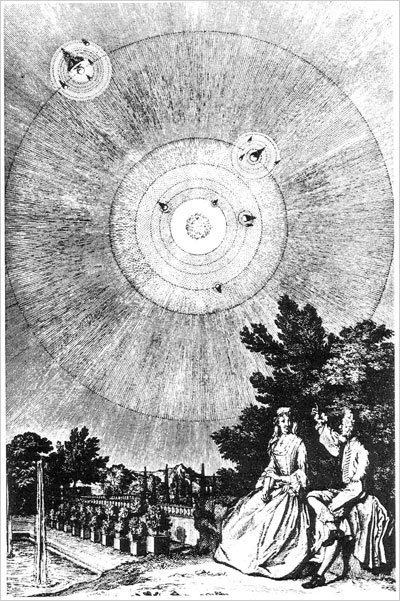
Conversations on the Plurality of Worlds
His name was Bernard Le Bovier De Fontenelle and his book, Entretiens sur la Pluralité des Mondes, (Conversations on the Plurality of Worlds) is a fascinating, though I suspect largely forgotten, bit of science history. Published in 1686, the book is remarkable, not so much for its literary merits as for the ultimate function its publication served. Conversations on the Plurality of Worlds holds the admirable distinction of being one of the first books of “popularized science” ever published, which is to say, a book of scientific ideas aimed directly at “the average reader” rather than natural philosophers. It became quite fashionable and in as much might be considered the Brief History of Time or Cosmos of it’s day.




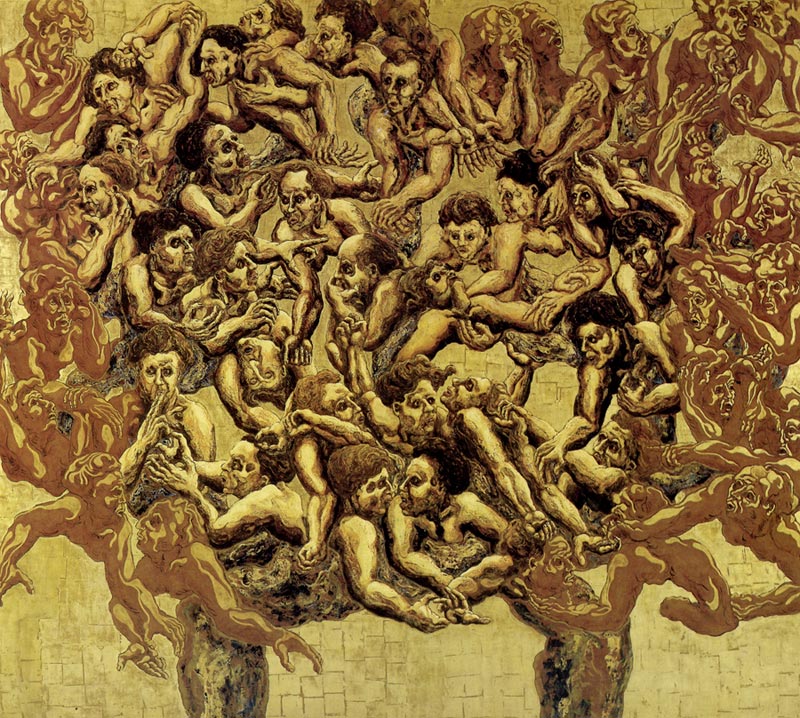
The Hundred-Handed Giants, Hecatoncheires to the Greeks, and later Centimani to the Romans, were the first beings born through procreation. Their father was Uranus, the Sky and their mother Gaia, the Earth. They were three in number, named Briareus, Cottus, and Gyges, and each was a gargantuan having fifty heads and a hundred arms. They were of vast proportions, stronger and more fierce than anything before them. In a manner befitting the species whose world they governed these first procreative births lead directly to marital conflict, conspiratorial plotting, attempted patricide, successful castration, all out war, and ultimately the downfall of the Titans and the rise of Zeus. “Out with the old and in with the new.” The more blood and guts and rumbling thunder the better, ay?


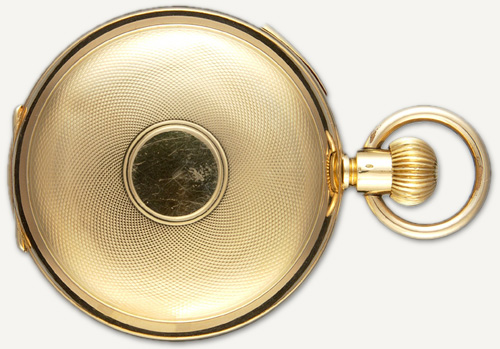
Description: A late 19th Century quarter repeating Swiss lever in a gold full hunter case. Gilt three quarter plate keyless movement with going barrel, four armed cam above the plate to actuate the automaton. Plain cock with polished steel regulator, compensation balance with blue steel overcoil hairspring. Club foot lever escapement. Slide quarter repeating on two gongs. Engine turned 18 carat gold full hunter case, slide in the band, etcetera.
Wow. Pretty fancy! And what is all that high presision Swiss mechanical dodaddery in the service of? What does it all lead to?

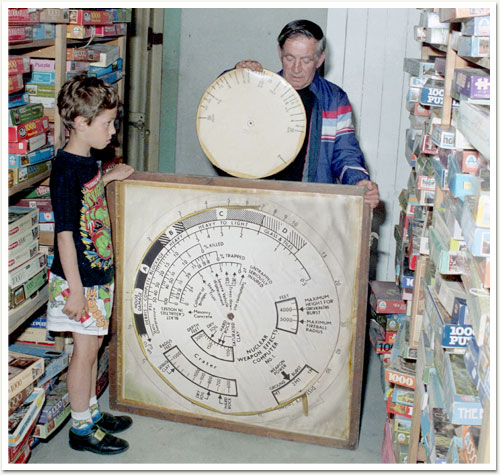
Boom Computing
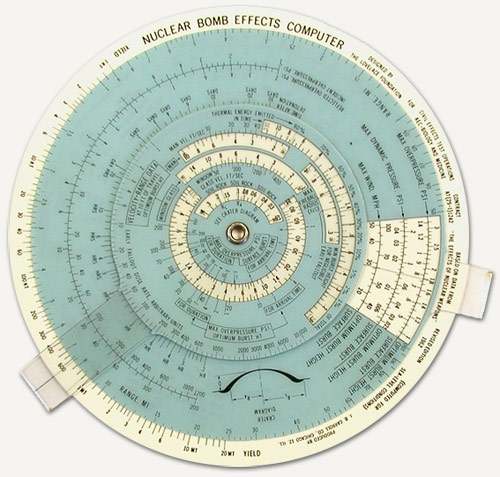
He kept his homemade, oversized, “nuclear weapon effects computer” in a room packed floor to ceiling with puzzles.⊕ To me, smugly distanced from the fearful zeitgeist of the atomic age (and its pragmatic preparations) this choice seems perfectly fitting. I can think of none better in fact. Circular slide rules manufactured to calculate the various effects and time lengths of a post nuclear landscape were once fairly common items. If you handed me one today and expected an important calculation in return you might as well hand me a icosahedron-shaped rubik’s and expect in return a nice slice of strawberry pie.



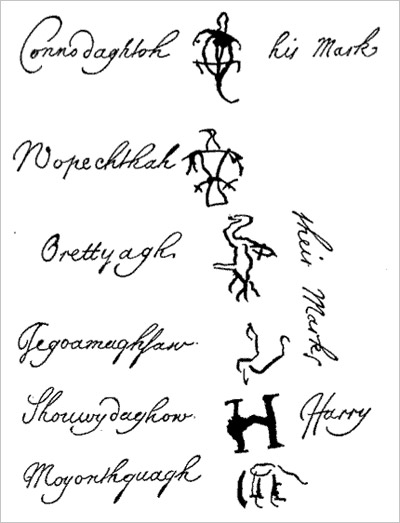
Beast Treaties
They were a pestilence, coming upon us in so many ways- with guns, knives drawn behind empty handshakes, bringing sickness and fire. No matter how many we killed, no matter how firmly we stood, they just kept coming. It was we who saw our numbers dwindling, our villages emptied or turned to ash. The death and desecration and misery was beyond what our gods had prepared us for. There were no ancestral stories to tell in the night which were more brutal than what we’d seen in the day, and so there was no wisdom to draw on… no comfort. In the end, staring at their piece of paper, the one they said would make it all stop, I took the pen and did the only thing left for me to do- I drew a tiny little elk’s head.



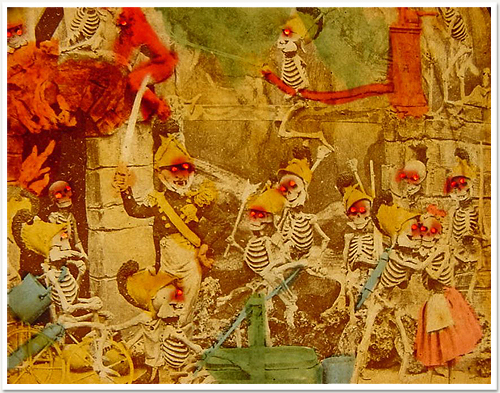
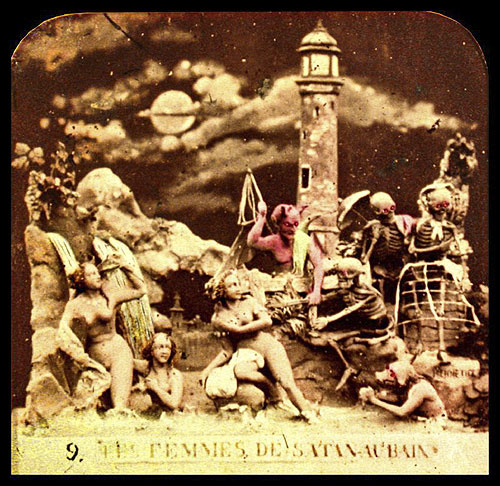
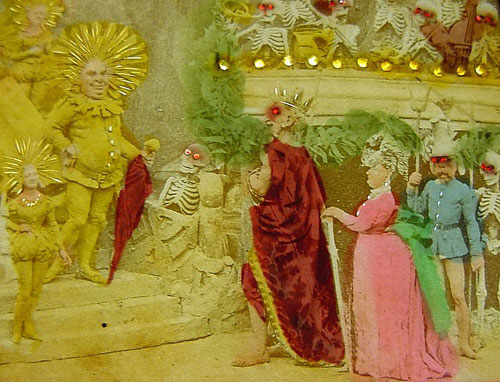
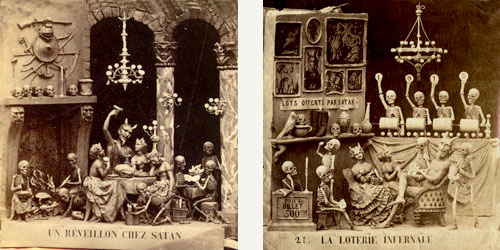
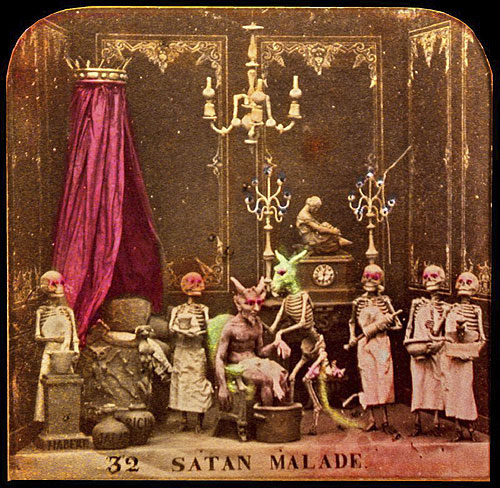
Diableries
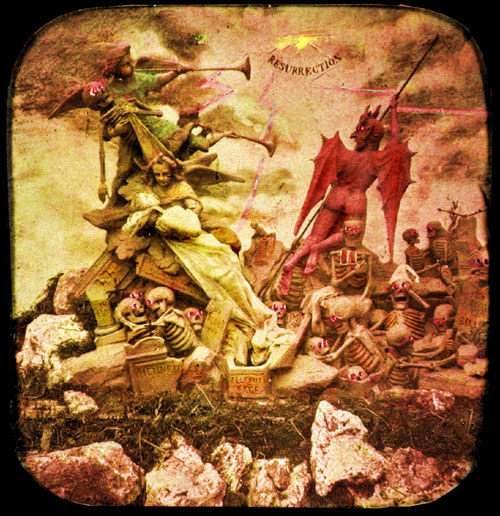
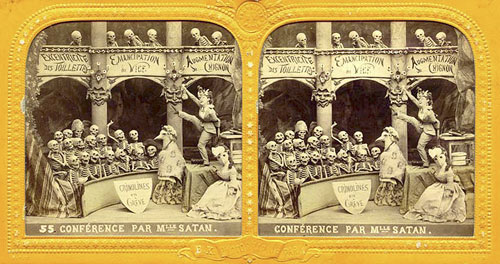
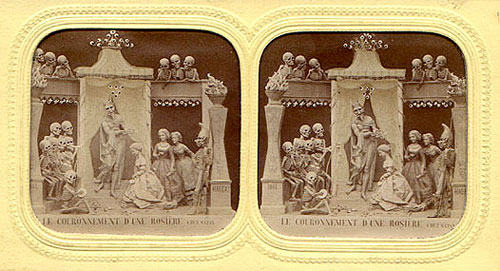
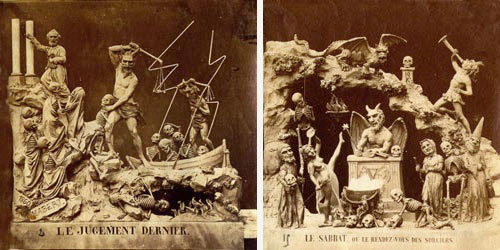
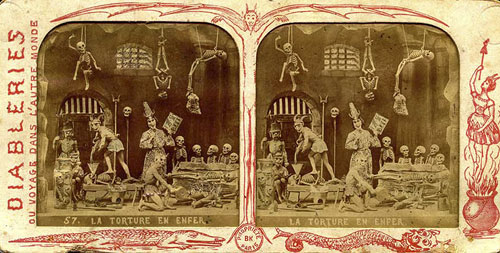
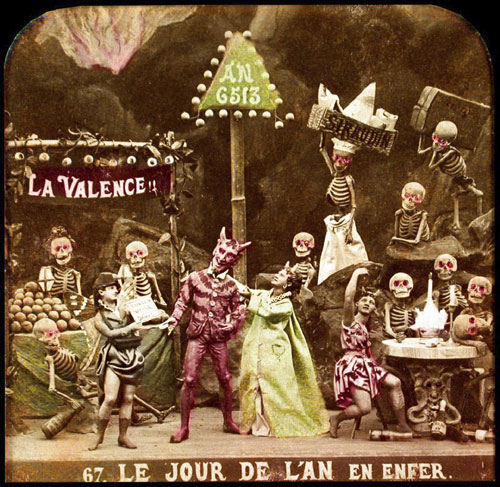
Their history, method of creation, and purpose are largely a matter of speculation. They originate from some time in the 19th century and are French. They were created by only a handful (perhaps 2 or 3) artists. It seems they were photographed from small clay dioramas, none of which have survived. They were presented as opaque stereo-photographs and transparent rear-projection tissues, some hand colored (as above) some a rich sepia. The mystery surrounding their origins was likely intentional in that there content, humorous and bawdy and dealing almost exclusively with satan, hell, and the dead, would likely be seen as heretical. The present thinking is that they were produced as social satire on the regime of Louis Napoleon Bonaparte who, as Napoleon III, was Emperor of France from 1852 to 1870. The relative anonymity of the creators and mystery of their origins would serve as protection against imprisonment and other dungeon-related unpleasantness. See below for a few scant examples and links to more complete resources.


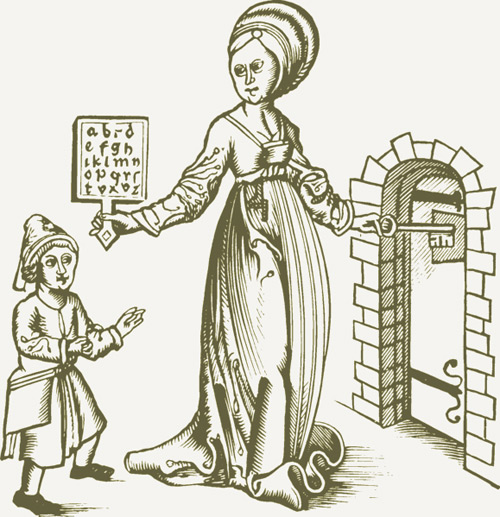
This battered bit of wood was once a ubiquitous piece of schoolroom equipment. Can you guess what it was used for? On first look, taking the terrible beating it seems to have suffered into account, it’s tempting to guess “A paddle for spanking the little brat’s backsides!”(yes, the good ol days ay?) Though I have zero doubt that this item did speed through the air only to come to rest on naughty backsides, repeatedly, punishment was not in fact its primary function. It was actually a simple primer used for teaching children their alphabet. It was called a “hornbook” and was used in classrooms for at least 400 years. The letters on the model above have long since disappeared, obviously, but take a look below for some more representative models and some accompanying history.