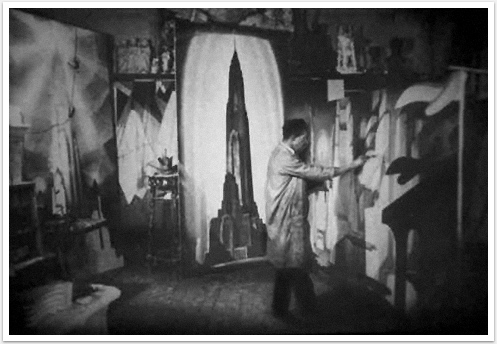
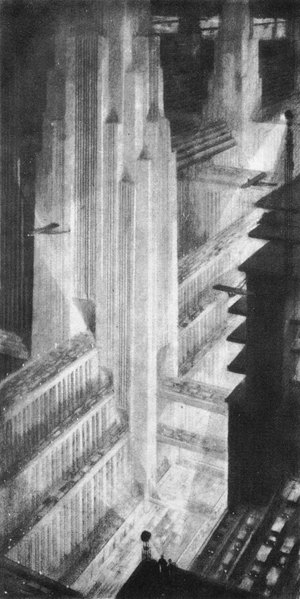
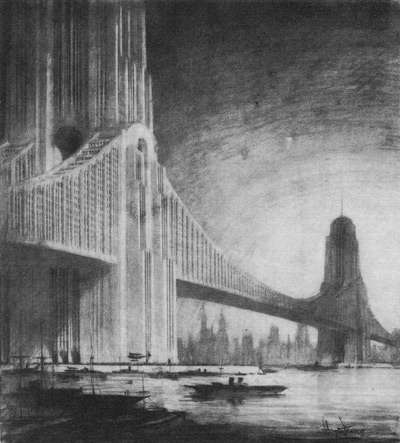
Picked up a reprinting of a 1929 book by Hugh Ferriss titled The Metropolis of Tomorrow. Ferriss was the preeminent architectural draftsman of his time who through his moody chiaroscuro renderings of skyscrapers virtually inventing the image of Gotham visitors came to the city to see and residents identified with so fondly. As Michael Mallow puts it: “By the mid-twenties, renderings by Ferriss had become almost de rigeur for successful competition projects; countless skyscrapers waited their turn to be bathed in the dark monumentality emanating from his drafting table. In these works a blasé department store appears as a giant lording over its block. Stodgy hotels cease to be stodgy hotels and become looming silhouettes emerging from the urban haze like shipwrecks. Ferriss went to grand new lengths in suppressing detail for mood, and clients loved it.”
Evidently Ferriss never designed a single noteworthy building, but after his death a colleague said “he influenced my generation of architects more than any other man.” With The Metropolis of Tomorrow it’s easy to see why. It’s beautiful with idealistic and poetically expressed ideas about the then current state of urban architecture (including the only recently enacted zoning laws) and a fond hope that architects to come would put concept, human experience, and emotional response before mere capitalistic considerations.
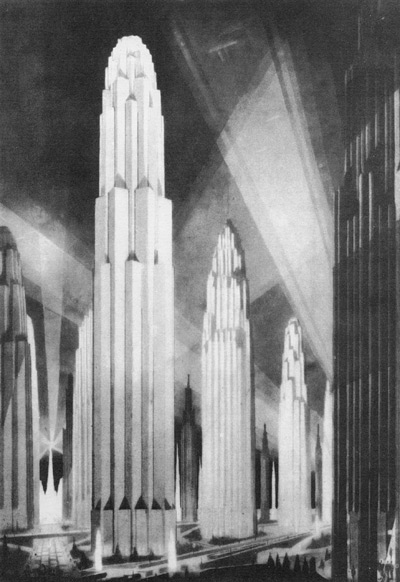
The book is broken up into three sections titled, Cities of Today, Projected Trends, and An Imaginary Metropolis. In choosing which images to post I’ve decided to leave aside the first chapter with its renderings of real buildings of the period, and focus instead on a few examples from the last two chapters, all of which were imagined by Ferriss to illustrate the key concepts of his text.
Hope you enjoy.
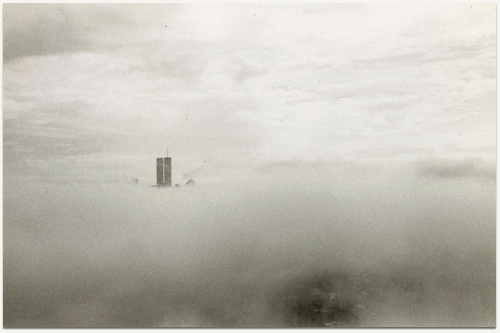
A first impression of the contemporary city, let us say, the view of New York from the work-room in which most of these drawings were made. This, indeed, is to the author the familiar morning scene. But there are occasional mornings when, with an early fog not yet dispersed, one finds oneself, on stepping onto the parapet, the spectator of an even more nebulous panorama. Literally, there is nothing to be seen but mist; not a tower has yet been revealed below, and except for the immediate parapet rail (dark and wet as an ocean liner’s) there is not a suggestion of either locality or solidity for the coming scene. To an imaginative spectator, it might seem that he is perched in some elevated stage box to witness some gigantic spectacle, some cyclopean drama of forms; and that the curtain has not yet risen.
There is a moment of curiosity, even for those who have seen the play before. since in all probability they are about to view some newly arisen steel skeleton, some tower or even some street which was not in yesterday’s performance. And to one who had not been in the audience before—to some visitor from another land or another age—there could not fail to be at least a moment of wonder. What apocalypse is about to be revealed? What is its setting? And what will be the purport of this modern metropolitan drama?


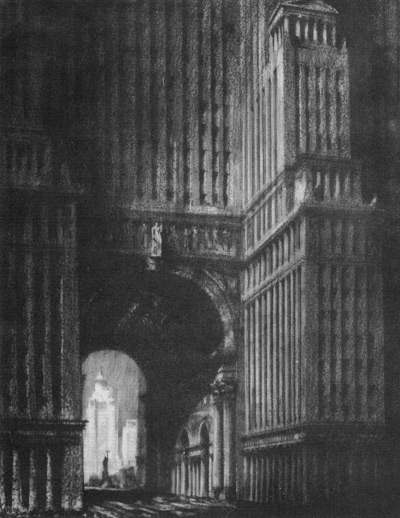
Broadly speaking, it has been our habit to assume that a building; is a complete success if it provides for the utility, convenience and health of its occupants and, in addition, presents a pleasing exterior. But this frame of mind fails to appreciate that architectural forms necessarily have other values than the utilitarian or even others than those which we vaguely call the aesthetic. Without any doubt, these same forms quite specifically influence both the emotional and the mental life of the onlooker. Designers have generally come to realize the importance of the principle stated by the late Louis Sullivan, “Form follows Function.” The axiom is not weakened by the further realization that Effect follows Form.
It can be recalled that there have been periods in the past when architects must have been quite aware of the influence of Architecture and consciously employed it for a specific object. Moreover, it is precisely these periods that are still spoken of as the “great periods” of Architecture.
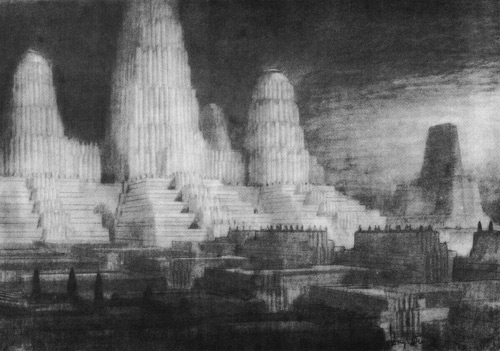


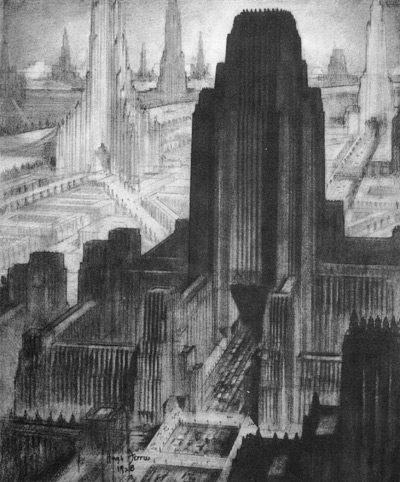
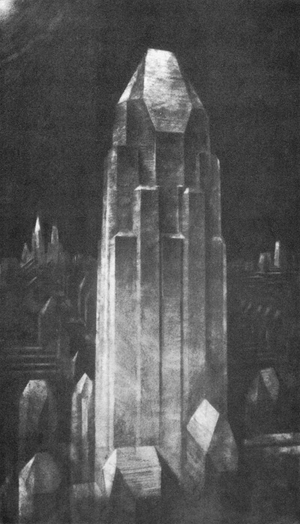
Buildings like crystal.
Walls of translucent glass.
Sheer glass blocks sheeting a steel grill.
No Gothic branch.
No Acanthus leaf.
No recollections of the plant world.
A mineral kingdom.
Gleaming stalagmites.
Forms as cold as ice.
Mathematics.
Night in the Science zone.
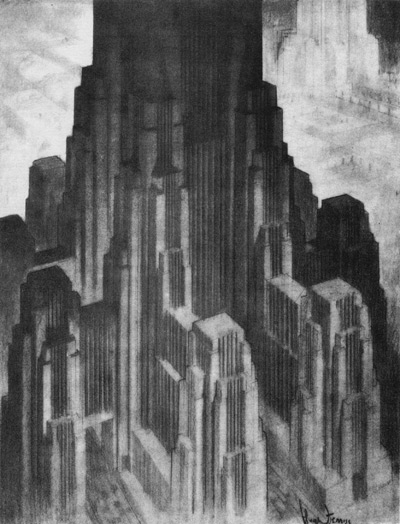

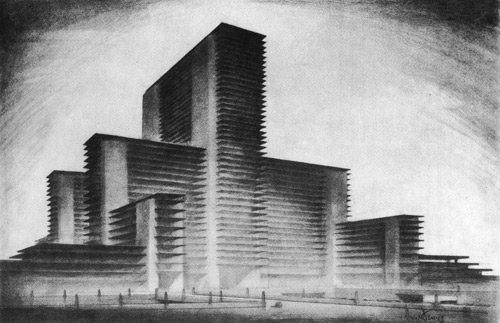

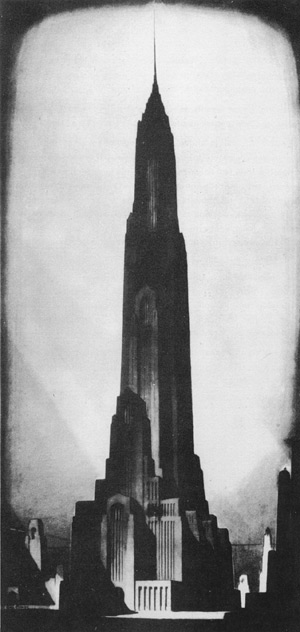
Are not the inhabitants of most of our American cities continually glancing at the rising masses of office or apartment buildings whose thin coating of architectural confectionery disguises, but does not alter, the fact that they were fashioned to meet not so much the human needs of the occupants as the financial appetites of the property owners? Do we not traverse, in our daily walks, districts which are stupid and miscellaneous rather than logical or serene—and move, day long, through an absence of viewpoint, vista, axis, relation or plan? Such an environment silently but relentlessly impresses its qualities upon the human psyche.
The contemplation of the actual Metropolis as a whole cannot but lead us at last to the realization of a human population unconsciously reacting to forms which came into existence without conscious design.
A hope, however, may begin to define itself in our minds. May there not yet arise, perhaps in another generation, architects who, appreciating the influence unconsciously received, will learn consciously to direct it?
But we may postpone more general conclusions until we have examined, at closer view, the existing facts. Let us go down into the streets ...
For a few more bits on Ferris see the following:
Place, Power, and the Human Being.
Tangible Futures example: Hugh Ferriss’s delineations.
High Priest of the New York Skyscraper Sex Cult.
Lastly The ASAI happens to offer an annual award for the best architectural illustrators which is named for Ferris. See here for past winners.
hide full text