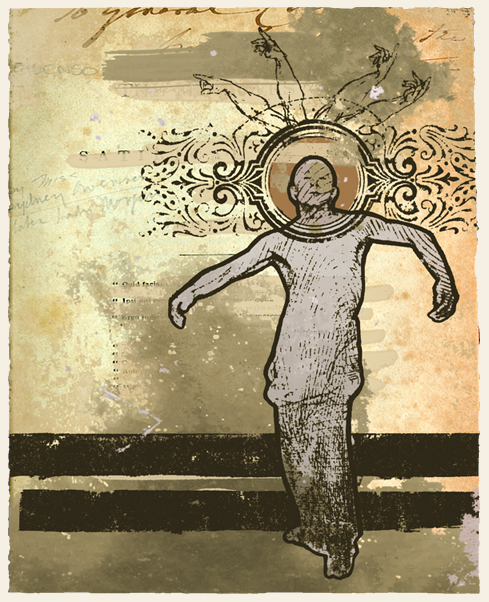
“But by an altogether Oriental means of expression, this objective and concrete language of the theater can fascinate and ensnare the organs. It flows into the sensibility. Abandoning Occidental usages of speech, it turns words into incantations. It extends the voice. It utilizes the vibrations and qualities of the voice. It wildly tramples rhythms underfoot. It pile-drives sounds. It seeks to exalt, to benumb, to charm, to arrest the sensibility. It liberates a new lyricism of gesture which, by its precipitation or its amplitude in the air, ends by surpassing the lyricism of words. It ultimately breaks away from the intellectual subjugation of the language, by conveying the sense of a new and deeper intellectuality which hides itself beneath the gestures and signs, raised to the dignity of particular exorcisms.”
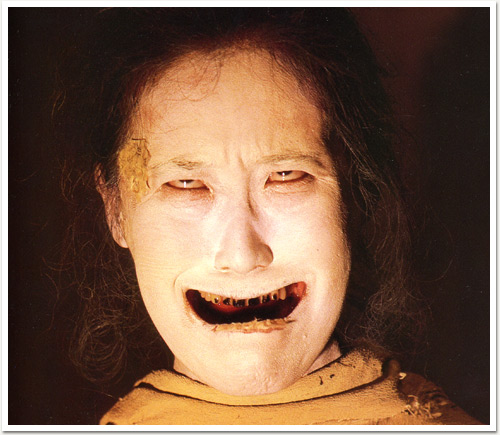
I first came across Butoh in 1996, while working at the the now defunct Tower Books. Issue 21 of Visionaire, which took the form of a box of oversized playing cards, featured as it’s hearts suit a group of arresting photographs of a man, covered in white make-up, twisting about and making crazy faces. I photocopied them and put them in my “archives” for later use. It was Ushio Amagatsu a second-wave Butoh dancer, and founder of the legendary troupe Sankai Juku, though I didn’t realize it at the time. In fact I didn’t make the connection until years later when I saw a performance by Kazuo Ohno on television. It was the first time I’d ever even heard the word Butoh or seen it in motion. I am not particularly a fan of dance, nor do I tend to gravitate toward performance art, and yet with this form I was totally fascinated.
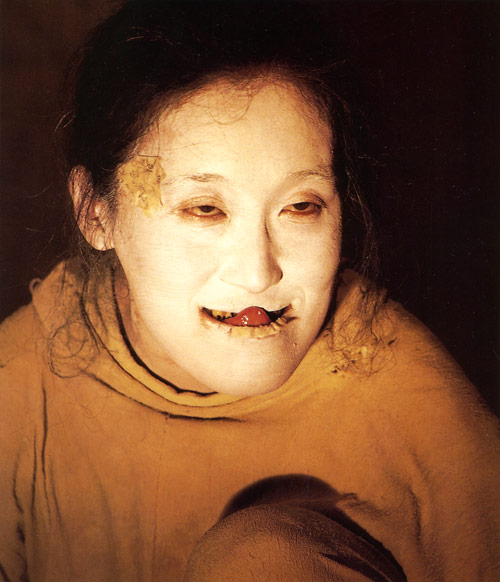
It’s a hard art to explain really. In my mind the best of it is dark and almost frightening in its viscerally primal strangeness. It can remind you of an epileptic seizure, or some ugly lunacy made flesh. Simultaneously, however, you’ll recognize in it tiny gestures and glances and movements which seem somehow sublimely beautiful. Perhaps it is the appalling humanity of it, so easily understood in the murky emotional realm of our private minds, but so strange to see manifest before your eyes. Since becoming aware of it I’ve noticed its stamp on everything from E. Elias Merhige’s masterpiece Begotten to Matthew Barney’s Cremaster Cycle.
Recently I received the 1987 book Butoh, Dance of the Dark Soul as a gift and wanted to take the opportunity to share some of it, as well as some other Butoh related material, with you.
Kazu Ohno. Dance: Admiring la Argentina.
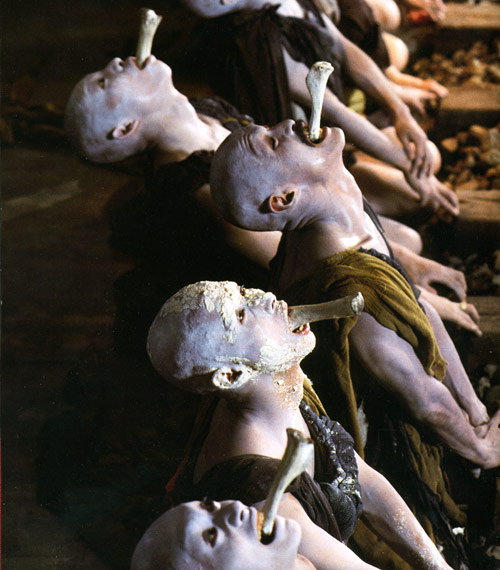
Dai Rakuda Kan. Dance: The North Sea.
“Butoh is an explosive, convention-shattering performance art that has redefined the limits of dance and theatre. The form was created by a handful of avant-garde postwar Japanese artists who drew upon their native agrarian myths, the iconoclastic theatre of Antonin Artaud, and the influences of Western modern dance.
But Butoh is more. It is perhaps the most daring attempt yet made to translate the mysterious, often tormented life of the unconscious into the communal medium of theatre.
The first true Butoh performance, an adaptation of Yukio Mishima’s novel Forbidden Colors, scandalized Japanese audiences when it premiered in 1959. Its creator, Tatsumi Hijikata, was banned by the Modern Dance Association and branded an outlaw dancer.”
-From the dust jacket of Butoh. Dance of the Dark Soul, 1987.
Ushio Amagatsu’s Sankai Juku company. Dance: Kagemi
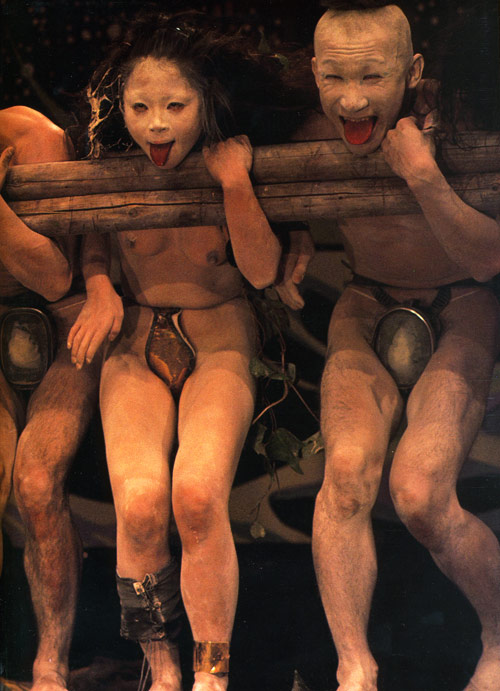
Byakko-Sha. Dance: Skylark and Living Buddha.
“Some people say that the essence of butoh lies in the mechanism through which the dancers stops being himself and becomes someone or something else. This is a different conception of dance then the conventional where the body of the dancer expresses an emotion or abstract idea.
For example, take the studying of a rooster. “The idea was to push out all of the human inside and let the bird take its place. You may start by imitating, but imitation is not your final goal; when you believe you are thinking completely like a chicken you have succeeded.
The important thing with this is not the transformation into a chicken, but the transformation itself, the fact that you change. Only in this way you can bring the body back to its original state. It is not depiction or symbolization which is the foundation of butoh. It is the metamorphosis.”
-Harmen Sikkenga, from Butoh - Dance of Darkness 1994.
Yoko Ashikawa. Dance: Intimacy Plays Its Trump.
Uno Man. Dance 21,000 Leagues.
“Butoh has a primordial quality. It is dark. It is generated somewhere in the lower strata of the subconscious, in the murky areas of personal prehistory. Memory is its source. Its etymology refers specifically to dance through the character bu. Buyoh is the neutral word for dance, but it has a sense of jumping or leaping, whereas toh implies a stomping. Buyoh is in the ascendant, like the vertical ascent of Vaslav Nijinsky or Isadora Duncan’s leap toward the source of light. Butoh is a descent. Hijikata would often say, “I would never jump or leave the ground; it is on the ground that I dance.”
The element of stomping, the intimacy with the ground, the soil. has its roots in agricultural society. Similar patterns are found in the dances of southern India, Spain, and in the Japanese classical Noh theater. The seasons and the agricultural cycle form the foundations of Japanese mythology, at the center of which is the Sun Goddess, Amaterasu, from whom the Emperor is descended. Amaterasu is said to have retreated into a cave and plunged the world into darkness after her unruly brother Susano, the Storm God, allowed his piebald horses to rampage through her rice fields. In the cold and darkness of her absence, the other spirits, or kami, gathered outside the cave and performed wild and bawdy dances. They also placed a mirror in the branches of a tree overlooking the cave. Amaterasu, curious at the sound of the revelry, peered outside and caught her reflection in the mirror. Dazzled by her own countenance, she returned to the world, and the warmth and light were restored with the onset of spring. The stomping of Butoh has its mythical parallels in the revelry of the spirits in a darkened world.”
-Mark Holborn, from Butoh. Dance of the Dark Soul, 1987.
Dai Rakuda Kan. Dance: The North Sea.
Byakko-Sha. Dance: Skylark and Living Buddha.
“Hijikata used the term Butoh to describe his dance. Although modern dance is something that is liberated from Western classical dance, Butoh is not comparable. If modern dance is like a thoroughbred racehorse, then Butoh is like a camel. The difference is like the difference between diamonds and cork, though both have the same elemental base.
Butoh is just a Japanese name. There are many parallel dances elsewhere. When I first saw the Omizutori, the fire festival on the hillside at Nara, an ancient religious ceremony from the eleventh century, the ceremony seemed like an imitation of my dance, just as 1 may have drawn from an eleventh century ritual. I was very impressed by the age of the ritual. Butoh is something new, but there are many comparable forms throughout history. Butoh is a form that almost precedes dance, just as a child moves and plays before he dances.
Imagine a snake emerging and appearing before a Japanese farmer, then sliding away. The step with which the farmer may have crushed the snake, may have been the beginning of a Butoh step.”
-Akaji Maro, from Butoh. Dance of the Dark Soul, 1987.
Dai Rakuda Kan. Dance: The North Sea.
Yoko Ashikawa. Dance: Intimacy Plays Its Trump.
Hitomi Sato. Dance: Gold Boy.
“Where are the points of difference between butoh and other forms of dance? First in the singularity of the body in butoh. As is particularly striking in ankoku butoh, the body of the butoh-ka is far removed from the balanced, ideal beauty of the ballet dancer, and has no reason to take pride in its powerful musculature or physical strength. Compared with the symmetrical beauty of conventional dancers, the butoh-ka with his stooped body, so small and lean, his bent legs, and his outsized caricature of a face is the picture of deformity. Butoh performers even seem to emphasize the rounded back, bull-neck, and bandy legs so typical of the Japanese physique. In addition to these peculiarities of the eastern body, some work like that of Kazuo Ohno brines together the complementary aspects of the same entity a delicate sensibility and the grotesque ugliness of old age. It was this kind of oddity which first drew attention to the more fundamental strangeness of butoh.
Oddity also makes the publication of collections of butoh photos an easy business, once the pathetic expressions of the strange figures which appear on the butoh stage are visually stimulating to the imagination. In this grotesque ugliness and corruption, however, there accomplishedcan be found an irreducible beauty and sweetness which are without equivalent elsewhere: Clearly, butoh has accomplished a reversal in the aesthetic consciousness.”
-Kazuko Kuniyoshi, from Butoh in the late 1980s, translated from the Japanese by Richard Hart.
Sankai Juku. Dance: Homage to Pre-History.
Kazu Ohno. Dance: Admiring la Argentina.
When I was, perhaps… 15 I had an experience that seemed so odd it impressed itself deeply on my memory. I was alone, sitting in a very secluded little spot of a neighborhood park where I’d often go to read; on a raised concrete slab surrounded on all sides by trees. It was mid-summer and the entire area was crawling with insects and loud with their buzzings and chirpings. As I sat there I began to focus on the insects, their sounds, their motions across the ground and the concrete slab. Eventually, and without forethought or reason, I began to mimic them. I made crazy sounds, writhed around a bit, and struck odd poses there on the slab in the sun. It lasted for about two minutes. Even then, having only just experienced it, I could see how bizarre the whole episode was.
I can only categorize it as some kind of primal outpouring, either creative or spastic, which seemed to come upon me from parts unknown. Being brought up Catholic, and being a child, I wondered whether it were some kind of possession, whether I’d in fact been talking in tongues or some other horrible thing. It was actually embarrassing somehow and consequently I told very few people about it. I recognize that same strangeness in the photos of Kazuo Ohno, however, and it seems to me now, all these years later, that it was a sort of naive Butoh, springing from the same subconscious well, seeking to cast off the composure and formality of being a “good kid.” It was play, albeit of a kind I only recognized when I got older.
In truth Butoh is most certainly something which must be seen for oneself in order to form any kind of opinion or reach any kind of understanding. It can’t be neatly summed up or even properly approached with a few quotes and a handful of images, no matter how enigmatic or beautiful. To spite that fact I hope you enjoyed this little taste anyhow.
For more on Butoh try:
Butoh.net
Butoh - Dance of Darkness
Butoh: The Darkness Amongst the Joy
About Butoh
What Does Butoh mean?
Butoh in the Late 1980s (pdf)
An Art Form In Transition
Butoh at Wikipedia
Sankai Juku: Butoh Dance from Japan
A Conversation with Ushio Amagatsu
Cokaseki.com
Bodytaster.com
Butoh-ultraego.com photogallery.
You Tube returns many result when doing a search for Butoh, most of which are pretty weak. Here are a few which might be of interest however:
1, 2, 3, 4, 5, 6, 7, 8, 9, 10.
*Note that all photos in the main body of this post (with the exception of “Gold Boy” and “Kagemi”) are by Ethan Hoffman from Butoh, Dance of the Dark Soul, which, if you are interested in Butoh, I recommend highly. It’s the best book on the subject I’ve yet found.
hide full text