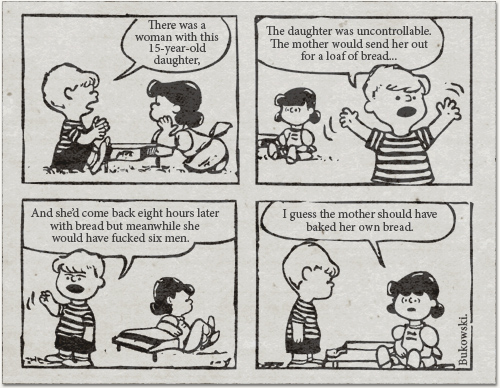
Peanuts, by Charles Bukowski. Funny, and strangely simpatico. Via Monkeyfilter.



Cockroaches that spent 12 days aboard the Russian orbital laboratory Photon-3 - Noah’s Arc, returned to Earth last week. Two of these cockroaches were pregnant, evidently becoming the first Earth creatures to have conceived in space and becoming the first members of the 100,000 mile high club. Russian scientists are expecting these two female cockroach cosmonauts to give birth to “the world’s first offspring conceived in microgravity.” That’s interesting, certainly, but do we really need to help these indestructible little buggers adapt their genes to space as well? Silkworms I’m not too worried about, but roaches?! If we keep this up, when we finally come across a monolith somewhere, there’ll already be cockroaches there, scuttling under it when we shine our flashlights.
In other science-factual news of a fascinating but highly questionable nature- Craig Venter has announced he’s built a synthetic chromosome out of laboratory chemicals, in effect creating the first new artificial life form on Earth. Pants-crappingly good news ay?
Part 1- Drama
This scene opens, the way 94 percent of all scenes do, with a person doing something or other. 47 percent of the time it’s a male doing something; you know, playing pool in leather pants, knifing someone, loading secrets onto a computer disk, that kind of thing. 47 percent of the time a scene opens with a female rather than a male, usually blow drying her hair in scanty under-things, wailing, or loading secrets onto a computer disk. 6 percent of the time it’s a moody but essentially empty interior or landscape. I’m guessing in terms of the numbers, of course, but the specific percentages make little difference, as a person almost always enters the scene in short order, sometimes even accompanied by a catchy tune. To be honest I’m not entirely sure a scene has properly begun until that entrance is made…

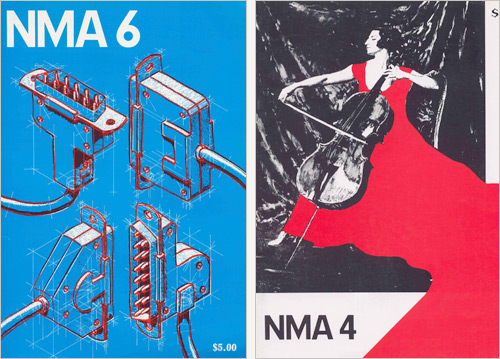
Video art, alternative television, McLuhan, performance art, computing, Buckminster Fuller, copyright, the electromagnetic spectrum, the Sony Portapak, feedback, activism, tape loops, media criticism, electronics, modding, kline worms, information economies, defense of public access channels, cybernetic guerrilla warfare… In the days before VCRs and personal computers these and other disparate subjects were being plumbed in the seminal magazine Radical Software. Published between 1970 and 1974 by Beryl Korot, Phyllis Gershuny, and Ira Schneider Radical Software serves today as a fascinating historical document of the very beginnings of the video art movement and the far flung ideas which surrounded the revolutionary medium’s introduction. The full run is available online here. Highly recommended.

I was lucky enough to get my grubby hands on a 1931 book titled, as seen above, Sins of America, by Edward Van Every, and my my are they many. It was a follow-up to a book he put out a year earlier titled, Sins of New York. Both books are collections of stories and illustrations which originally appeared in The National Police Gazette and they are fantastic. The Gazette was a sensationalistic tabloid aimed at the “sporting” single men of the 19th Century. It was sold through barber shops and saloons. It was chock full of dramatic woodcuts of sporting events, brutal crimes, female burlesque performers, actresses in racy poses, and the scandals of the day. During it’s peak it had a readership of over 200,000 and was the most successful such publication of it’s time. More than that it can be credited with the invention of the sports page and the gossip column. Pretty much everything we associate with tabloid journalism, as well as men’s magazines, had a start in the Gazette.


Fence Music
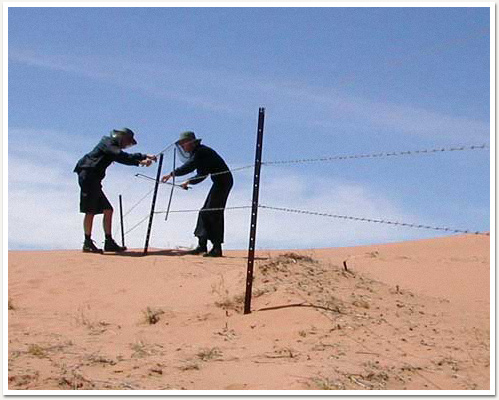
Quote: Many people look at fences and see not much; Jon Rose and Hollis Taylor look and see giant musical string instruments covering a continent. The strings are so long that they become the resonators as well as the triggers for the sound. On straight stretches of a simple five-wire fence, the sound travels down the wires for hundreds of meters. The music is ethereal and elemental, incorporating an extended harmonic series (the structure of all sound); the longer the wire, the more harmonics become available. The rhythms of violin bows and drum sticks uncover a fundamental sonic world. The fence music encapsulates the vastness of the place. Music of distance, boundaries and borders.
Is it a coincidence that the love-child of their first names, actor John Hollis, has had industrial-grade ear coverings surgically implanted deep into his ear canals? Yes it is.
Beyond the fences, at Jon Rose’s own webpage, you’ll find evidence of a lifetime’s fetish for violins including: “Relative Violins” of his own construction, violin videos, related ephemera to ponder, articles, applets, violin erotica, and many samples of Rose’s own violin work. Meanwhile…

While searching out some images of sputnik (this week marks the 50th anniversary of the satellite’s launch) I came across this image. Initially I thought it was a photo with some digital filter applied. Turns out it was a wooden bas-relief by Dutch sculptor Ron Vander Ende. Curiosity piqued, I checked out his site which, as it turns out, features some pretty nifty work. Mostly bas-refliefs made of “reclaimed timber.” Pictured above for example is Lunar Orbiter (apollo space capsule II) 2006. Also on view… a Vostok, an Apollo capsule, a Sony prototype U-Matic video recorder, an Akai-VT100 reel recorder, and a whole series of checkout counters, to name a few. See below for another example with a bit more context.




And you shall know us by our doodles!
Oh, the tortured and convoluted minds of the insane! What a horror, the knowledge that they slink down the evening streets, pass us on rainy highways, stand behind us on line at the supermarket. They mutter, they stammer, they crane their necks and wail with bloodied hands during every lighting storm. But when they are silent? When their tumultuous souls are temporarily still? How shall we know them then? I ask you, how will we safeguard our slumber parties and campsites and abandoned gas stations? How will we ever again feel safe walking through poorly lit parking garages at three in the morning? How will we change flat tires on remote rural roads knowing deranged minds lurk all around us?! Fortunately, good citizen, there is an answer- for so deranged are these crazies that their madness spills over, not only into their ramblings and murderous hands, but onto the very walls around them! Lunatics simply can not resist the urge to scrawl their turbulent thoughts over every inch of bare wall available to them. They are, one and all, compulsive doodlers… evidently.
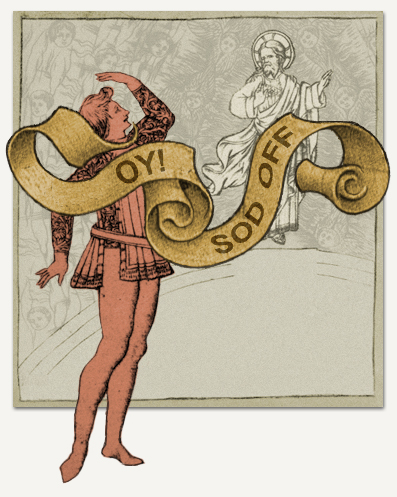
Exercise of Insubmission
by E.M. Cioran
“How I detest, Lord, the turpitude of Your works and these syrupy ghosts who burn incense to You and resemble You! Hating You, I have escaped the sugar mills of Your Kingdom, the twaddle of Your puppets. You are the damper of our flames and our rebellions, the fire hose of our fevers, the superintendent of our senilities. Even before relegating You to a formula, I trampled Your arcana, scorned Your tricks and all those artifices which produce Your toilette of the Inexplicable. You have generously endowed me with the gall Your pity spared Your slaves. Since there is no rest but in the shadow of Your nullity, the brute finds salvation by just handing himself over to You or Your counterfeits. I don’t know which is more pitiable. Your acolytes or myself: we all derive straight from Your incompetence: pitch, patch, hodgepodge—syllables of the Creation, of Your blundering…”

Eugenics- It’s too broad and prickly a subject to tackle in any meaningful way in the short strokes of a blog post frankly. Debatable issues, movements, historical consequences, ethical quandaries, scientific disciplines, philosophical attitudes all stem from or tangle with it like branches of a gnarled millennia old tree. One thing I can say for certain is that as with all Ideologies seeking to convert themselves into some dispassionate, quantifiable (and hence reputable) Science, Eugenics relied heavily on statistics. It follows that, as with all such endeavors, one of the chief concerns was how best to present said statistics in an affecting way. The Eugenics movement, being focussed as it was on issues of race, class, breeding, and illness (all sources of viscerally opinionated reaction in the annals of human discourse) was able to produce some doozies.