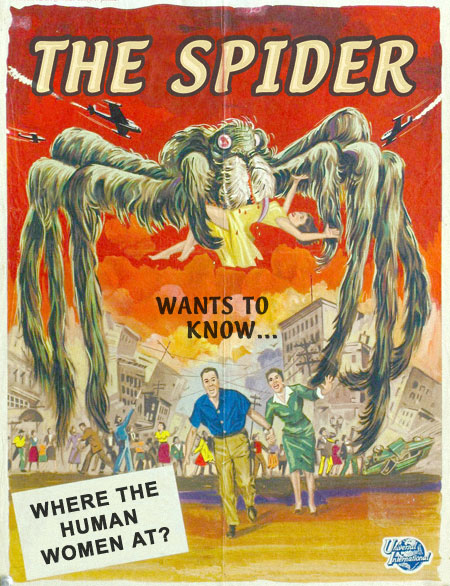
His name was Bernard Le Bovier De Fontenelle and his book, Entretiens sur la Pluralité des Mondes, (Conversations on the Plurality of Worlds) is a fascinating, though I suspect largely forgotten, bit of science history. Published in 1686, the book is remarkable, not so much for its literary merits as for the ultimate function its publication served. Conversations on the Plurality of Worlds holds the admirable distinction of being one of the first books of “popularized science” ever published, which is to say, a book of scientific ideas aimed directly at “the average reader” rather than natural philosophers. It became quite fashionable and in as much might be considered the Brief History of Time or Cosmos of it’s day.
From the University of Hong Kong’s fascinating (but seemingly now defunct) search for extraterrestrial intelligence page:
“The book was unusual in that it was the first time that scientific knowledge had been written for the public in a common language and in a manner to encourage the reader to enjoy the process of learning. Hitherto, all scientific knowledge had been written only for other scientists and usually in some classical language. Newton, for example, was at that time busy composing his monumental work Principia Mathematica Philosophiae Naturalis (The Mathematical Principles of Natural Philosophy) - in latin, of course.”
And what scientific ideas was Fontenelle’s book offering up to the public exactly? The answer to that question represents the second reason the book is remarkable.
Owing a great deal to the previous work of Copernicus (the heliocentric theory of the solar system) and Descartes (particularly his theory of vortex motion of the planets meant to counteract Newton’s idea of gravity), his work rebutted the idea of a centre to the universe and speculated in great detail on the habitation and multitudes of other planets.
Now take that in for a second… this book was published in 1686 as I’ve said. That’s less than a century after Giordano Bruno was burned at the stake for “desacrilizing” the Earth by suggesting the possibility of multiple inhabited worlds. It’s only 50 years after Galileo had lost his freedom and had been placed under permanent house arrest for writing “daring astronomical theories.”

As Nina Rattner Gelbart puts it in the introduction to the 1990 edition of Conversations on the Plurality of Worlds:
“While much of Fontenelle sounds matter-of-fact to us—his talk of boundless universe, his speculation on intelligent and extragalactic life, his discussion of space travel—we have to remember that publishing his book three centuries ago was risky business. The ideas he was bandying about were bold, controversial, even forbidden. As they had been scarcely known to the average reader before he explained and disseminated them, these astonishing ideas suddenly became all the rage.”
Fontenelle himself seemed aware of the dangers and tried to pre-empt negative judgment from the religious quarters with a few choice words in his own preface to the book:
“It only remains for me to speak to the one group of people, who will perhaps be the most difficult to satisfy; Not that I haven’t given them very good arguments, but rather that they may, if they wish, refuse any good arguments. These are the scrupulous people who think there is a danger in respect to religion in placing inhabitants elsewhere than on Earth. I respect even the most excessive sensibilities people have on the matter of Religion, and I would have respected Religion to the point of wishing not to offend it in a public work, even if it were contrary to my own opinion. But what may be surprising to you is that Religion simply has nothing to do with this system, in which an infinity of worlds with inhabitants exist. It’s only necessary to sort out a little error of imagination.
When I say to you that that the moon is inhabited, you picture to yourself men made like us, and if you’re a bit of a theologian, you’re instanatly full of qualms. The descendants of Adam have not spread to the moon, nor sent colonies there. Therefore the men in the moon are not sons of Adam. Well, it would be embarassing to theology if there were men anywhere not descended from him, it’s not necessary to say any more about it; All imaginable difficulties boil down to that, and the terms that must be employed in any longer explication are too serious and dignified to be placed in a book as unserious as this. Perhaps I could respond soundly enough if I undertook it, but certainly I have no need to respond. It rests entirely upon the men in the moon, but it’s you who are putting men on the moon. I put no men there at all: I put inhabitants there who are not like men in any way.”

Fontenelle not only managed to avoid the usual persecution but in fact his book became an instant best seller of the day, and went on to be translated into no less than 10 languages. Perhaps it was the way he structured the book which helped it avoid censor (the book takes the form of a succession of casual evening conversations) or perhaps it was the the intentionally abstract and theoretical tone of the ideas themselves.
As Sylvia Engdahl puts it in the wonderful New Mythology of the Space Age:
“The ideas had less impact on culture than they have today. In the first place, they were abstract beliefs, a matter of principle rather than speculation about the future. It did not occur to anyone that travel between solar systems might become possible. It was assumed that mortals from one solar system could never have knowledge of the others, except perhaps in an afterlife. In the second place, although plurality of worlds was discussed by “natural philosophers”—they weren’t called “scientists” until the 19th century, when Whewell coined the word—it was not expected that science could ever learn anything about the subject, nor, for that matter, offer evidence for it.”
The reason for the volume’s wild popularity is less a mystery and accounts for yet another remarkable aspect of the book. The “casual evening conversations” are not had in a study between stuffy learned men, but between a charming philosopher and his hostess, a Marquise, in the evenings as they stroll through her moonlit gardens.
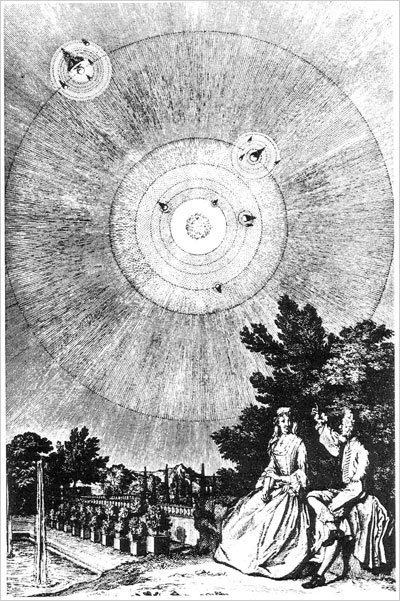
Paula Findlen, of Stanford University describes this change from the norm in her essay Becoming a Scientist: Gender and Knowledge in 18th c. Italy:
“No longer a man of the university, a scholastic master surrounded by male disciples, Fontenelle’s philosopher was a charming seducer of women, a wit who made science comprehensible by cultural analogy. His knowledge was no social liability that removed him from ordinary conversation, but the very reason that he held the attention of an aristocratic Marquise for several days and nights, as he educated her in the mysteries of the post-Copernican, cartesian universe.” In short, just exactly the kind of thing high society was likely to eat up. But Fontenelle took this arrangement a step further-
In a time when women were not expected to know much of anything “scientific” Fontenelle’s society lady was not strolling in the moonlight to be seduced, as might be expected, but to genuinely learn. He hoped to “encourage women through the example of a woman.” This was no small thing at the time and Fontenelle was quick to tell his female readers that the abilities of his imaginary woman philosopher did not exceed their own capacity to learn. Quite the opposite.
Again from his preface:
“I’ve placed a woman in these conversations who is being instructed, one who has never heard a syllable of such things. I thought this fiction would serve to make the work more enticing, and to encourage women through the example of a woman who, having nothing of an extraordinary character, without ever exceeding the limitations of a person who has no knowledge of science, never fails to understand what’s said to her, and arranges in her mind, without confusion, vortices and worlds. Why would any woman accept inferiority to this imaginary marquise, who only conceives of those things of which she can’t help but conceive.”

He goes on in that vein for a while. So whether it was clever recognition of an untapped market, a sincere desire to educate women and give them a fictional role model in the sciences, or to goad the men who would surely read the book into a more careful consideration we can not know. The effect, however, was to achieve all three. This book helped to popularize the ideas of a “plurality of worlds” (which we have recently firmly established as truth), extraterrestrials, and space travel, in a time when such ideas were totally revolutionary, and thus primed the public in some degree for ideas which would follow (like those put forth in Christiaan Huygens posthumously published Cosmotheoros for example.)

In any case Conversations on the Plurailty of Worlds made such a big impression on people’s imagination that, according to one source, “Not long after, at the time of the death of Newton, vast amounts of sentimental poetry about other solar systems appeared in literary magazines, much of it by women and some based on the theme of Newton’s soul viewing other solar systems on the way to heaven. People were as eager to visit them as we are today, but could imagine only one potential opportunity, a time after death when the soul…
Unbounded in its ken, from prison free
will clearly view what here we darkly see
those planetary worlds, and thousands more
now veil’d from human sight, it shall explore.
-Robert Gambol, Beauties of the Universe, 1732.
According to others these same ideas heavily influenced what we now call the Baroque in Art and Theater.
These are no small accomplishments to be connected with for a man who was lampooned by Voltaire and to this day is considered only moderately noteworthy.
Wikipedia says as much in an entry:
“He has no claim to be regarded as a genius; but, as Sainte-Beuve has said, he well deserves a place ‘dans la classe des esprits infiniment distiugués’—distinguished, however, it ought to be added by intelligence rather than by intellect, and less by the power of saying much than by the power of saying a little well.”

Popularizing science is a task which 300 years later, in our age of stunning technology, liberal attitudes, and torrents of information, continues to be necessary. If only Fontenelle were around today to apply his particular talent to the task of re-popularizing evolution or pounding the importance of stem cell research into people’s skulls.
Hope you enjoyed.
For a bit of related reading-
A full Google book scan of Conversations…
Oeuvred de Fontenelle. (in French)
Some Fontenelle quotes.
An Essay on Fontenelle from Dramatic Essays of the Neoclassic Age.
Wikipedia entry.
French Tales of Infinity from Astrobiology magazine.
The Discovery of a World in the Moone at Giornale Nuovo.
To the Moon, Alice at Varieties of Unreligious Experience.
And lastly check out Extraterrestrial Life and Our World View at the Turn of the Millennium by Steven J. Dick which is a nice recap of ideas and trends which have lead to our current views on the same subjects.
-
Note: This post was the first in a series of reworkings of old posts which date from before the redesign of The Nonist. The links have all been updated, the text has been edited slightly, and the images are all new. I will be periodically adding these reworkings into the flow of new content in an effort to eventually remove all the old pages from circulation.
hide full text