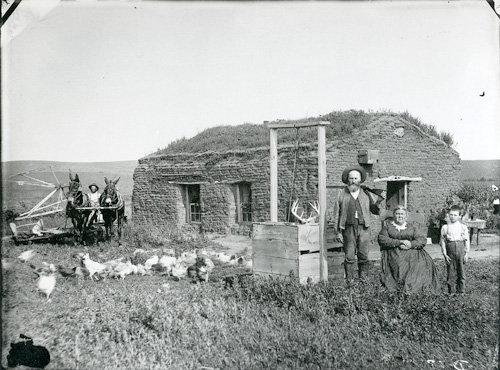
The mud was high, the sod-roofs were damp, the watermelon was sweet, and in the lens of newfangled camera’s men never smiled. It was Nebraska in the late 1800’s and at “only one-ninth of principle due annually, beginning two years after purchase” it was destination soon crowded with homesteaders. One of them was Solomon D. Butcher who arrived in Nebraska in 1880 to farm. After five years of struggle he realized that he was not tough enough to meet the demands of the homesteader’s life but having in those five years developed a genuine love of the life, and realizing that the period of settlement would soon be over, he set out instead to create a photographic history of what it was to be a pioneer. Between 1886 and 1912 Butcher generated a collection of more than 3,000 photographs. Like most men “he died believing himself a total failure.” His work, however, for its breadth and specificity, has proven to be one of the most important chronicles of homesteading ever exposed to the light.
The Homestead Act, signed into law by President Abraham Lincoln in 1862, turned over vast amounts of public land to private citizens. It was a significant event in the history of the westward expansion of the United States of America. Ultimately, 270 million acres (10 percent of the area of the United States) were claimed and settled under this act.
A homesteader had to be the head of a household and at least 21 years old to claim 160 acres of free land. Each homesteader had to live on the land, build a home, make improvements, and farm for five years before becoming eligible to take full and legal ownership. The filing fee of $18 was the only money involved.
The early settlers were often newly arrived immigrants (from Ireland, Germany, Sweden, the Czechoslovakian region of Bohemia, Russia, Denmark, and Polish and French colonies), Eastern farmers without land of their own, single women, and former slaves. They were determined and hardy, carving out a life and a civilization, raising children, breaking land, planting farms, and digging wells in the midst of the tall grass prairies of the Great Plains.
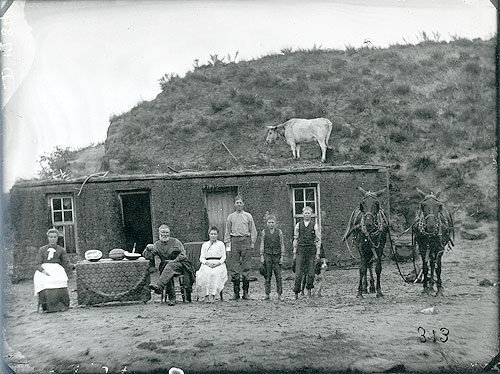
Sylvester Rawding house, 1886
Lookout Point, near the Snake River. (altered).
Detail. the trees and figures are inked.
The John Curry house, 1886.
The end of the Civil War unleashed a migration of thousands of expectant pioneers who crossed the Mississippi River to the plains lured by the government’s promise of 160 acres of free land to any who could homestead it for five years. It was a hard life and a precarious existence that began as soon as the settlers arrived. Those who migrated to the Nebraska plain were forced to build their homes out of slabs of sod carved from the almost treeless landscape. The exposed soil was then plowed for crops. These “soddies” were naturally infected with all kinds of vermin ranging from insects to snakes and inherently dirty. However, it was better than living in the open.
Mr. & Mrs. James McCrea with their son George, 1890.
The Chrisman sisters, 1886.
The Omer Madison Kem family, 1886.
Detail. Omer Kem (left) was elected to the U.S. House of Representatives while living in a sod house.
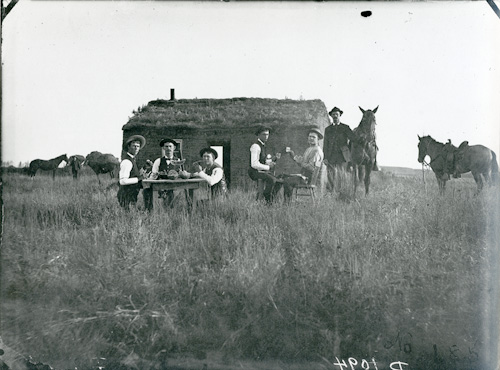
The sons of Zachariah Perry, 1886.
Detail. Eating watermelon and playing cards.
When photography was invented, young America was beginning to stretch into the new trans-Mississippi West, and within ten years of the revelation of Daguerre’s successful photographic process in 1839, image makers were pressing onto the frontier. Few pictures from this early period have endured, and we can only imagine the vision of the fresh world found by those who first photographed the lands of the Louisiana Purchase.’
The great national tragedy of the Civil War focused America’s attention away from the promise of its western lands, and, for a time, siphoned its photographers off for the grim business of picturing the devastation of war. It was during this war that Americans developed a true sense of the power of the photographic images. “Save the shadow ere the substance fades” was a catch phrase among photographers of the day, and many a family retained the memory of a lost son, husband, or brother in a photograph. Americans knew well the power of the photograph to so perfectly abstract reality. A person could literally see and, in a sense, experience that which another had seen and experienced without the selective interpretation of the painter’s brush. Time had become less fleeting; now slivers of it could be isolated and saved.

The David Hilton homestead, 1887.
Detail. Mrs. Hamilton was so embarrassed by her sod house she refused to be photographed in font of it. She insisted the pump organ be brought outside instead.
East Custer County, Nebraska, 1887.
Shooting ducks on Marsh lake, 1910. (altered).
Swain Finch showing how he fought grasshoppers in 1876. Photo 1900.
Detail. Threshing the (hand-drawn) grasshoppers with a willow bush.
Because many of the pictures that Butcher made were more than portraits, a unique interaction resulted between photographer and subject. Images appear to have been set purposefully like a stage. the subjects seem to assume stances that are symbolic and expressive. Some appear with jaw set and shoulders back, others with sweeping, master-of-all-you-survey gestures. In some instances people dragged their most precious possessions out to be photographed with them, or rearranges equipment and livestock to be a significant part of the image. But this hauling out of prized possessions was not done as often as some have assumed. Sod house dwellers were fundamentally a people who lived out of doors. Their house was a shelter while they slept, a haven from storm, and a place to cook in the winter. The standard litany recited about sod houses is that they were warm in the winter and cool in the summer—and that is true owing to their three-foot-thick earthen walls. But they were also dark and usually cramped. So when the weather permitted, almost all living activities took place outside. Many items, such as chairs, sewing machines, and stoves, normally associated with indoor activities are found outside in the Butcher photographs. When the sod house era had passed, so too had this need for outdoor living. In his later photographs, which show frame structures, the clutter of outdoor living disappears.
There is another element, too, affecting the often stiff and sober poses. The popular attitude toward photography in the late nineteenth century was markedly different from that commonly held all these years later. In Butcher’s time the photograph was still something produced by, an artist, and it was almost the turn of the century before the amateur snapshot appeared as a significant photographic genre. So, one might assume, the nineteenth-century Nebraska homesteader held an attitude toward the photograph not unlike the attitude held by his eighteenth-century eastern ancestor toward the limner. A photograph was a thing to be taken seriously.

Settlers taking the law into their own hands.
Boating on the irrigation canal, 1904.
Detail.
Dr. Kirby’s new car, 1911.
Detail.
The photographs (and a couple of the quotes) were all taken from the book, Solomon D. Butcher. Photographing the American Dream put out by the University of Nebraska Press in 1985.
Notes on the images: Very few of butchers own prints survive so the images here are reprinted from his negatives. in that he often cropped his shots drastically there is no way of knowing what his intended compositions really were.
For a bit more more on Butcher, his photographs, and the homesteader life in general see the following:
Prairie Settlement, the
at the library of Congress.
Nebraska studies.org. Specifically Living in a sod house and the section on the Homestead Act.
A new look at familiar scenes which uses digital tech to shed further light on Butchers photographs.
The Roots Web Butcher galleries.
The Song of the Lark from Masterpiece theater.
And lastly P.B.S.‘s New Perspectives on the West archive.
hide full text