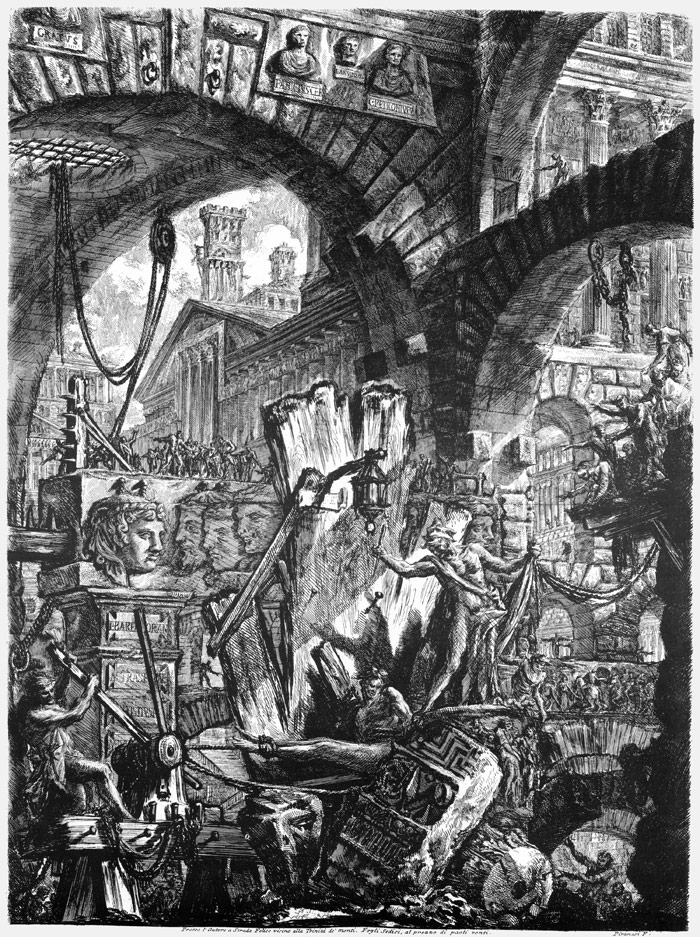
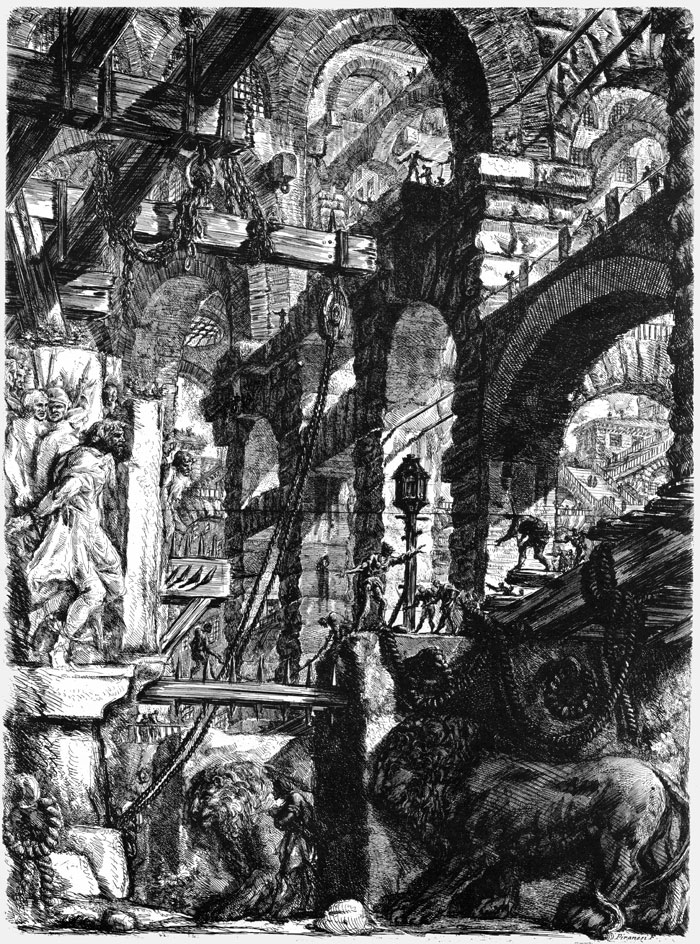
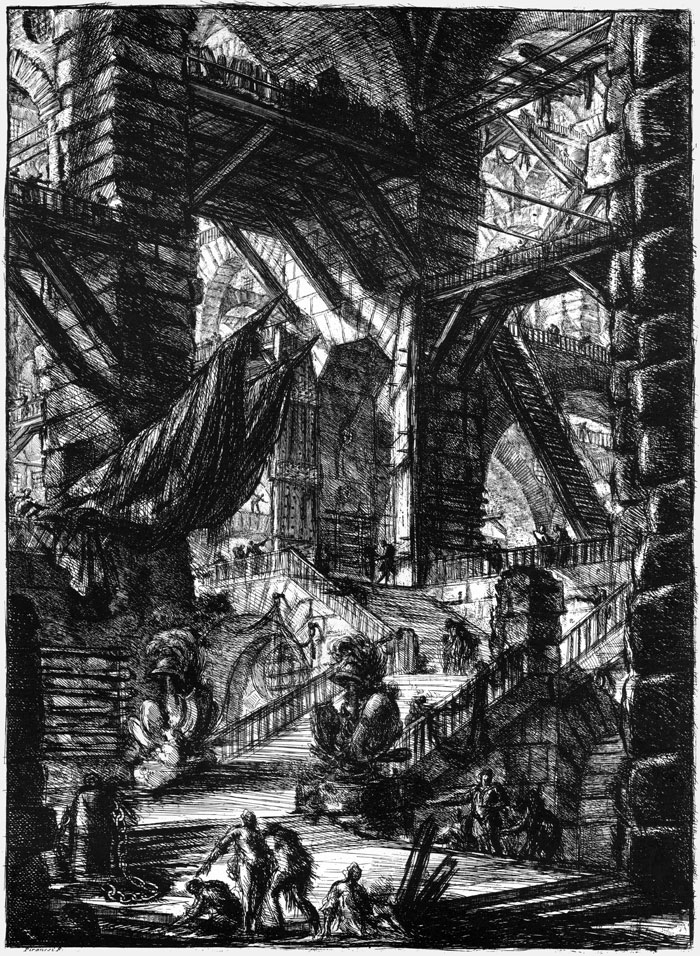
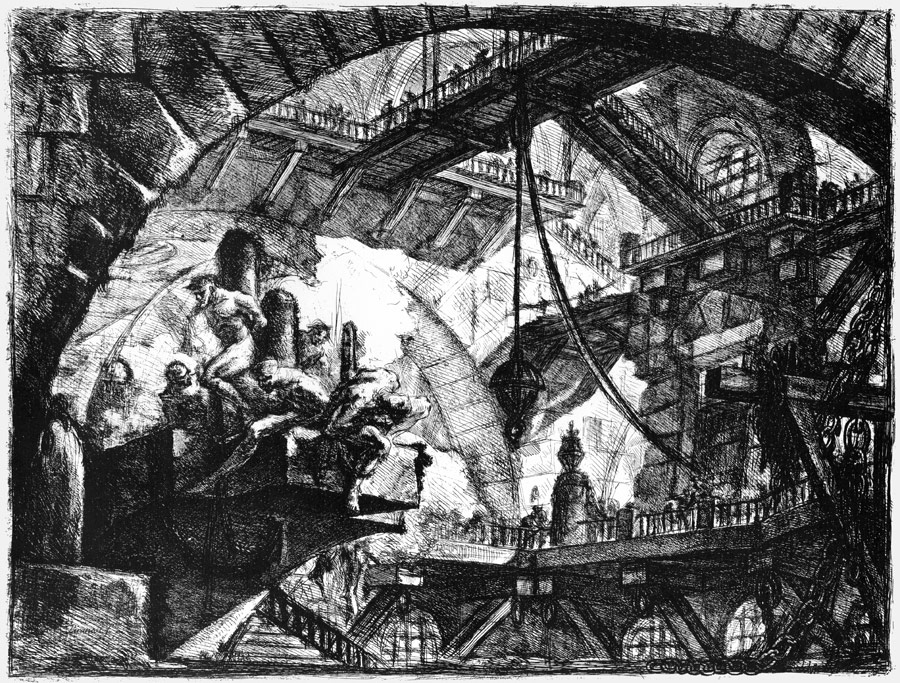
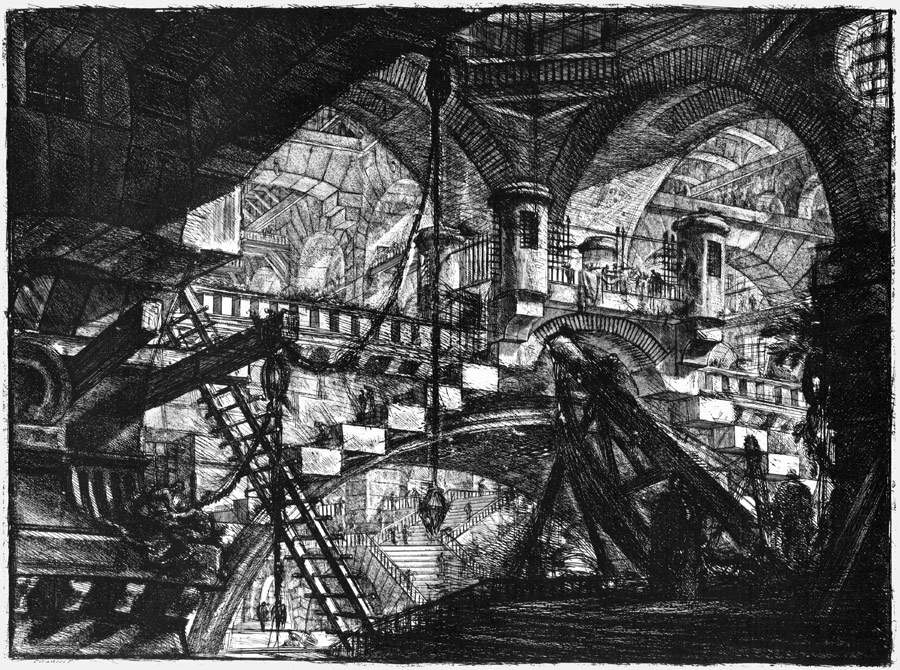
Picked up an oversized folio put out in 1973 reproducing a series of etching by Giovani Battista Piranesi. They depict a series of giant imaginary prisons. They are at once loose, layered, and complex, exhibiting a style not at all common in mid 18th century etching. Beyond this a quick read through the essay which begins the book shows Piranesi himself to be a somewhat tragic figure, not in any grand way, but rather in that he was unknown in his lifetime and to go a step further unfulfilled as well. You see even though these etchings of his are unmistakably beautiful Piranesi himself actually wanted to be an architect, a wish which, aside from a couple small commissions in the mid 1760’s completely eluded him. It didn’t help that the imaginary spaces he created were completely unbuildable, nor did it help that the lengthy original title of this series (which was etched in the frontispiece) was both grammatically incorrect and misspelled. Ah well, the guy might have died an unfulfilled wannabe architect but his etchings are quite something.

The Prisons, by Giovani Battista Piranesi









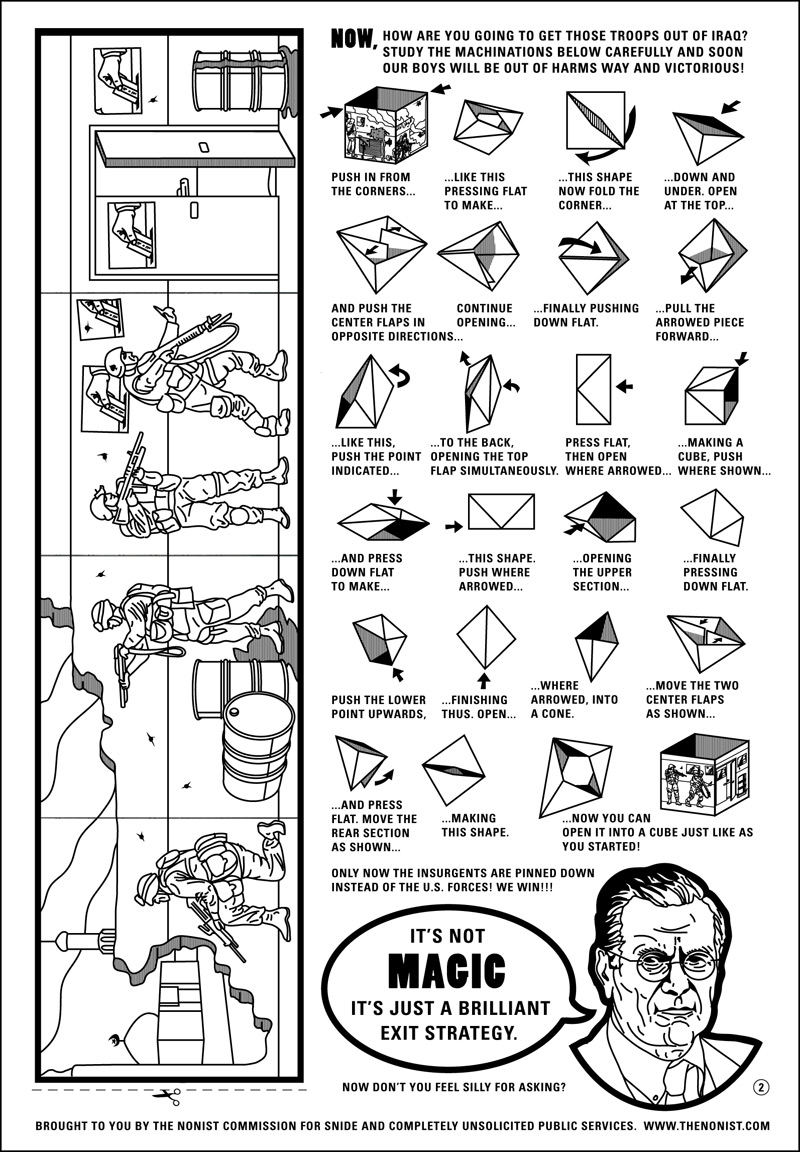
It strikes me that most of we lay-folk, unversed in the “art of war” as we are, find ourselves dismayed and horrified by the goings-on in Iraq (yes, lest we forget in the fog of news on other ugliness, we’re still there) and I wondered whether there was anything I could do to help my fellow citizens better grasp the situation. After much research I was surprised to find that the Bush cadre does indeed have an exit strategy, and that the violence, strife, and chaos we see daily on our idiot boxes is not exactly what it seems. Following this brilliant strategy the Administration in fact has the broiling insurgency right where they want them. In as much I decided to take the initiative and create a handy, hands-on, illustrated handout, suitable for the White House website, social studies teachers and parents wishing to instruct the young, or indeed any lay person seeking to better understand the Bush administration’s exit strategy. See below.

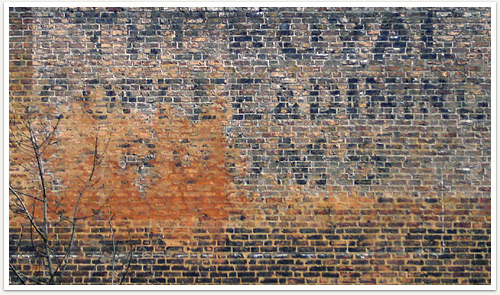
You walk the grid and are faced in the dark alleys, the back streets, the main drags, with those who have come before you. Looking up you see the work of their hands, the words which once enlivened their lips. Valiant signs try to hold on to the boldness of their pronouncements. They labor against the flow of time to go on advertising products and businesses long forgotten. Bent arrows point to non-existent locations. Fonts and faces of real and imagined ideals struggle against the inevitable fade; These artifacts and artifices long torn from their intended contexts, they are the blood of the hustle coagulated to stone.

C6H14O5
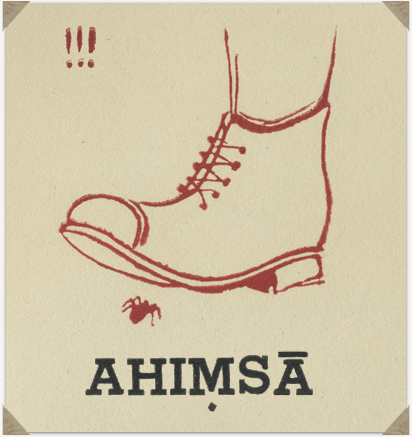
Ahimsa is a religious concept which advocates non-violence and a respect for all life. Ahinsa is Sanskrit for avoidance of himsa, or injury. It is interpreted most often as meaning peace and reverence toward all sentient beings. Ahimsa is an important doctrine of Hinduism, Jainism, and Buddhism (pdf). I think if it has made any inroads into the modern westerner’s mind they have likely been through its connection to yoga. I will not comment on the concept itself here, becuase in truth I am by no means sure of my own opinion toward the “do not swat a fly” brand of radical pacism, but rather will offer up a few images from an interesting book I picked up a long while ago called Chinese Poems and Pictures on Ahimsa by Raghu Vira, published in 1954. As for the sentiment they express, well, decide for yourself the value.


