on being sane in insane places
 read an interesting little article in fortean times science section yesterday about an informal experiment undetaken in 1972. a psychologist named david rosenhan wanted to test if trained mental health professionals could really diagnose mental illness. he sent eight sane volunteers into psychiatric hospitals across america. they each reported the same symptom, hearing an indistinct voice in their head, but otherwise offered completely accurate details of themselves and their pathology free life stories. each and every one was admitted into a the mental hospital. once inside they stopped claiming to hear voices and acted completely normally. everything they did however seemed to reinforce the doctors opinion that they were schizophrenics, and they were dosed accordingly. interestingly a full third of the other patients noticed the impostors straight away. the full text of the report published in 1973 titled on being sane in insane places is pretty interesting. also 30 years later a woman named lauren slater replicated resenhan’s experiment the results of which you can read here. aslo interesting.
sexy beasts
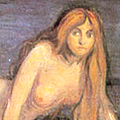 a fellow by the name of heinz insu fenkl has put together a nice illustrated essay delving into the history of some sexy beasts, namely- mermaids, sirens, etc. interesting. what i especially like is that the whole thing was touched off by an overheard argument in a starbucks about the companies logo. he gets into the desexualization and history of that particular ubiquitous trademark and along the way makes mention of sheila-na-gigs, aphrodite, delphine, disney’s ariel, jesus, the virgin mary, the film she creature, joseph campbell, and the relative late bloom of patriarchies among many other things. (via plasticbag) the site which hosts this essay has many interesting non-fiction goodies in their reading room actually, all devoted to the “mythic.” very nice.
who owns ideas?
In the new MIT Technology Review, a fine quartet of articles on the current state of ‘intellectual property’. See especially Lawrence Lessig’s the people own ideas! (see below for more.)
A quote:
“The Brazilian government is beginning to internalize the tenets of the free-culture movement as well. Brazil’s minister of culture, Gilberto Gil, is leading a push for practical reform of the copyright system. His ministry has launched a project called Points of Culture (Pontos de Cultura) that will establish free-software studios, built with free software, in a thousand towns and villages throughout Brazil, enabling people to create culture using tools that support free cultural transmission. If things go as planned, the result will be an archive of Brazilian music, which will be stored in digital form and governed by a license inspired by free software’s GPL. The Canto Livre project will “free music” made in Brazil, for Brazilians (and the world) to remix and re-create. And like a free-software project, it achieves that freedom on the back of copyright.
Gil is emphatically not against copyright. He’s one of Brazil’s most successful musical artists, which means he has benefited greatly from copyright. But he is also one of the very few Brazilian artists to make it outside of Brazil. And he is convinced that a different kind of economy might spread Brazilian creativity more broadly.”
Imagine that! A cabinet-level government bureau run by someone who cares! It’s enough to make one nostalgic for the New Deal.
Apropo of this post, see also Brian Martin’s indispensable essay against intellectual property, which does to info-feudalism what Tom Paine’s common sense did to monarchy: disembowels its entire rationale, exposing it as but a fraud and theft of the people’s right to decide for themselves.
Read Less...
quantum physics made relatively simple
 in 1999, legendary theoretical physicist hans bethe, who discovered the violent force behind sunlight, helped devise the atom bomb, and eventually cried out against the military excesses of the cold war delivered three lectures on quantum theory. the presentations made only limited use of mathematics focusing more on his own personal as well as historical perspectives. bethe was 93 at the time and died this past march. you can check the lectures out on the web thanks to a cornell site (where he worked and taught for 70 years) called quantum physics made relatively simple. each lecture averages about 45 minutes and are synchronized with slides of his talking points and archival material. the curious should bookmark and watch at their leisure. don’t let the thumbnail worry you, there are no chalkboards involved.
goy marriage: immoral or disgusting?
It’s good to see that someone is trying to do the right thing in these fetid times, even if it is the international jewish conspiracy.
the trouble with religion
the following short piece was written by a guy who has experienced the love and tollerance religion can offer first hand, namely- salman rushdie. it was originally published in the telegraph (calcutta) but i snatched it from sterling’s blog a few weeks back. give it a read.
THE TROUBLE WITH RELIGION
Wherever religions get into society’s driving seat, tyranny results
by Salman Rushdie
Exception to European secularism
I never thought of myself as a writer about religion until a religion came after me. Religion was a part of my subject, of course—for a novelist from the Indian subcontinent, how could it not have been? But in my opinion I also had many other, larger, tastier fish to fry. Nevertheless, when the attack came, I had to confront what was confronting me, and to decide what I wanted to stand up for in the face of what so vociferously, repressively and violently stood against me.
Now, 16 years later, religion is coming after us all and, even though most of us probably feel, as I once did, that we have other, more important concerns, we are all going to have to confront the challenge. If we fail, this particular fish may end up frying us.
For those of us who grew up in India in the aftermath of the Partition riots of 1946-1947, following the creation of the independent states of India and Pakistan, the shadow of that slaughter has remained as a dreadful warning of what men will do in the name of God. And there have been too many recurrences of such violence in India—in Meerut, in Assam and most recently in Gujarat. European history, too, is littered with proofs of the dangers of politicized religion: the French Wars of Religion, the bitter Irish troubles, the “Catholic nationalism” of the Spanish dictator Franco and the rival armies in the English Civil War going into battle, both singing the same hymns.
People have always turned to religion for the answers to the two great questions of life: Where did we come from? and how shall we live? But on the question of origins, all religions are simply wrong. The universe wasn’t created in six days by a superforce that rested on the seventh. Nor was it churned into being by a sky god with a giant churn. And on the social question, the simple truth is that, whereverreligions get into society’s driving seat, tyranny results. The Inquisition results, or the taliban.
And yet religions continue to insist that they provide special access to ethical truths, and consequently deserve special treatment and protection. And they continue to emerge from the world of private life—where they belong, like so many other things that are acceptable when done in private between consenting adults but unacceptable in the town square—and to bid for power. The emergence of radical Islam needs no redescription here, but their resurgence of faith is a larger subject than that.
In today’s United States, it’s possible for almost anyone—women, gays, African-Americans, Jews—to run for, and be elected to, high office. But a professed atheist wouldn’t stand a popcorn’s chance in Hell. Hence the increasingly sanctimonious quality of so much American political discourse: the current president, according to Bob Woodward, sees himself as a “messenger” doing “the Lord’s will”, and “moral values” has become a code phrase for old-fashioned, anti-gay, anti-abortion bigotry. The defeated Democrats also seem to be scurrying toward this kind of low ground, perhaps despairing of ever winning an election any other way.
According to Jacques Delors, former president of the European Commission, “The clash between those who believe and those who don’t believe will be a dominant aspect of relations between the US and Europe in the coming years.”
In Europe the bombing of a railway station in Madrid and the murder of the Dutch filmmaker Theo van Gogh are being seen as warnings that the secular principles that underlie any humanist democracy need to be defended and reinforced. Even before these atrocities occurred, the French decision to ban religious attire such as Islamic headscarves had the support of the entire political spectrum. Islamist demands for segregated classes and prayer breaks were also rejected. Few Europeans today call themselves religious—only 21 per cent, according to a recent European Values Study, as opposed to 59 per cent of Americans, according to the Pew Forum. In Europe the Enlightenment represented an escape from the power of religion to place limiting points on thought, while in America it represented an escape into the religious freedom of the New World—a move toward faith, rather than away from it. Many Europeans now view the American combination of religion and nationalism as frightening.
The exception to European secularism can be found in Britain, or at least in the government of the devoutly Christian, increasingly authoritarian Tony Blair, which is now trying to steamroller Parliament into passing a law against “incitement to religious hatred” in a cynical vote-getting attempt to placate advocates for British Muslims, in whose eyes almost any critique of Islam is offensive. Journalists, lawyers and a long list of public figures have warned that this law will dramatically hinder free speech and fail to meet its objective—that it would increase religious disturbances rather than diminish them. Blair’s government seems to view the whole subject of civil liberties with disdain: what do freedoms matter, hard won and long cherished though they may be, when set against the requirements of a government facing re-election?
And yet the Blairite policy of appeasement must be defeated. Perhaps the British House of Lords will do what the Commons failed to do, and send this bad law to the scrap heap. And, though this is more unlikely, maybe America’s Democrats will come to understand that in today’s 50/50 America they may actually have more to gain by standing up against the Christian Coalition and its fellow travellers, and refusing to let a Mel Gibson view of the world shape American social and political policy. If these things do not happen, if America and Britain allow religious faith to control and dominate public discourse, then the Western alliance will be placed under ever-increasing strain, and those other religionists, the ones against whom we’re supposed to be fighting, will have great cause to celebrate.
Victor Hugo wrote, “There is in every village a torch: the schoolmaster—and an extinguisher: the parson.” We need more teachers and fewer priests in our lives because, as James Joyce once said, “There is no heresy or no philosophy which is so abhorrent to the church as a human being.” But perhaps the great American lawyer Clarence Darrow put the secularist argument best of all. “I don’t believe in God,” he said, “because I don’t believe in Mother Goose.”
Read Less...
edison hate future
don’t know if any of you nonists read warren ellis’ blog, (i know a lot
of people do and he certainly does not need any plugs from me that’s for sure) but for the last couple of months he’s been sporadically putting up this clip art style, one panel, comic strip which cracks me up every time. it’s called edison hate future. see below for a few panels…
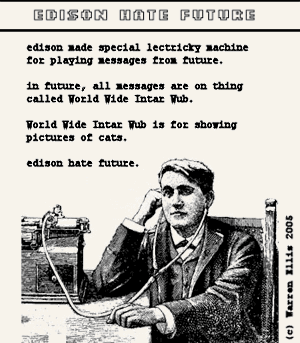
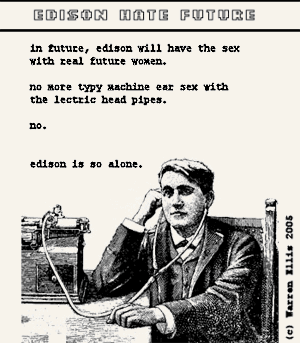
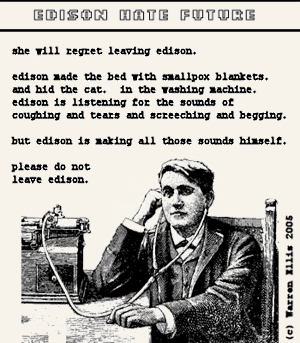
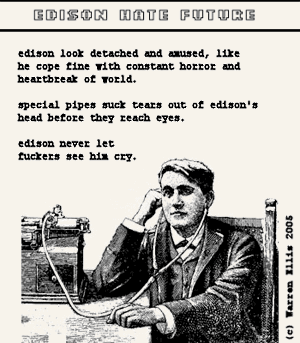
that last one’s my favorite. hahah. ah. what a smart ass.
Read Less...
becoming human
 came across this very slick and well done bit of webery called becoming human. they describe it as follows: an interactive documantary experience that tells the story of our origins. journey through four million years of human evolution..” etc, etc. sections include evidence, anatomy, lineages, and culture. there is a lot of interesting content including many images, lots to read, 4 short films and a host of audio. not sure if you will learn anything new but it’s well done and a fine way to kill some time you’d otherwise waste in a manner containing absolutely no references to cave painting.
White House Press Release
The Bush administration must feel that it no longer needs to be quite as covert about its agenda, judging from this rather piquant press release.
remembering cookie head jenkins
 this past march was the 18th anniversary of the murder of a breakdancer named cookie head jenkins. it strikes me that with all the outpouring of grief over the loss of biggie and tupac, cookie head’s death in contrast has been largely forgotten. i mean you never see a chico mural of cookie head frozen forever in one of his famous stances? big pun? yup. big l? indeed. jam master jay? certainly. and all rightly so! but why did the death of cookie head, which occurred way back in 1987, not stick in the hip hop communities consciousness?
is it because unlike so many other rap tragedies the crime was actually solved? is it because breakers (the isolated period which yielded so much electric boogalooing excepted) have always gotten the short shrift in the rap game? (dancing today is wik-wik-whack at best. no rock steady crews at the party. not even so much as a scoob and scrap lover! to be fair though dancing must be pretty tough in a bullet proof vest.) or is as i suspect the little matter of cookie head being a fictional character?! considering the thousand metric tons of pure high grade fronting which hip hop has produced in it’s history that hardly seems fair. what follows is a short pictorial remembrance of cookie head and those involved (or not) with the whole sad affair.

cookie head wowing the crowds.
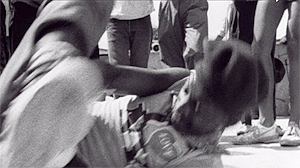
cookie pulling off one of his patented sick moves.

cookie’s missing! his family is concerned.

they hire a private eye to find some answers.
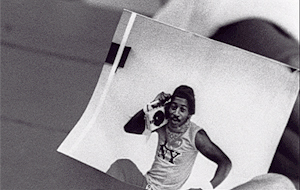
he hits the streets asking around.

the usual names come up but no ones talking.
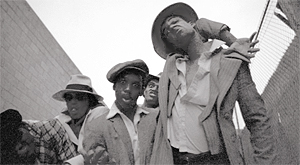
the streets are on edge, even the the zombie pimps are out in force.

somethings got to give. showdown time.

the field narrows. time to play hardball.
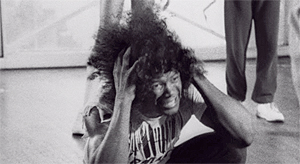
the detective’s risky activator gambit pays off. a confession!

the people wont forget you and your fictional plight cookie. this i vow.
Read Less...
sex lingo or murder as art, your choice
 came across a site called supervert while in search of thomas de quincey’s on murder considered as one of the fine arts. whilst there noticed a whole bunch of other stuff. today i’ve decided to share with you supervert’s sex lingo shockwave thingamabob. they describe it as follows, “ever wonder what a hummer is? ever worry you’re a meatball or a rabbit? ever go to a jack shack? ever stutter in embarrassment when a girl asks you if you want french, greek, roman, or russian? ever wonder what pornchops are? what a fluffer does? what a glory hole looks like? wonder no more! s now you can see the difference between ghoulies and gigglers… you can compare breeders, creepers, and steerers. you can learn how to make turkey money by sending a bennie to a pony girl. And a whole lot more!” enjoy, or if you prefer you can in fact download the pdf of de quincey’s black comedy on the art of murder instead. (apologies for that awful thumbnail.)
truth with a capital t
here at the nonist a multiple choice question is included for folks signing up as members of the site, namely: is there truth? all the classic magic eight ball answers are on offer as choices, i.e. outlook good, reply hazy ask again, etc. what i’ve noticed, and find fascinating, is how few people choose yes as their answer. a few people answered it is certain but by and large uncertainty or even outright doubtfulness seem to prevail. this result piques my interest and i decided to reach out and ask members of the site, as well as fellow bloggers, to address the issue directly and expound on their outlook on the notion of truth.
now it should be mentioned here that i can be extremely naive. i fully expected this to be an exercise people would embrace gladly, it being a real touchstone to understanding anyone’s outlook on life and the world, and as such something anyone ought to have a fairly well oiled opinion about. i imagined a compendium of blogger opinions, a ever expanding database of personal takes on the subject from bloggers and commenters far and wide. haha. well, as i said, i can be naive and i admit, thinking it through now, a request of this kind coming from a total stranger must be none too attractive. hell i didn’t even feel like writing about it today! in any case a few people were kind enough to offer up some musings on the subject and i’ve included them here, along with some historical opinions, for your consideration.
i say:
is there truth? i am among the doubtful. if pressed by menace of torture and threat of death, or if asked casually on the street by say a girl scout or frail old nun, i’d have to say, “no, i don’t believe there is such a thing as truth with a capital t.” i admit straight off this is a hard position to argue from in that no argument whatsoever can be made without the implication that the arguer in fact holds certain things to be true. otherwise what’s to argue about? expounding on why you believe ultimate truth does not exist is therefore difficult. to do so some qualifications need to be made.
truth exists. that’s the main qualification. is my name jaime? yes. do i posses a y chromosome and as such am a male of my species homo sapien sapien? yes. that’s true. am i currently sitting in my lair in new york city. yup. is the sun shining outside my window at this very moment? it is. absolutely. these are all true. i suppose i could be lying though so what about matters not having to do with me specifically which others might be able to corroborate? well, does 2 + 2 = 4? i think we can all agree it does so it’s true.
i could never dispute that truth exists. but truth with a capital t? greater truth? ultimate truth? i’m doubtful. i believe that outside of human consciousness there is no such thing as greater truth. i believe absolute truth is a construct, a fond wish of human minds always on the hunt for meaning and purpose. yes things exist, processes are in motion, events are occurring, forces are at work, all of which may be beyond our understanding, etc. but why should we suppose that any of it points to an overarching absolute truth, a meaning, or a greater purpose? in my mind that’s what the notion of truth with a capital t denotes, a baseline, beyond the merely factual, by which all else must be judged. the judging can only occur though with us as onlookers. remove us, or any sentient beings from the equation, and truth seems a moot point. is there truth beyond us, a truth not brought into being by the mechaniations of our value systems and judgements? is there truth outside of the sentient, “why?” obviously i can’t say and as such i feel it’s more honest to assume no, or at very least admit the jury is out and may always be out, than to assume yes without reasons beyond a fond desire.
another admission: i may be biased. it’s quite possible the endless parade of hypocrites and villains throughout human history claiming to have a strangle hold on absolute truth have turned me away from it forever. isn’t that what religion is after all? how much misery and suffering can be directly attributed to the arrogance of surety? how often is one view of the ultimate truth of existence forced upon someone else? we seem to have the damnedest time agreeing on totally inconsequential things… how can any one sentient being be more qualified than any other to make pronouncements on matters metaphysical and possibly beyond comprehension? i strongly suspect that everyone is exactly as qualified as everyone else in making grand pronouncements on this matter: in the case there is no such thing, perfectly qualified (and all equally correct) or in the case there is an absolute truth totally unqualified (and all equally wrong).
i certainly don’t know anything. i am like every other human- a delicate shifting amalgam of beliefs, conjectures, suspicions, faiths, impulses, misconceptions, instincts, dreams, superstitions, biases, fears, and irrational hopes. more often than not i feel like the squirrels in central park have a better grasp on reality and truth than i do. in so much as we keep assuming it exists, and keep searching it out, i suspect in the end, like the great riddle of the licks and the tootsie pop, “the world may never know.” that’s the best i can really do on the subject right now and though i have not said much, and added precicely nothing to human understanding of the subject, at least i’m not claiming to know something you don’t, or telling you that you’re wrong and will burn for all eternity, or go to jail, or have your nuts cut off as punishment. that should count for something in this truth racket shouldn’t it?
——————————————————
t.s. elliot says:
Truth on our level is a different thing from truth for the jellyfish, and there must certainly be analogies for truth and error in jellyfish life.
Richard Rorty says:
Truth is simply a compliment paid to sentences seen to be paying their way.
graham greene says:
The truth has never been of any real value to any human being—it is a symbol for mathematicians and philosophers to pursue. In human relations kindness and lies are worth a thousand truths.
——————————————————
member rich martinelli says:
I’m a strong proponent of words meaning something. So, YES there is truth. Logic requires it. Even if there was no truth, the statement “there is no truth” would be a truth. You get the idea. More difficult is to define when something qualifies as Truth.
Simple truths abound. They are generally not debatable and of little interest.
Concepts that must be adjudged truth or not truth flow like a continuum. Bigger issues, more variables, more complexity and separating truth from half-truth from flat out fibs becomes harder and harder. Truth gradually looses focus and gets fuzzier and fuzzier. At some point the label truth ceases to apply. Trust, belief, or—the worst—faith become more applicable…or, agreeing to disagree, spirited debate, and all out war.
The good news is that little truths build one upon the other and things that used to be fuzzy become clear. Then you don’t need to worry about them anymore. At least the rational among us don’t.
——————————————————
Oscar Wilde says:
A truth ceases to be true when more than one person believes in it.
ralph waldo emerson says:
Truth has not single victories; all things are its organs,—not only dust and stones, but errors and lies.
albert camus says:
Truth, like light, is blinding. Lies, on the other hand, are a beautiful dusk, which enhances the value of each object.
Schopenhauer says:
All truth passes through three stages: First it is ridiculed. second, it is violently opposed. Third, it is accepted as being self-evident.
——————————————————
frank feijen of one man safari says:
The truth is out there. I can feel it. And I don’t think it matters much if it’s the Truth with a capital T or not. It’s the same truth isn’t it? So the truth is out there but of what truth are we talking really? it is a pretty big word with a pretty stern face. Sort of distant, uninviting, looming large. I approach with caution.
One thing is for sure though: I don’t doubt my senses. I know the world is out there and I know you know it too. I have no doubts about thet at all, not even philosophical ones. I am not dreaming. I am not in The matrix. This is a sentence and you’re reading it right now, see? So I am not going into the Truth of What Is. I would like to be practical, I was thinking, and into an area where we all are: our ordinairy (or maybe not so ordinairy) daily lives.
When do I think about the truth, really, I wondered? Well, I guess it just starts when people start talking, or communicating somehow, was the quickly found answer. Because there might be a chance that they don’t tell the truth. This doesn’t apply so much to my little circle of friends and loved ones, but it sure does apply to the very large circle of people I don’t really know, don’t know at all, and maybe, just maybe shouldn’t trust completely.
Yes I have those doubts. Is what’s being told by that eager salesman the truth? Is that sly looking politician telling me something without a hidden agenda? Is he leaving something out? Had that actress really such a hilarious good time on the set with her co-star? What do we really know about the facts presented to us by news reporters? What is not told? Who is lying? The accuser or the accused? And etcetera.
Shadows are there because of the sun, and the truth, or truth with a capital t, wouldn’t matter much really, wouldn’t matter at all I’d say, not in the real world, if it’s opposite wasn’t there all the time sitting right next to it, being pretty stern too, and uninviting, and looming just as large.
——————————————————
william burroughs says:
Truth is used to vitalize a statement rather than devitalize it. Truth implies more than a simple statement of fact. “I don’t have any whisky,” may be a fact but it is not a truth.
john milton says:
Truth ... never comes into the world but like a Bastard, to the ignominy of him that brought her forth.
william james says:
Truth lives, in fact, for the most part on a credit system. Our thoughts and beliefs ‘pass,’ so long as nothing challenges them, just as bank-notes pass so long as nobody refuses them.
——————————————————
sebastian from pcl linkdump says:
no, there is no universal truth. but there is a momentarily truth for everyone.
this truth, though, may have changed to be not valid the next minute.
But this is all we got, and the best we can do. There are, however,
grains of truth to be found everywhere. Where these grains come from
nobody knows for sure. It’s all about meterorology.
——————————————————
Marvin Cohen says:
ah, the truth, what a thing it is! I sacrifice so much for it, with people: I forego, for truth’s sake, discretion, loyalty, diplomacy, tact, polite manners, elegance, grace, poise, balance, good taste, conformity, image-role, fashionableness, polish, confidences, promises, ambition, consistency, identity, clarity, comprehensibleness, good will, hypocrisy, and lots of other things—amass sacrifice, at truth’s altar. God! is truth worth it? I hope it is. It better be, in fact.
Lucien says:
the truth is hidden from us. Even if a mere piece of luck brings us straight to it, we shall have no grounded conviction of our success; there are so many similar objects, all claiming to be the real thing.
robert frost writes:
The truth is the river flows into the canyon
Of Ceasing-to-Question-What-Doesn’t-Concern-Us,
As sooner or later we have to cease somewhere.
——————————————————
member dave cascino says:
truth. When’s the last time I experienced something that elicited a good hard belly laugh. Ah yes, I remember now. t’was wednesday, three days ago. lasted roughly 2 minutes. to me, that’s truth. the moment of disconnecting and thus connecting at the same time.
truth is not what I think it is. to me, in fact, ‘thought’ blocks the truth. thoughts seem to connect things that are not connected and draw divisions where none exist.
alas, I am but a flawed piece of meat, I’m destined to get caught up in the traps of thought. guess its best to just keep up the vigilance. perhaps next time hearing a song will be the jolt that shakes me up and reveals some truth, even for a fleeting instant. heck, I’ll take it. the truth always lies nearby, waiting for me to wake up from my hypnotic state and experience it.
——————————————————
aldous huxley says:
When truth is nothing but the truth, it’s unnatural, it’s an abstraction that resembles nothing in the real world. In nature there are always so many other irrelevant things mixed up with the essential truth. That’s why art moves you—precisely because it’s unadulterated with all the irrelevancies of real life.
George Santayana says:
The truth properly means the sum of all true propositions, what omniscience would assert, the whole ideal system of qualities and relations which the world has exemplified or will exemplify. The truth is all things seen under the form of eternity.
h.l. mencken says:
Truth—Something somehow discreditable to someone.
Gustave Flaubert says:
There is no truth. There is only perception.
——————————————————
nicholas szumowski from robotcult says:
despite the usual flighty and light subjects I post on robotcult., this is one of those topics I am generally obsessed with. I should first like to state that I simply reduce all human response to the basic level of the identity or ego (and i do not mean basic actions like initial fight-or-flight, hunger, etc…). What is real, true, life, experience, meaning, belief, association, etc; I see as concepts processed and then projected by our identity. I am not really sure how much we can control this considering how deeply saturated we have become in such systems. I would say a belief system would be the second tier up from ego, then meaning mixed with some association. What we subscribe to for a belief system, will shape how we associate meaning with a given experience and the our response to it. If we are limited by this system, which I am thinking we all are at different levels, the experience is invalid in a sense.
I can not honestly explain what I see as truth with a capital t as I am writing and thinking about all of this within my own context. I have ideas, like I have stated, but what are they based on? If I remind myself that none of this is Truth, wherever and whatever it is I am in at the moment, then i feel closer to Truth as it is, not with what we project on everything. I guess think there is a “universal truth”, we just can not comprehend it and probably wouldn’t like it and think it quite boring were we able to because it is probably nothing. I find that quite beautiful
Maybe we should ask the Universe what it thinks? OK I must stop before i start spacing out and getting way off topic, I am very bad these days at writing in a coherent manner and articulating what is in my mind. I hope it wasn’t too confusing and please take it with a grain of salt, i’m only human! I think it would be great to get a big open group dialogue going and exchange ideas as I see that as one of the the only things that gets us evolving and out of the static little loops/systems we sometimes get lost in!
——————————————————
Soren Kierkegaard says:
The truth is a snare: you cannot have it, without being caught. You cannot have the truth in such a way that you catch it, but only in such a way that it catches you.
aristotle says:
The investigation of the truth is in one way hard, in another easy. An indication of this is found in the fact that no one is able to obtain the truth adequately, while on the other hand, no one fails entirely, but everyone says something true about the nature of things, and while individually they contribute little or nothing to the truth, by the union of all a considerable amount is amassed. Therefore, since the truth seems to be like the proverbial door, which no one can fail to hit, in this way it is easy, but the fact that we can have a whole truth, and not the particular part we aim at shows the difficulty of it.
samuel butler says:
Truth: It should not be absolutely lost sight of but it should not be talked about.
——————————————————
member tom bolger says:
So the truth is I have started and erased this essay on truth about 5 times now. This is mostly because I find the subject annoying and almost insulting. I have a hard time threading the needle as it were, with things like this. Where do we go to find truth when we live in the country of the convenient lie? This country was founded on some so called truths that were found to be self evident and yet simultaneously did not apply to everyone. A war was fought to ensure that people in America did not have to be taxed without being represented, taxed on their cotton, their tea and their slaves. What was the truth of the revolutionary war? Patriots fighting for their country or landowners fighting for their land? Truth, what a rotten word, what a terrible concept.
Truth, if you believe in the truth, means that you are beholden to some set or concepts or pre-conceptions that bind you to a course of action in any given situation. Some truths, like the truth of gravity, are considered facts. Facts are supposed to be truths with scientific grounding that are inescapable and undeniable, yet it was once true that man could never fly. It was once truth that man could never explore space. Hell it was once true that all of our physical ailments were caused by restless spirits and demons. So, if our idea of what is and is not physically possible changes from decade to decade, from century to century, where does that leave the other truths? The philosophical, the spiritual and emotional truths?
Webster’s dictionary defines truth as:
God I have no idea. the dictionary is all the way in the living room and i’m here in front of the computer and i’m not going all the way over there just to look something up. besides, i think it’s an American Oxford anyway. (yeah yeah, dictionary.com and all but I’m not doing that either)
i think truth exists but i also think that it is subjective more often than not. we as a species seem to simultaneously have both a hunger for and an amazing ability to obfuscate the truth. i think instinct is an undeniable truth, the instructions hardwired into us by millions of years of evolution that resides in the tiny little clenched fist part of our brains. i think that truthfully, we spend more time justifying or denying these electrical impulses then a we would care to admit. I think it has never been easier for a person to deny the very idea of truth than it is right now in history, we are so insulated from each other and from the world that it is a simple thing to make up a reason for not doing something, for not giving to charity, for carpet bombing some city, for wasting resources, for just not giving a shit about anyone but ourselves. I also think that the average person is capable of being led to do the right thing by his instincts more often than not if they choose to listen to them and if they aren’t a sociopath.
The big problem as I see it is that we have become a nation of solipsists and dissemblers each one of us ignoring what our gut may tell us in favor of being comfortable. I can not honestly believe that deep in her heart, soccer mom 1a does not have twinges of conscience about the fact that young men and women are dying half a world a way in part so she can continue to badly pilot that 8 mile to the gallon oversized monstrosity she calls a family vehicle, but those twinges get buried underneath the hum of her motor, the twitter of her cel-phone and the demands of her children.
Our society may in general be more cluttered more full of noise than signal when it comes to the idea of truth with a capital t, but I don’t think our particular brand of self seeking and denial is germane only to America in the 20th and 21st century. It seems spanning the length of recorded history we find one charismatic personality or one group of power players willing to distort truth to make their own ends come to fruitition. I have spent a paragraph or two dancing around the subject but in my eyes the idea of truth boils down to one thing, and that is the relative worth of life. Meaning that we are all worth the same potentially and that worth is not defined by the person doing the judging but is inherent and potential in the breast of all people currently walking, who once walked and who will walk the face of this planet. I am not trying to paint this in terms of a higher power although I do believe in one, I feel it is something that stands outside matters of faith, all men and women fundamentally are worthy of life and it stands to reason that if they are worthy of life, they are worthy of being loved.
Some people are better or worse at this than others, either through subconscious learned behavior patterns, rank cynicism, or ignorance, but this does not mean they should be consigned to some status of lesser or less worthy. Americans in particular have a hard time with this. As our recent and ongoing illegal war proves, we as an aggregate seem to be pretty ok with the idea of mass murder in order to prolong and secure our style of living for even a couple of years. I don’t want to make this into a political thing, although it is. It most certainly is. Concepts and ideologies concerning what the truth is have never had more of an impact on this planet than they do now. We are at the point where millions of lives can potentially be erased over some matter of doctrine that one party holds to it’s breast and declares to be his most high and that some other party repudiates and finds to be unacceptable. Buttons can be pushed, phone calls can be made, and millions can die. But see, the reality is that a conflagration between oh lets say Islamic fundamentalists and first world capitalists (as far fetched as that may seem…) isn’t about whose truth is um, truer. It’s about being right.
Now being right has as much to do with truth as football does with brain surgery. Being right, is about being inflexible in the face of contrary facts as often as not. Being right is a useless activity that human beings engage in so they don’t have to face up to the fact that they may have possibly been misled at some point in their lives. that a series of decisions they have made on a flawed assumption may have put them in a situation, that when viewed rationally, is completely untenable. Being right usually boils down to shouting louder, hitting harder and kicking the other guy when he is down. It also seems, to my mind, that we are much more often interested in being right than we are in being true. Of course, paradoxically, all the big truths have to stem from personal ones and if we set our store in a philosophy that is fundamentally flawed (‘cheap oil’ for example or ‘all women were put on the earth to tempt the purity of man’) we are left in the unpleasant position of trying to make sure that other people understand that our truth is right and the other guy is some evil-doing jerk with questionable taste in facial hair
The truth is, I often think we’re kind of fucked. But in my opinion, if there is any salvation to be had, it lies with that concept of personal truth. If we clean up our side of the street, and start at home, ensure that we live our lives in a fashion we consider to be compassionate and honest and take pains to make sure that it is represented in our daily actions (not just ‘thinking good thoughts’ while assiduously putting the screws to our friends and neighbors) that we are responsible for our actions, that we consider them not just take them. That we make amends when we find that we have been wrong (that we are capable of even admitting that we were wrong) that we teach by example, that we set a course for ourselves as best as we can maybe we can reach some sort of critical mass by which we’ll at least be nicer to each other. Be a little more flexible. Imagine a world where the concept of truth was not a whip which drove multitudes to murder but something that fomented a nice little debate in a public square or an online community somewhere.
Ok, I almost quoted john lennon in that sappy final paragraph so I think I’m done.
——————————————————
and so is this post, for now. i’d love to keep this open to anyone out there who cares to contribute or weigh in. please feel free to do so in the comments section or to send us your thoughts via the contact link. who knows, maybe this will grow over time we can add this to the projects page? thanks to all of you who took the time to respond and to all dead folk whose words i plundered. all the best! (p.s. to any of said dead folk, if you’re reading this from beyond the grave, kindly get off your ghostly asses and haunt my apartment sometime soon. stop being so stingy will you please?! what did you find out?) salud.
Read Less...
wal-fare sucks tax payers dry
Think twice the next time you step into a Wal-mart to purchase cheap tube socks, bulk chex mix, or your yearly trapper keeper. The hand that feeds you is also the hand that needs you, in the form of your tax dollars. Sneaky Wal-mart Execs have figured out a way for you to pay their employees the living wage that they’d rather keep in the form of profits. In general, I recommend this website for debunking the conservative bias that is so hip in current mainstream media.
a journey into diggin’
 republish.org is offering up a fantastic mix of madlib and madlib sampled tracks for download. it’s compiled and manipulated by two time world champion dj. trouble and runs over an hour in length. it’s called a journey into diggin’ (subtitled quasimoto meets himself, rarities, remixes and originals. it even includes super tight packaging art you can download as a pdf.) very nice. includes pieces from all madlib projects from lootpack on, as well as tracks from mandrill, axelrod, the dells, kool and the gang, etc. get it while you can.
the birds and the bees (and the molecubes)
 living organisms are very complicated aggregations of elementary parts, and by any reasonable theory of probability or thermodynamics highly improbable. that they should occur in the world at all is a miracle of the first magnitude; the only thing which removes, or mitigates, this miracle is that they reproduce themselves. therefore, if by any peculiar accident there should ever be one of them, from there on the rules of probability do not apply, and there will be many of them, at least if the milieu is reasonable. -john von neumann, from his theory of self-reproducing automata. the study of artificial self-replicating structures has been taking place now for about half a century. penrose’s wooden tiles, greg chirikjian’s lego robot, cellular automata, etc. now we can add to that list hod lipson’s molecubes. check out the videos, and read the faq for some interesting stuff. also here’s a short article from new scientist.
a poet looks at the world…
 the way a man looks at a woman. that’s a wallace stevens quote. nice. when he was an old timer he had this to say about his life’s work, “as I look back on the little that I have done and as I turn the pages of my own poems gathered together in a single volume, I have no choice except to paraphrase the old verse that says that it is not what I am, but what I aspired to be that comforts me. It is not what I have written but what I should have written that constitutes my true poems.” as for me- when i was young i loved poetry. when i was slightly less young i did not. i scoffed and spat. it represented all the saccharine romanticism i was embarrassed of in myself. now years later and to my surprise, i find i’m beginning to enjoy it again. wallace was and still is among my favorites, a group that can be counted on one and a half hands. just because i’m in the mood, here are a few of his poems. enjoy.
Disillusionment of Ten O’Clock
The houses are haunted
By white night-gowns.
None are green,
Or purple with green rings,
Or green with yellow rings,
Or yellow with blue rings.
None of them are strange,
With socks of lace
And beaded ceintures.
People are not going
To dream of baboons and periwinkles.
Only, here and there, an old sailor,
Drunk and asleep in his boots,
Catches tigers
In red weather.
Six Significant Landscapes
I
An old man sits
In the shadow of a pine tree
In China.
He sees larkspur,
Blue and white,
At the edge of the shadow,
Move in the wind.
His beard moves in the wind.
The pine tree moves in the wind.
Thus water flows
Over weeds.
II
The night is of the colour
Of a woman’s arm:
Night, the female,
Obscure,
Fragrant and supple,
Conceals herself.
A pool shines,
Like a bracelet
Shaken in a dance.
III
I measure myself
Against a tall tree.
I find that I am much taller,
For I reach right up to the sun,
With my eye;
And I reach to the shore of the sea
With my ear.
Nevertheless, I dislike
The way ants crawl
In and out of my shadow.
IV
When my dream was near the moon,
The white folds of its gown
Filled with yellow light.
The soles of its feet
Grew red.
Its hair filled
With certain blue crystallizations
From stars,
Not far off.
V
Not all the knives of the lamp-posts,
Nor the chisels of the long streets,
Nor the mallets of the domes
And high towers,
Can carve
What one star can carve,
Shining through the grape-leaves.
VI
Rationalists, wearing square hats,
Think, in square rooms,
Looking at the floor,
Looking at the ceiling.
They confine themselves
To right-angled triangles.
If they tried rhomboids,
Cones, waving lines, ellipses—
As, for example, the ellipse of the half-moon—
Rationalists would wear sombreros.
Gray Room
Although you sit in a room that is gray,
Except for the silver
Of the straw-paper,
And pick
At your pale white gown;
Or lift one of the green beads
Of your necklace,
To let it fall;
Or gaze at your green fan
Printed with the red branches of a red willow;
Or, with one finger,
Move the leaf in the bowl—
The leaf that has fallen from the branches of the forsythia
Beside you…
What is all this?
I know how furiously your heart is beating.
Thirteen Ways of Looking at a Blackbird
I
Among twenty snowy mountains,
The only moving thing
Was the eye of the black bird.
II
I was of three minds,
Like a tree
In which there are three blackbirds.
III
The blackbird whirled in the autumn winds.
It was a small part of the pantomime.
IV
A man and a woman
Are one.
A man and a woman and a blackbird
Are one.
V
I do not know which to prefer,
The beauty of inflections
Or the beauty of innuendoes,
The blackbird whistling
Or just after.
VI
Icicles filled the long window
With barbaric glass.
The shadow of the blackbird
Crossed it, to and fro.
The mood
Traced in the shadow
An indecipherable cause.
VII
O thin men of Haddam,
Why do you imagine golden birds?
Do you not see how the blackbird
Walks around the feet
Of the women about you?
VIII
I know noble accents
And lucid, inescapable rhythms;
But I know, too,
That the blackbird is involved
In what I know.
IX
When the blackbird flew out of sight,
It marked the edge
Of one of many circles.
X
At the sight of blackbirds
Flying in a green light,
Even the bawds of euphony
Would cry out sharply.
XI
He rode over Connecticut
In a glass coach.
Once, a fear pierced him,
In that he mistook
The shadow of his equipage
For blackbirds.
XII
The river is moving.
The blackbird must be flying.
XIII
It was evening all afternoon.
It was snowing
And it was going to snow.
The blackbird sat
In the cedar-limbs.
The Plot Against the Giant
First Girl
When this yokel comes maundering,
Whetting his hacker,
I shall run before him,
Diffusing the civilest odors
Out of geraniums and unsmelled flowers.
It will check him.
Second Girl
I shall run before him,
Arching cloths besprinkled with colors
As small as fish-eggs.
The threads
Will abash him.
Third Girl
Oh, la…le pauvre!
I shall run before him,
With a curious puffing.
He will bend his ear then.
I shall whisper
Heavenly labials in a world of gutturals.
It will undo him.
more wallace stevens poetry here if you’re interested.
Read Less...
the fantastic
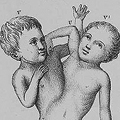 mark over at exclamation mark took the wind out of my sails a little on this one. been sitting on my desktop for a while, but hey, you snooze… great link in any case. the fantastic in art and fiction is one of cornell university’s many fine online galleries. this one collects samples of the fantastic, grotesque, and bizarre from within their library holdings. some beautiful stuff here if you’re into such things. sections include: angels and demons, weird science, bestiary, possession and insanity, freaks, etc, etc. i only hope they expand it. continue your exploration with the somewhat related gravely grotesque a small gallery of nineteenth century gargoyles also presented by cornell. enjoy.
page 2 of 3 pages < 1 2 3 >