A couple of weeks ago I saw a link somewhere to a “list of fictional something-or-others” at Wikipedia. Might have been fictional expletives or fictional gods (which by the way is far too long a list since it could have been summed up easily in a single word, I’ll let you guess what that word is); I can’t rightly remember. I got the bright idea though to do a broad search for “list of fictional” at Wikipedia, thinking the results might make for a nifty little post. The search turned up a whopping 2150 results! That’s a lot of fictional stuff. Too much in fact. I mean how do you choose between fictional chimpanzees, fictional drugs, fictional robots, fictional universes, fictional narcissists, fictional books, notable mustaches in fiction, etc, in order to craft a cogent post? You can’t. So I scrapped the idea.


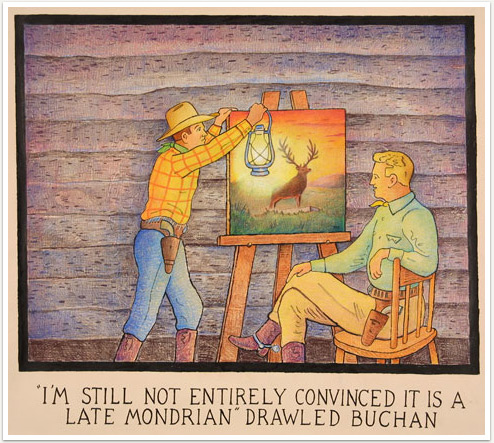
Quote, “Rockets, canoes, bagpipes, fish, good old chaps with patches on their elbows and jokes about Derrida: Glen Baxter’s world is always instantly recognizable. Blunt, innocent-looking lines tether its extravagant surrealism to the page like guy ropes, the economy of those pen strokes undermined by the accompanying text, blocked out in hand-written capitals, which sheds often surprising light on the dummy-blank expressions of the characters.” from an old Guardian article called King of the surreal. Anyone whose work contains multiple Giacometti jokes, or indeed a constant stream of art gags, gets the nod in my book. So let me ask you, are you, like myself, an admirer of this Glen Baxter by any chance? Well, you are about to become one.
Links: Glen’s homepage, Thorogood, Modernism Inc, The Tate, Flowers East, Int. Herald Tribune piece, and a short audio interview.

It may surprise you to learn, good reader, that in our splintered, chaotic and perhaps irreducibly complex world there yet remains something pure. In my research, relentlessly poking every facet of human experience, I have identified something so widespread and yet simultaneously so unlikely as to be truly worthy of the overused adjective- extraordinary.

The above (picturing a decidedly unorthodox color blindness test) is from a series of whimsical, satirical paintings by artist Jose S. Perez. Collectively titled Perez on Medicine the 29 separate pieces each focus on a different medical specialty. The whole series, which was initially published as a book in 1993, is presented online at The National Library of Medicine site. Each plate includes a written interpretation as well as initial pencil studies. Very nice.
Quote, “Some books are ahead of their time. Some books convey a message which threatens prevailing notions, and are therefore brushed away. Some books are mixtures of profound insights and garbled speculations. Hamlet’s Mill, An Essay on Myth and the Frame of Time (1969) partakes to varying degrees in all of the above. Hamlet’s Mill began a revolution in understanding the profound sources of ancient mythology. Although it tottered on the edge of oblivion for years, it has reemerged as the fundamental inspiration for many progressive researchers who find the precession of the equinoxes lurking within ancient creation myths around the world.” - From an intro to the complete online text of Hamlet’s Mill by Giorgio de Santillana and Hertha von Dechend. (Via.)
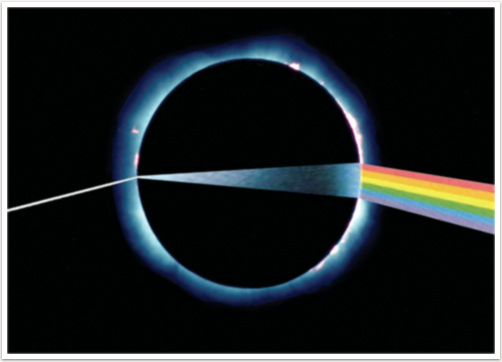
Quote, “Some stars undergo a natural process that generates acoustic waves similar to those produced by wind instruments. The gas inside the star contracts and expands, which leads to a heating and cooling cycle. This periodic change in temperature alters the star’s light intensity, and astronomers can detect the resulting pulse patterns with telescopes. Kolláth and Keuler use this data as a basis for their music, but after one critical adjustment: Since the frequencies of star sounds are much too low for humans to hear, the team uses a computer program to shift the pitches by as many as 30 octaves—over four times the difference between the highest and lowest notes on a piano. So essentially, stars produce sound waves that appear visually as patterns of light, which are then translated into music.” Seed story on astrophysicist Zoltán Kolláth and composer Jen? Keuler’s Stellar Music Project.
Related: space sounds, space audio, ESA sounds from space, space weather vlf receiver, listening to leonids, sounds from space: sonification applications, NPR The Musical Sounds of Space, and the sounds of Titan.

Chances are when you conjure in your mind’s eye an image of a “psychedelic” 60’s rock poster (whether for fun or because you’re an ex-hippie flashing back involuntarily to your blocked-out youth from within the soft leather comfort of your Mercedes) you are likely, without even realizing it, envisioning a Victor Moscoso. It’s been said that Moscoso “was the first of the rock poster artists with academic training and experience.” He studied at the Cooper Union and at Yale (under Josef Albers) and it shows. Moscoso’s own style is, at this late date, damn near synonymous with the form in the same way that you think “band-aid” when you envision of a little adhesive-backed bandage. Likewise though Robert Crumb went on to be the most famous underground artist of the era I guarantee when you think of Zap Comix you think of Moscoso’s dancing mr. peanut / mr. penis cover. I don’t think it’s overstating it to say Moscoso’s style was aped and absorbed by the culture to a such degree that it just seems to be a force of history in retrospect rather than the inspired work of a really talented designer.
To see and read more try: Fine Arts Museum SF, the Neon Rose series & Victor Moscoso at Wolfgang’s Vault, the Victor Moscoso poster gallery, more Neon Rose, the music machine, an interview at the Comic’s Journal, Liberatore: A portrait of the artist as a counterculture connoisseur, and 1960s Psychedelic Rock Concert Posters and the Broadening of American Spirituality.
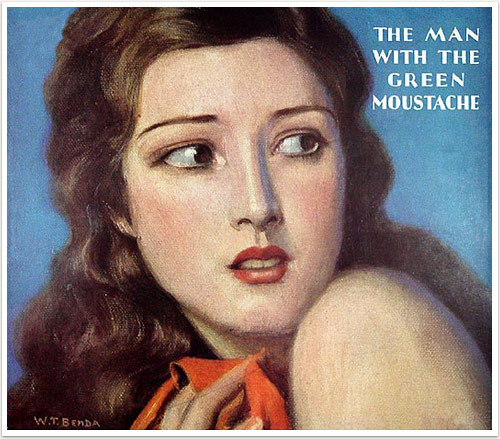
Yes ladies, by all means, draw your shawl near to yourself and beware The Man With the Green Moustache! There is no telling where it, or he, has been! This image was taken from an extensive and beautiful collection of magazine covers stretching, mainly, from the 1890’s through the 1940’s. (Via / If you scroll down you’ll see the full menu.) It is presented by a site dedicated to Ellis Parker Butler, with each of the magazine covers representing an issue which contained his work. Unfortunately the story of the dreaded “green moustache” was penned by someone else, so we’ll most likely never know its wonders. The site offers a few Ellis-penned surrogates though in the form of some similarly mysterious sounding men like- The Man Who Did Not Go to Heaven on Tuesday, The Man Who Murdered a Fairy, The Man Who Was Someone Else, and The Man With the Glass Front in their reading room.
Gk. hysterikos, “of the womb.”
From wikipedia: An ancient Greek myth tells of the uterus wandering throughout a woman’s body, strangling the victim as it reaches the chest and causing disease. This theory is the source of the term hysteria, which stems from the Greek word for uterus, hystera. A prominent physician from the second century, Galen, wrote that hysteria was a disease caused by sexual deprivation in particularly passionate women: hysteria was noted quite often in virgins, nuns, widows, and occasionally married women. The prescription in medieval and renaissance medicine was intercourse if married, marriage if single, or massage by a midwife as a last recourse. It was a popular diagnosis in the Victorian era for a wide array of symptoms and treatment came in the form of a “pelvic massage” — manual stimulation of the woman’s genitals by the doctor to “hysterical paroxysm”, which is now recognized as orgasm.
Links: Female hysteria, Why Only Women Get Hysterical, In the History of Gynecology, a Surprising Chapter, Freud, Charcot and hysteria: lost in the labyrinth, Hysteria’s Notorious History, Medical texts and other fictions, The wandering womb, Unbalanced Drive Shaft, History of the vibrator, For pleasure, Come again?, Nerves and Narratives, The Wandering Libido and the Hysterical Body, and finally…

All this and the surface of the sun?
(which ought to be a poem title but is here squandered)
• “It’s there in every aspect of life. You can’t stop looking at things through your designer eyes. Everything you do is clouded by this thing that lives inside you.” The Design Disease from Noisy Decent Graphics.
• Details and vid for Natetrue’s kick-ass Time Fountain. (Thanks Rich.)
• On October 24, 1946 a group of soldiers and scientists in the New Mexico desert saw something new and wonderful—the first pictures of Earth as seen from space.
• Art Lozzi muses on and explains some background painting techniques. (Via.)
• Video for Black Refuge by José González side project Junip.
• Behold and quial before Oded Ezer’s Typosperma project. (Via.)
• Greatest song in the history of music? You decide. (Thank you kempa.)
• A four and a half minute compliation of every Ray Harryhausen animated creature in feature films, presented in chronological order. (Via.)
• Behold The Surface Of The Sun and ponder your tiny and piddling insignificance!