Quote, “Have you ever considered the possibility that God might be a crazy woman? Or that John Dillinger died for you? Do you think there might be a secret technique by which the Enlightened can literally get Something for Nothing? Could the Martians have the true religion while Earthians are lost in superstitious darkness? Can a cup of coffee be a sacrament, and if not, why not? Does the mathematics of six-dimensional space-time and philosophy of Multi-Ego Pantheistic Solipsism explain the universe?” Intro to the 1986 piece Religion For the Hell of It by the revered Robert Anton Wilson.



Quote, “John Currin’s new show draws a sharp distinction between sex and sexiness. There is more explicit erotic action on view than in any images hitherto by this avid courter of controversy, and there is sexy paintwork to boot. But, instructively, you don’t find both in the same places… A controlled, super-knowing nastiness used to typify Mr. Currin’s bodies — women with sagging, almost tumorinflicted posteriors, absurd basketball busts, and protruding, bony hip joints — and still comes across [in some pictures]. But there is a different dynamic between Mr. Currin and chinaware. If anything, the elusive, recalcitrant objects inflict a certain cruelty on the artist trying to fix them to the canvas while getting across their homey American rococo.” From an interesting piece by David Cohen over at Art Critical about Currin’s new show at Gagosian.
Meanwhile over at David Zwerner Lisa Yuskavage has a new show (looking for all the world like it was separated at birth from a group of Julie Winter character sketches for Sam Kieth’s The Maxx.)

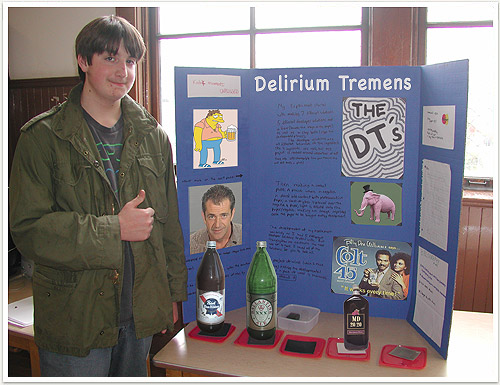
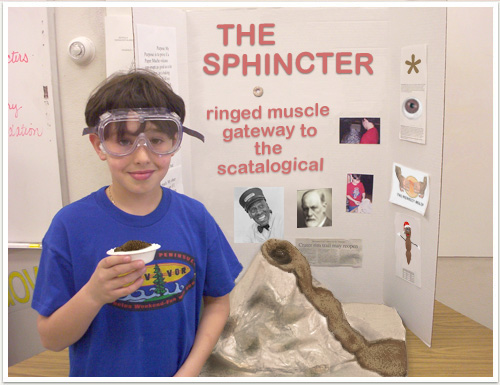
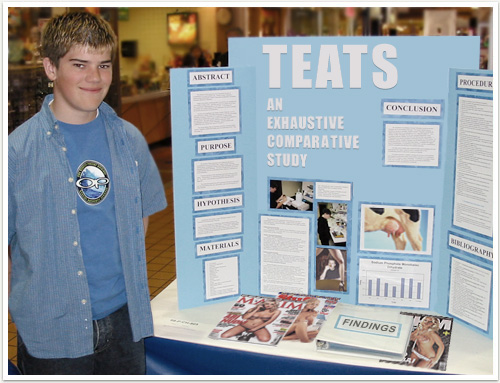
While searching out some relevant linkage for the term “pantheistic solipsism” I came up pretty well flat. One hit, however, made me laugh. There was an entry for it on a site called “all science fair projects.com” which bills itself as the Science Fair Project Encyclopedia… I started thinking about some kid doing research for his tired old sputtering volcano and coming across (who knows how) the idea for “pantheistic solipsism” and deciding, “Hey, that sounds like a great science fair project!” What are the odds? I imagined the kid standing there with some poster board diorama with scribbly marker text and a few taped up photos and I just had to laugh. Made me wonder what other unlikely bits of science project fare might be listed in the Science Fair Project Encyclopedia… I laughed heartily, then, of course, I had to fire up ye olde photoshoppe. See below.





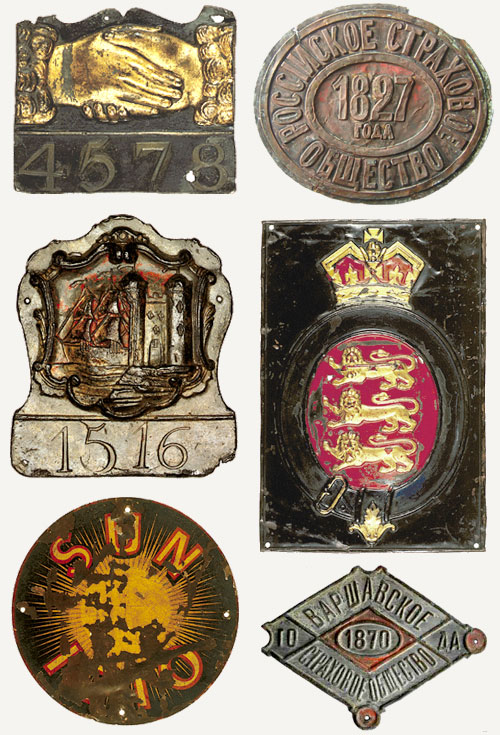
Prior to the 17th Century there wasn’t much in the way of organized fire control in Europe. Neighborhood night watches were organized by the residents of an area and they would essentially stay awake and keep an eye out for leaping flames. In the late 17th century this was to change, after The Great Fire of London in 1666 wiped out tens of thousands of homes, the first fire engines (hand pumps) appeared, and by the beginning of the 18th Century fire brigades, in the modern sense, were being created…


Infinite Thirst
Or: The Misadventures of Yorick’s Skull, Part 1.
The skull of Yorick, deceased jester to a fictional court, rolls into a bar, occipital bone over frontal, until it comes to rest at the base of a bar stool. It stares upward and though sans-mandible calls out to the barkeep none the less, “What Ho goodman Carl!” The words are slightly slurred, whether for lack of larynx and lips or because this isn’t the first stop on the skull’s boozey itinerary it’s hard to say. The bartender, Dave, turns to see who’s calling him “Carl” (not being versed in Elizabethan slang) and sees no one.

Elevator lady, elevator lady, elevator lady, elevator lady…................. Levitate me.
Quote, “In the beginning was the Word. There was a little pond and in the pond was a little letter “O”, a word. Soon the pond was full of trillions of O’s, happily mouthing their meaning. And the word was fruitful and multiplied. Then something happened. An “O” changed to an “I”. Another changed to an “A”. (Others changed to “x” and “p”, but these were not fruitful and were, sadly, deselected.) Soon, the pond was swimming with O’s and A’s and I’s. The I’s, in particular, thought they were something special, but the O’s were happy just to be noticed…” Zachriel’s Sea of Beneficence, part of the larger Word Mutagenation.
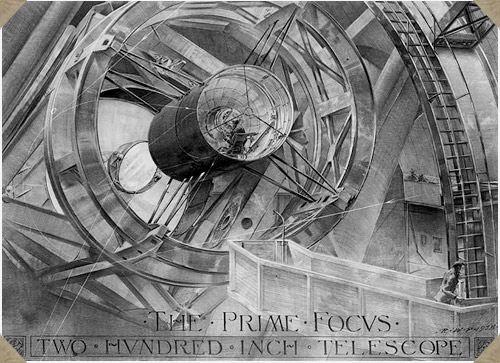
Russell William Porter (1871-1949) was an architect, explorer, mapmaker, watercolorist, and pioneer in the field of “cutaway illustration.” As though this were not an impressive enough skill-set Porter was also an ameture astronomer and telescope builder, sometimes referred to as the “founder of amateur telescope making.” It was presumably this wonderful intersection of talents which lead astronomer George E. Hale to recruit him to work on the design of the 200-inch telescope on Mt. Palomar (for a time the largest telescope on earth). During its conceptual development Porter produced 19 beautiful drawings of the instrument, which amazingly (considering their technical depth and exactitude) were all done before the telescope was actually constructed using only blueprints as a guide. The Prime Focus, from this set, is pictured above.

Reintroducing: Hella Basu
Picked up a 1980 design annual today put out by the venerable (but soon after to fold) U.K printing house Penrose. In it I found many amusing bits about then state-of-the-art computer graphics technology, articles of interest to the design dork with a historical bent, purty pictures, etc. The most striking bit by far, however, was a feature on a calligrapher by the name of Hella Basu. Beautiful work which put me in mind of everyone’s current fave Marian Bantjes, except Basu was born in 1924. A subsequent internet search for information on her work came up empty. Judging by the samples in the feature that’s a real shame. It’s my pleasure then to reintroduce her here, on the web, with the following 10 pieces culled from the Penrose annual.


Night of the Ground Stars
Or: urban shoe-gazing finds a purpose
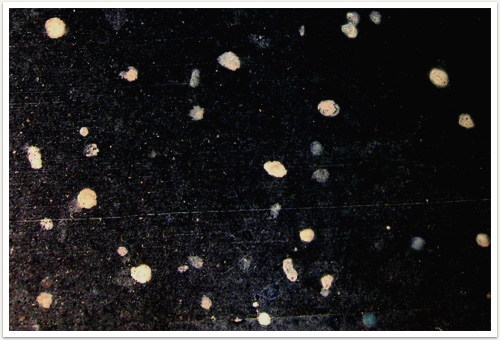
Electric light, Concrete, and Chewing Gum, what have they in common? Though, admittedly, both concrete and chewing gum can ultimately trace their roots to antiquity, all three of these items, in something akin to their modern form, entered the American stage in the 1870’s.
Edison invented the first commercially successful incandescent lamp around 1879. At the Centennial Exhibition in Philadelphia in 1876 David O. Saylor exhibited the first American made portland cement, though it was not until 1891 that the first concrete street in the United States was paved. Thomas Adams opened the first chewing gum factory in 1870, and a year later Adams’ chicle based New York Gum went on sale in drug stores for a penny apiece. By the beginning of the 20th century all three of these items had become popular and were on their way to being staples of American life.


