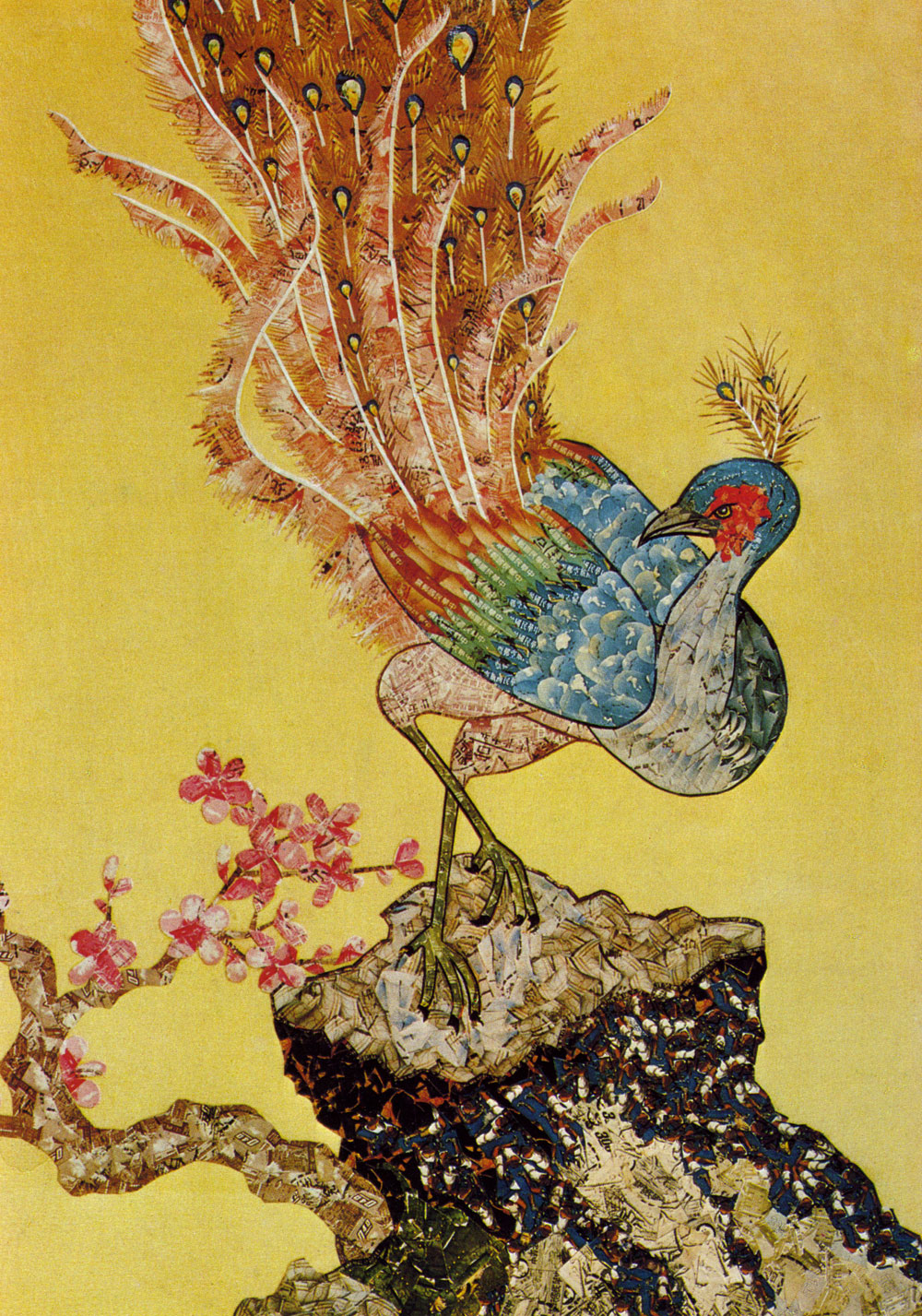
Quote: “On stepping out to the terrace, I was very agreeably surprised to see my shadow some 200 feet high, s thrown on the mist by a strong lamp, rise up to the zenith! It was a very curious spectacle indeed. every movement of the hand or head was faithfully reproduced by the phantasm. But only the head and shoulders of the figure were neatly delineated. The remainder of the body was exceedingly indistinct. Giant rays of colour radiated from the head in all directions.” –E.M. Antoniadai, 1896.
What was for the astronomer Antoniadai “very agreeable” was for generation upon generation before him, understandably, a shock, an anxious source of folkloric speculation, and a bit of a horror.
This 200 foot high shadow figure lurking about the misty mountaintops goes by various names, mountain specter for instance, in China it is called Buddha’s Light, and one would assume that somewhere, at some time, it must be have been called something along the lines of “The Holy Crapuolossus: Bowel Evacuator.” It is best known, however, as the Brockengespenst or Brocken Spectre, owing to the ideal conditions at The Brocken, a peak in the Harz Mountains in northern Germany, for its sudden appearance.

Quote: “A gigantic figure haunts the Mountains, known by the name of “The Spectre of the Brocken.” The ignorant peasants were, in former times, in great fear of it, thinking it a supernatural being, and fancying that it brought upon them all manner of evil. And it must be confessed it was a fearful sight to behold suddenly upon the summit of a lofty mountain an immense giant, sometimes pointing in a threatening attitude to a village below, as if dooming it to destruction; sometimes with arms upraised, as if invoking ruin upon all the country; and sometimes stalking along with such tremendous strides as to make but one step from peak to peak; often dwarfing himself to nothingness, and again stretching up until his head is in the clouds, then disappearing entirely for a moment, only to reappear more formidable than before.” -Frank Richard Stockton, from Round-about Rambles in Lands of Fact and Fancy c. 1910.
De Quincy in his Confessions of an Opium Eater devotes a section to “The Apparition of the Brocken.” If we selectively string together a few sentences (leaving out the far larger chunks about testing the apparition’s faith for fear that centuries of bearing witness to the dark idolatries of pagan sorcerers have made him impure, and the sections about weeping for lost childhood love, like Judea, under a palm-tree) we get this-
“Who and what is he? ...in order to test the nature of this mysterious apparition, we will try two or three experiments upon him… Make the sign of the cross, and observe whether he repeats it. Look! he does repeat it… You are now satisfied that the apparition is but a reflex of yourself.”
Which is, of course, a case of a poet’s hallucinatory metaphor unintentionally touching upon the truth of a thing.

Quote: “A wild tale has long circulated about a giant specter seen by mountain climbers on the Bocken, a German mountain. As the story goes, there was once a climber working his way along the precipice who suddenly saw an immense human figure rise out of the mists toward him. In his fright he lost his footing and fell to his death. Doubtless this is just a story, but the Brocken specter does exist, not only in Brocken but wherever shadows are cast upon mist, fog, and fine water droplets” -Willim R. Corliss, from The Handbook of Unusual Natural Phenomena.
As it happens these specters are in fact the result of multiple, comparatively rare, optical phenomena acting in tandem to produce a sort of “perfect storm” of visual trickery. In truth it’s hard to imagine an illusion more tailor made to give a human onlooker reason for serious pause than a giant, mysterious, mountain dwelling shadow-figure, whose head is surrounded by a luminous nimbus of rainbow-colored light. Perhaps if it also had tits?
I say “comparatively rare” optical phenomena, but of course that’s misleading. This is science we’re talking about here and these phenomena will reliably occur wherever the conditions are right.
From wikipedia: “A Brocken spectre, also called Brocken bow or mountain spectre, is the apparently enormously magnified shadow of an observer, cast upon the upper surfaces of clouds opposite the sun.
The ‘spectre’ appears when the sun shines from behind a climber who is looking down from a ridge or peak into mist. The light projects the climber’s shadow forward through the mist, often in an odd triangular shape due to perspective. The apparent magnification of size of the shadow is an optical illusion that occurs when the observer judges his shadow on relatively nearby clouds to be at the same distance as faraway land objects seen through gaps in the clouds, or when there are no reference points at all by which to judge its size. The shadow also falls on water droplets of varying distances from the eye, confusing depth perception. The ghost can appear to move (sometimes quite suddenly) because of the movement of the cloud layer.
The head of the figure is often surrounded by the glowing halo-like rings of a glory, rings of coloured light that appear directly opposite the sun when sunlight is reflected by a cloud of uniformly-sized water droplets.”
The comparative rarity here is that prior to human flight a comparatively few people actually had occasion to witness this phenomena. In as much you can hardly blame the folks who did for descending the mountain and heading straight for the local Pub to get hammered and spread their tales of giant ghostly figures and high altitude pants crapping.
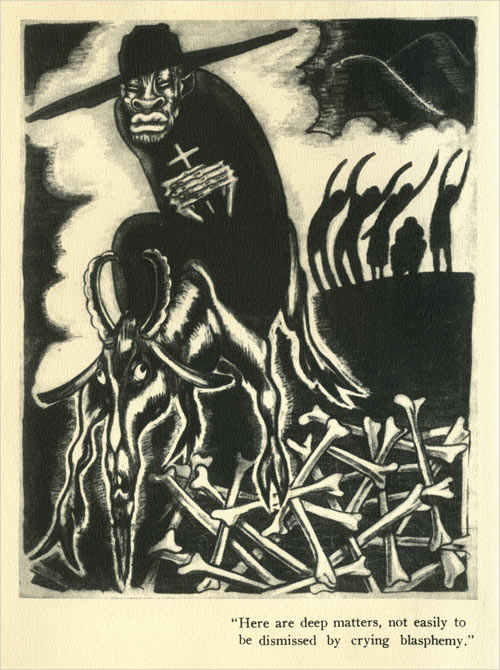
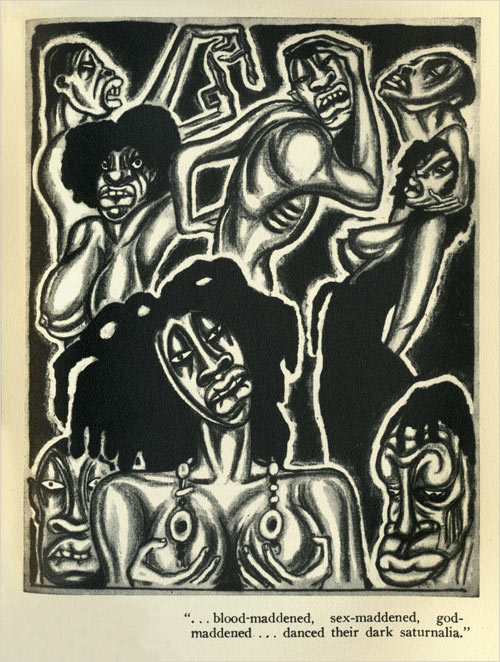
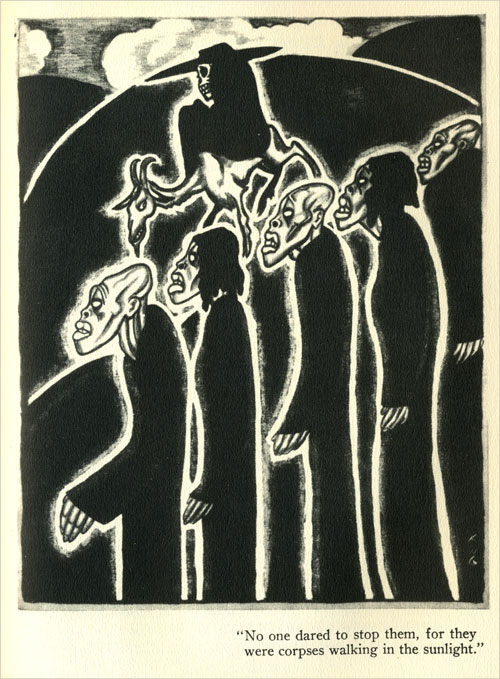
In any case the illustrations above hardly do justice to the oddity and, yes, beauty, of the Brocken Spectre. As such I’ve gathered together a group of photographs for your viewing pleasure. See below-
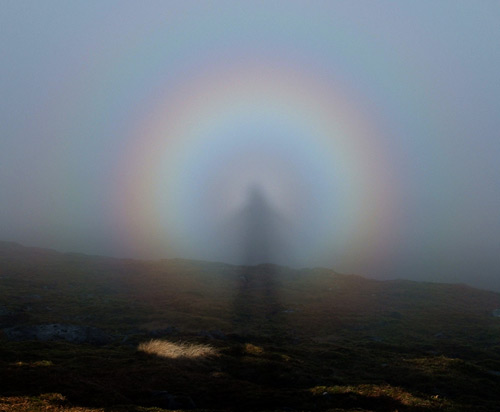


Now that I think about it, I’m not sure a still photo, transmitted over “the tubes,” and viewed on one’s computer screen really does the phenomena justice either. I’m sure under the right circumstances, say pumped full of hallucinogens and trudging alone at dusk on a German mountainside, even we learned moderns might find a landslide accidentally triggered in our lederhosen before our rational minds managed to get the “all’s clear” message out to our jumpy animal parts. Either that or we’d find ourselves not too long afterward telling our bemused mates- “That’s right, I’m quitting my job, changing my name to Baron Fogdancer, and building the worlds largest lollipop factory… Because God appeared to me and told me to! That’s why!”
Anyhow, hope you enjoyed.
For more check out Brocken spectres, bows, and glories by Henry Sharpe.
hide full text