• Dig into the Instruments for Science (1800-1914) pages which reproduce for your geeky pleasure the scientific trade catalogs in the Smithsonian collections. Includes, but is by no means limited to: levers, pulleys, manometers, balances, air pumps, barometers, drawing instruments, electric machines, extensometers, telescopes, spectroscopes, photometers, tuning-forks, dissecting instruments, metallurgical equipment, galvanometers, turbines, electromagnets, theodolites, sextants, microscopes, globes, and glass prisms. Pictured above is Amslers Polar Planimeter. Enjoy… you big dork.
• The online world of linguistics is fast, funny, and bears no resemblance to hours spent in a classroom. Linguists and wordsmiths (including Grant Barret from Double Tongued Word Wrester) talk about new words, new blogs and new usage. NPR audio: How the Web Is Changing Language. Via.
• “A picture must be painted in such a way that the viewer can understand its meaning. If the people who see a picture cannot grasp its meaning, no matter what a talented artist may have painted it, they cannot say it is a good picture.” -Kim Jong-il. Art in North Korea.
• Card Culture. On the design impact of credit cards and “affinity” cards. Via.
• An interesting paper on: Life (Briefly) Near a Supernova (pdf). Via.
• Proverbial wisdom from around the world in the form of 12,000 proverbs from 300 different countries. Search by keyword or browse by country.
• The Olduvai Theory: Sliding Towards a Post-Industrial Stone Age, circa 1996, and The Olduvai Theory: Energy, Population, and Industrial Civilization (pdf) circa 2006. Can’t wait for post-industrial civilization.
Rembrandt the Quadracentenarian
Today marks the 400th birthday of my homie Rembrandt Harmenszoon van Rijn. In celebration I offer a couple of paragraphs from a favorite book of mine, What Painting Is by James Elkins, which happens to touch on the physicality of Rembrandt’s canvas surfaces. See below.
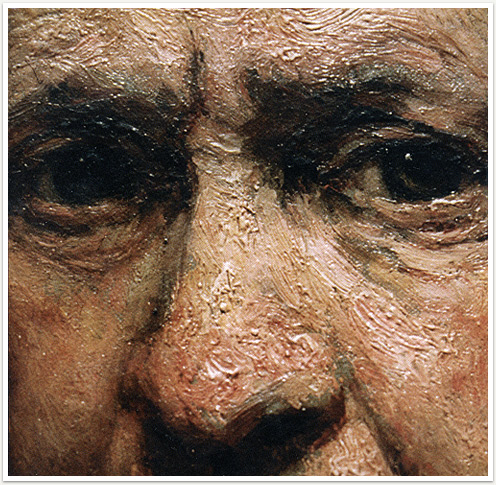
From Chapter 4, How do substances occupy the mind?, in reference to the image which served as thumbnail to this post-
Rembrandt is well-known for the buttery dab of paint that he sometimes puts on the ends of the noses of his portraits, and this nose is certainly greasy and has its little spot of white. But touches like that do not stand alone: when Rembrandt was interested in what he was doing, as he was here, he coated entire faces in a glossy, shining mud-pack of viscid paint. The skin is damp with perspiration, as if he were painting himself in a hot room, and he slowly accumulated a slick sheen of sweat. It is impossible to ignore the strangeness of the paint. If I looked at my face in the mirror and saw this, I would be horrified. The texture is much rougher than skin, as if it is all scar tissue. As a painter works, the shanks of the brushes become repositories for dried paint, and flecks of that paint become dislodged and mix with fresh paint, rolling around on the canvas like sodden tumbleweeds. They are all over this face, forming little pimples or warts wherever they end up. (There is a large one halfway up the nose.) Among contemporary artists, Lucien Freud has made an entire technique out of these rolling flakes and balls, and he lets them congregate in his figures’ armpits and in their crotches. In short, the face is a wreck, much more disturbing than the unnaturally smooth faces that most painters prefer.
Although historians tend to see Rembrandt’s method as an attempt at naturalism, it goes much farther than portrait conventions have ever gone, then or since. Consider what is happening in the paint, aside from the fact that it is supposed to be skin. Paint is a viscous substance, already kin to sweat and fat, and here it represents itself: skin as paint or paint as skin, either way. It’s a self-portrait of the painter, but it is also a self-portrait of paint. The oils are out in force, like the uliginous oozing waters of a swamp bottom. The paint is oily, greasy, and waxy all at once—even though modem chemistry would say that is impossible. It sticks: it is tacky and viscid like flypaper. It has the pull and suction of pine sap. Over the far cheek, it spreads like the mucilage schoolchildren use to glue paper, resisting and rolling back. On the nose—it’s rude, but appropriate—the paint is semi-solid, as if the nose were smeared with phlegm or mucus. On the forehead, it looks curdled, like gelatin that is broken up with a spoon as it is about to set. There is drier paint around the eyes, and the bags under the eyes are inspissated hunks of paint, troweled over thin, greyish underpainting. The grey, which is left naked at the corner of the eye and in the folds between the bags, is the imprimatura, and the skin over it is heavy, thick, and clammy. The same technique served for the wings of the nose, where dribbles of paint come down to meet the nostril but stop short, leaving a gap where the grey shows through. Of course, the nostril is not a hole, but a plug of Burnt Sienna with Lamp Black, and it also lies on top of the grey imprimatura. Rembrandt’s thin moustache is painted with wiggles of buttery paint, almost like milk clinging to a real moustache. Over the eyes and eyelids there are thick strips of burned earth pigments -Lamp Black and Burnt Sienna— covering everything underneath. The tar spreads up and inward, and then falls into the hollows between the eyes and the nose in dense pools like duplicate pupils.
There is no limit to this kind of description, because Rembrandt’s paint covers the full range of organic substances. It is more fully paint, more completely an inventory of what can happen between water and stone, than the other examples in this book. And that means it is also more directly expressive of qualities and properties: it is warm, greasy, oily, waxy, earthy, watery, inspissate. It is not dried rock, like Monet’s cathedral, nor water, like his marine paintings. The thoughts that crowd in on me when I look this paint have very little to do with the underlying triad, or with the named pigments or oils. They are thoughts about qualities: I feel viscid. My body is snared in the glues and emulsions, and I feel the pull of them on my thoughts. I want to wash my face.
-James Elkins.
“I want to wash my face.” Ha. Love it.
hide full text

Mimas and Enceladus beside Saturn.
• Looking at this photo taken 4 days ago by the Cassini orbiter It strikes me just what a poor job NASA has done in making actual human space-flight compelling for the Earthbound. We have astronauts up there in the great black yonder at this very moment and yet I find myself more interested in the various other projects (Shooting the moon, Flying over the cloudy world, Out on the Horizon, STEREO, Bigelow’s inflatable habitat, etc.) undertaken from the ground. The only angle represented in the media during the recent trip to the ISS seems to be: “Will the astronauts blow-up?!” which frankly should be the least interesting angle of space-flight as far as I’m concerned. The danger is a given, the risks accepted by all involved. Is it just the media’s omnipresent suckitude or has NASA fumbled the P.R. ball? I should think that by now, in the year 2006, people would be gladly lining up for one-way missions without batting an eyelash, with the rest glued to their 24 hour space network rather than looped footage of falling foam.
• George rounds up a few Links on the recent “rulings” on the SNES Challenge.
• Check out Paul Davies Prayer Antenna (Via) the artists who also brought us, as you may recall, The Curious Furniture of Ned Troide.
• As artificial intelligence research celebrates its 50th birthday Marvin Minsky asks “what makes the minds of three-year-olds tick?” Meanwhile the Times UK touches on the idea of technology dividing us into digital natives and digital immigrants.
• Full pilot episode of Mike Mignola’s quirky The Amazing Screw-on Head.
• Seed offers a short video tour of the underground accelerator at CERN (previously searching for the god particle, finding art.)
• Lastly Monocrom points us toward two interesting nuggets at Nature- Should we flood the air with sulphur? and What shape is a pebble?
07.15. filed under:
City Metaphors from the vaults of the Cooper-Hewitt
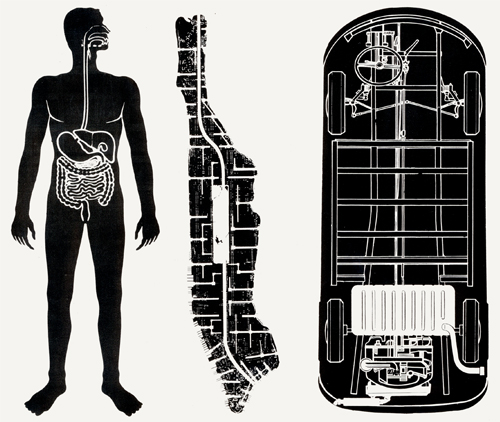
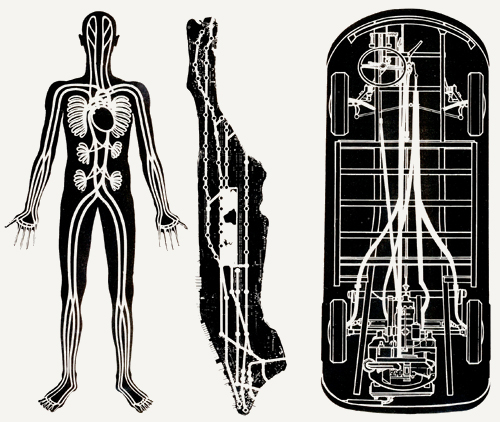
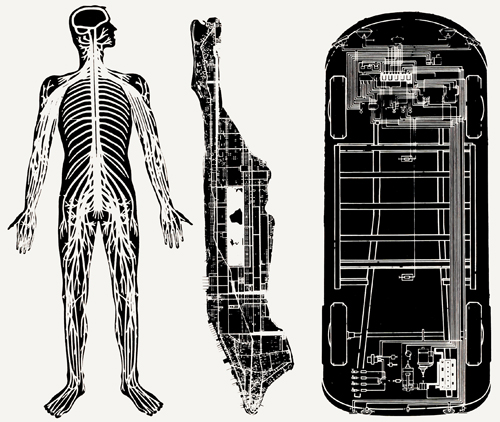
What follows are four plates from architect O.M. Ungers’ City Metaphors which were included in a larger exhibit on view in 1976 at the Cooper-Hewitt called MAN transFORMS. It was the kick-off show of the institutions’ rebirth as the Smithsonian Institution’s Nation Museum of Design. I’m lucky enough to have procured the exhibition catalog, which is just chock full of goodies, and the tiny taste which follows are taken from it’s pages.
an organism: bone structure.
a city: street structure.
a mechanism: frame structure.
an organism: digestive system.
a city: sewer system.
a mechanism: exhaust system.
an organism: circulatory system.
a city: subway system.
a mechanism: fluid system.
an organism: nervous system.
a city: power system.
a mechanism: electro system.
More to come…
hide full text
What shall we use to fill the empty spaces?
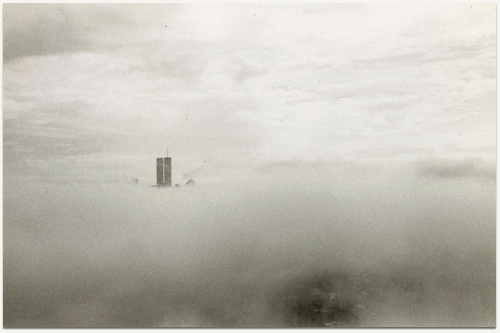
I took this picture what seems a thousand years ago, when I was still a lad and my father was working on the 72nd floor of the Empire State Building. (You could actually just walk over and open the widows like they were the little sliver of a bathroom window in your apartment.) At the time it was just a bad photograph. Not quite perfectly exposed, not quite perfectly framed. A couple of buildings and a shroud of thick fog. Fwap! Onto the pile. But now? Well, with that whole “buildings in heaven” look it got going on perhaps it’s found a new relevance?
Recently something dawned on me. I came out of my office and turned south toward the N/R station. I happened to look up and saw the emptiness which terminated the pinpoint of a horizon, where, as it so happens, the towers used to be. It struck me, looking up casually and unthinking, that what I really wanted to see were those towers. It wasn’t a sad moment, I didn’t crash knee-down on the pavement and (damn them!) launch into a Heston-worthy soliloquy. I simply looked up and realized for the first time, that long after all the sadness and shock and directionless anger, after the promises and grand plans and presentations that what I would most fondly like to see were those two towers again. My opinion suddenly formed solidly on what should be built on that ground.
A few months ago I had to go down to the court building to throw my name into the jury-duty hat, and afterward walking by the site of “ground zero” I was dismayed to see what, after nearly 5 years, all the glitzy competitions, heated debate, and ponderously heavy rhetoric had wrought… exactly nothing. “Ground zero,” suddenly a doubly fitting name, was ground that contained zero. It was a huge fucking hole in the ground; that’s it. I don’t know whether those of you living outside of the Tri-State area realize that. With all that has been said and all that has been done in the reverent name of 9/11, the actual site, the “holy ground” which evidently just radiates with meaning and power, is still, 5 years later, a dirt hole. It seems that in “this post 9/11 world” symbolism and rhetoric are all that can be built-up, with passionate gusto, tall and strong.
When I say what I really want to see when looking south are those towers I mean it literally. You know what I don’t really want to see? A hideous fucking monstrosity, covered in prisms, couched in forgettable hackneyed concept, birthed from the piteous wombs of politics, greed, and compromise.
Message to George Pataki- You and your “Legacy” can suck cock. I can only take heart that your utter failure will impede your using our tragedy to bolster a presidential bid (like a certain Mayor, who everyone seems to forget was widely despised by those he governed before events allowed him to don the hero-mask… oh wait… it’s 2006… that’s a Presidential pedigree today isn’t it?)
Message to Larry A. Silverstein- Kill yourself. Seriously. You are a Scumbag. I’d rather tongue-kiss a lipless leper crack-addict than even look at you.
Message to the Lower Manhattan Development Corporation- Fire yourselves.
Message to George W. Bush, his cabinet members, and the sycophantic House and Senate- Get the term “9/11” out of your filthy fucking mouths. I don’t want to hear another tangential argument given weight by your use of September 11th as ballast until the “ground zero” of those events is afforded the same weight, in physical reality, as it is in your “stirring” words.
You know that primary construction on the original Twin Towers only took about 5 years? That means that if our leaders were not so full-of-shit, if our business-men were not so totally devoid of social conscience, and our citizens were not so listless, that we New Yorkers could look south and see, if not this September then one very soon, two reassuringly familiar (albeit structurally improved) towers rising to fill the empty spaces? How “right” would that feel? As things stand symbolism is threatening to usurp reality completely. If the incompetence continues much longer the symbol itself might be threatened with transformation. Anyone who says “Think of 9-11” will be saying “Think of how utterly full-of-shit we are.”
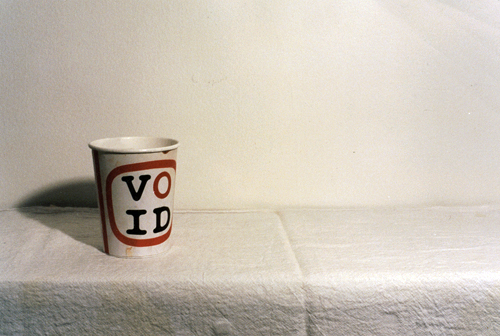
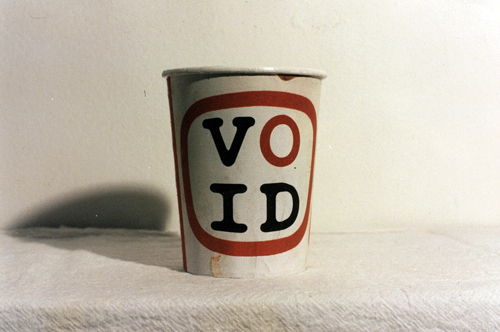
This is another photograph I took years ago. For some reason this image of a classic (Milton Glaser designed) “I heart N Y” coffee cup substituted with the word “V O I D” had a vitality and meaning to me. I made the cup and shot a whole role of it. I think I even had a t-shirt. Today, if I’m being honest, I have no idea what it meant to me exactly, or why it resonated. But again, as with the “towers in heaven” image, it seems to have found a new relevance, resonating for more obvious reasons. It’s an accidental protest image I suppose and I would like to offer it to you.
If anyone out there finds themselves similarly dismayed and upset by the void which still occupies what is ostensibly one of our countries most important sites, one which seems to symbolically initial all manner of political blank-check, then take it and use it.
Here is another:
Fuck it. What else is there for me to say? I’m tired.
hide full text
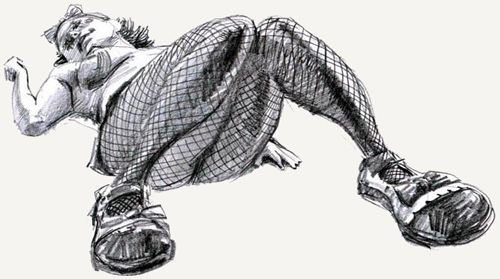
Dottie Lux sketched by Fred Harper
• The Village Voice offers: Model Behavior. A short interview with Molly Crabapple, founder of Dr. Sketchy’s Anti-Art School. I, for one, love the idea and yet it seems slightly inadequate somehow. Can it avoid the stain of hipster trendiness which ultimately relegates so many good ideas to fad-status in short order? I would prefer a noon to 4 a.m. establishment with continuous model-sitting and booze. A sort of dive bar for life-drawing. Imagine the monday afternoon crowd at such a place!
• Related to the above: Uwe Scheid’s 1000 historical Nudes in 13 categories.
• Non-Errors: Those usages people keep telling you are wrong but which are actually standard in English. Highly interesting for the “language-minded.” Via.
• Regrets Only. On the curious political statement of 6 graphic designers honored by the National Design Awards, and the dissenting voice of Chip Kidd.
• Some vids of Mark Jenkins’ most recent pieces.
• CSICOP on The Tautology Objection.
• “A curious, exciting sight greeted my eyes. Lines, circles and squares in a geometrical, abstract arrangement of symbols. If I were an alien, I’d land here!” Over Roswell - 2002. Via.
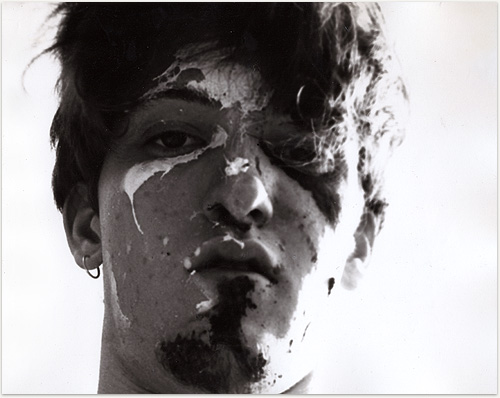
self portrait, 1992
When you are young you know nothing but are convinced you know everything. And that’s its charm. It’s what makes foolhardy youth passionate and beautiful. When you are old you know nothing and are well aware you know nothing. After all the trial and error and revolving 3 a.m. philosophies you are still naked and lost. It’s exactly this which tinges age with sadness.
Postcard from a lifetime away
While going through a box of old photos just now I came across a misplaced postcard which very nearly had me in tears. It was from a friend of mine who died some years back. He was a wonderful guy and I miss him terribly. The saddest thing about coming upon this card for me is the fact that I didn’t just forget about it… no, I can’t even remember ever receiving it. I can’t remember him handing it to me, which he surely did, probably while sidled up next to me at the Library Bar on Avenue A and 1st street. He almost never mailed me anything, preferring instead to just hand over his missives face-to-face. When I pulled it from the box it was like I only just received it… from a lifetime and a trillion miles away. For the benefit of those of you who knew him I’m posting it here. Without doubt you’ll know who it was from instantly.
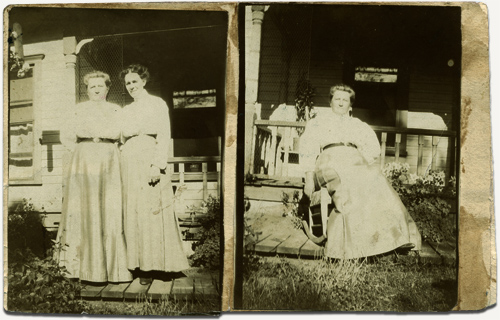
Text Reads:
I bought this at Chelsea Fleamarkets for twenty-five cents. I can’t help but wonder that if maybe Karen had scanned it into her computer and applied a decent black border around, perhaps I would suddenly consider it art. Images like these are ubiquitous in Art; we all like to think that we are somehow profound because we appreciate images such as this one. We look at this photograph and we think, “That’s someone’s great grandmother” and we yearn for the identities of these people. And we yearn for our own identities as well, because we have no sense of family in the way that our grandparents do. And so we yell everyone that it has aesthetic value because we don’t even know who we are, and then we blame them for not understanding our Art. We subject the entire world to our idiosyncratic insecurities and then we think we are somehow deeper when they don’t get it.
“The sweetness of sorrow and love. To be smiled at by her in the car. That was the most beautiful thing of all. Always the longing to die & yet keeping oneself alive; this alone is love.” -Kafka.
hide full text

What if I wrote a single sentence each day? Would the sentences add up to a novel? No. A poem? No. And why does escape seem impossible? What if I retreated into non-sequiturs? What if I scribbled on paper and hooted in guttural bursts? Why can’t I? You can. And why the tendency to align, to repeat, to perpetuate? Why does it naturally become this and not something totally different? Why couldn’t it be something nimble enough to avoid the pin and the shadow box? I can’t say. And what if I wanted to tear it all down? You have. You’ve torn it down and built it up again. So why doesn’t it change? Because it is you.
Admission:
In April I bought 8 colored pencils and 5 different pads. They were beautiful things. The possibilities inherent in their eventual interaction were exciting. I imagined them as they’d look here on this screen. I imagined the birth of pixels rather than their simple relocation. I imagined the characters of A Voyage to Arcturis with their many eyes and foreign limbs rendered and neatly titled. I imagined my hand moving in sweeping arcs and careful angles. I imagined a flow which I’d call freedom. The pencils and pads are beautiful things still, dusty things in the museum of my desk.

What if I wrote? Wrote like a machine without a grammar-module or spell-check? Wrote like the eyes of a man lost in a jungle? What if I wrote hard and wild and whistled into the necks of empty bottles in the nighttime? Would you be gratified? What if I cast it all aside and hunted the head of my potential’s long shadow? Isn’t that what you do already? Can anything slow the relentless narrowing down of possibility into reality? No.
Admission:
I’ve forgotten how to write. What you see before you is what you see everywhere-compromise. It’s the road paved with good intention. It’s an anagen hair hiding its precious root-tip. It’s about as funny and beloved as a woman’s laugh lines. It’s all excuses. It’s the personal failure which passes for public accomplishment. You think I kid but I do not. No creator ever hungered to be a curator instead.

People enjoy it. So what? I brush up against thousands of people every day on the subway, in the elevator, on the sidewalk, in the hallways, at the bank and the deli; They file past my desk and window in an endless shambling stream. Their children shit themselves and scream and want; their dogs walk on the left and they walk on the right, taught leashes strung between like tripwires. “People enjoy it?” Yes. What the fuck do I care what they enjoy? Is it my job to tickle their asses with a delightful little feather? I don’t like them much, not sure I ever have. “Hope you enjoy.” How many times have you written that? Weak moments, punch-lines, every one.
Admission:
All is not what it seems. It’s less than it seems, and perhaps even less than that.
What if I called a spade a spade? Do you destroy a delusion by naming it as such? What if I called it what it was, self-absorption, and rather than prostrating myself and pretending at remorse I embraced it as my birthright in our culture? What if I wrapped myself in my own weaknesses? What if I split apart all syntax, ignored all context, and defied all expectation? What if I broke the contract and burst the bounds and spit in the eye of every passerby? That wouldn’t be like you. Exactly! And if “it” is me then to change it… But why would you want to change it?
Admission:
Because eventually the repetitive act of rooting out links and following them to their connected pretty pictures makes you want to do nothing so much as vomit.
What if I wrote a self-indulgent, rambling prose-poem, and posted it accompanied by meaningless scribbles? Would the result still be The Nonist? I don’t know. And does it matter?
hide full text