let us alone
came across this small gallery of found images from the arkansas state prison all dating from between 1914 and 1937. from the site: “second only to a coroner’s photographs of the newly dead, police and prison identification photographs are perhaps the least merciful and most democratic and anonymous photographs of all. The lighting is the same for everyone. The people being photographed have no interest in the photographs being made; the people making the photographs have no interest in the photographs they have made. There are no names on the prints, and the files connected with them were long ago put somewhere no one now remembers. All that remains of these prisoners from seventy, eighty and ninety years ago are these anonymous images.”
all of the images are evocative, sad, and a bit creepy, but i particularly liked the ones which have been obscured by time (below). they’re really beautiful and seem particularly fitting for their subject matter.


let us alone. time driveth onward fast,
and in a little while our lips are dumb.
let us alone. what is it that will last?
all things are taken from us and become
portions and parcels of the dreadful past.
let us alone. -tennyson, the lotus-eaters.
Read Less...
case 123
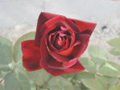 here’s a short excerpt from psychopathia sexualis, a book i picked up long ago, and leaf through in times of boredom. first published in germany in 1886 the book attempts to catalogue and illuminate every manner of “sexual perversion” possible. most of it seems downright cuddly and sweet in our filthy world of 2005 when a shampoo commercial carries more outwardly explicit sexual content than a 19th century woman’s entire adult existence. here in case 123 we have a fetish which is wholly benign, strangely poetic, and really, to be envied. imagine if it were all so simple…
“b., thirty years of age, apparently untainted, refined and sensitive; great lover of flowers; liked to kiss them, but without any sensual motive or sensual excitement; of a rather frigid nature; before twenty-one did not practice masturbation, and subsequently only for periods of time. at twenty-one he was introduced to a young lady who wore some large roses on her bosom. since then large roses had dominated his sexual feelings. he incessantly bought roses; kissing them would produce erection. he took roses to bed with him, although he never touched his genitals with them. his pollutions, henceforth, were accompanied by dreams of roses. he dreamt of roses that had fairy-like beauty; when he inhaled their fragrance, he ejaculated.”
ha. fantastic.
Read Less...
puzzledom circa 1914
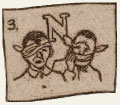 came across this juicy treat- sam loyd’s cyclopedia of 5000 puzzles, tricks and conundrums (with answers). from the intro written by sam loyd himself, “puzzling is a pastime of very ancient growth, rich in historical associations, and embracing much that is romantic, as well as scientific. the cyclopedia abounds in those classical tidbits which, collectively, give us a true history of the art and literature of puzzledom as may be written.” essentially this book represents the state of the art in puzzling as of 1914. very cool book for both conundrum content and plain ol’ purtiness.
rough americana
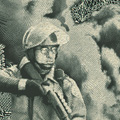 in that this pseudo-revolutionary artwork seems to be bringing folks pleasure at the moment i thought i’d take the opportunity to post a bit of artwork which i did a while back but never posted to the nonist. in this case the work was not created in a flash and off-the-hip but labored over. it’s the cd package design for a record called rough americana by the duo of morgan craft and dj mutamassik. this was designed long before we went into iraq for the second time and obviously long before the election. it was also created before anti-money scanning technology was included in photoshop. click all for larger versions. enjoy.


if your interested in hearing the music there are a couple samples over at the burnt sugar index. very abstract and not for the faint of heart. if you like it, it’s available at cd baby. similarly i packaged a dvd for this record which was a re-imagining of the music by video artist dvdell. you can check it out at the excellent dvdell site if you so please. until tomorrow…
Read Less...
the red scare
well, the creative commies graphic i whipped up a couple of days ago continues to make the rounds. today wired news has a story about the web community’s reaction to bill gates’ comments to news.com likening intellectual property reformers to modern day communists. normally i’d be pleased to see a piece of work get such widespread circulation, but in this case i’m actually a bit torn.
being that this is the first meme (or more acurately mini-meme) i’ve been directly involved with, i’ve followed it’s spread pretty closely through technorarti, and it’s fascinating. but what’s more fascinating is the reaction. i went on to a few forums and read what was being said and was utterly perplexed. on the one hand there are those who laugh, and say, “hey cool image,” which seemed the proper response. on the other there are those who are annoyed and alarmed at the implications of willingly equating what is essentially a “market-based approach to copyright” with the great american bugaboo of communism. it upsets these folks to see people actually embracing what was essentially a slur. the reason it upsets them is the same reason i’m troubled, because conceptually, i think they are correct: it’s not the embracing of a negative in and of itself but the fact that the comparison is totally flawed. embracing it in many ways does a disservice to the cause of intellectual property reform because it allows the opposition to frame the argument in a disingenuous way. a tactic of debate i think we are as a culture very familiar with at this point.
here is some of what’s been said thus far from a couple of different forums:
patrick nielsen hayden:
The real story is that a relaxed intellectual-property regime is one of the things that made America a great power, and that the kind of ultra-restrictive, we-own-everything-forever IP now being promoted by Hollywood is in fact the new, alien, and un-American thing. The bad guys’ basic strategy is to portray themselves as defending the status quo while in fact effecting a revolutionary change. When you, their opponents, allow yourself to be defined as the alien, you’re doing exactly what they want you to do, and you lose. So knock it off with the photoshopped Soviet Constructivist fun and start wrapping yourself in the American flag.
Henry Farrell
I’m increasingly convinced that the “free culture” movement could, and should, be revolutionary in its implications - it’s maybe the best thing to hit the left in the last twenty years, if the left will only wake up to it. Which isn’t to say that the Soviet riff makes good political sense - but free culture is, and should be revolutionary. In other words, it should be all-American in exactly the same sense as Eugene Debs, Joe Hill and Woodie Guthrie were all-American.
xeni jardin
The notion that people who support copyright reform are “commies” is hilarious, and I think these little bloggable visual jokes are a perfectly appropriate and effective way to point out just how ridiculous that notion is.
Greg London
Satire is fine as long as you’re casting the bad guys as bad. The Hermetic President pokes holes in the Administrations attitude that dissent is the same as “aiding the enemy” by showing it for what it is: bald-faced nationalism that could easily lead to facism. So framing Bush as Hitler has it’s purpose.The problem with the “copyleft == communist” satire is that it takes an inherent trait of intellectual ideas (that knowledge is community property) and casts it as evil (communism).
Lucy Kemnitzer
...you have no intention of advocating a cramped, joyless, fearful and tongue-tied opposition. But I do think that the result of being afraid of communism jokes and defiant and ironic humor will be that. Actually, I believe this is one of the two or three things I know for sure. When we’re outspoken, and we offend a few people, and we glory in ourselves, we win. When we hedge, and mumble, and worry more about offending than about getting our say, we lose.
michael
I love the creative Commies meme. It makes fun of the Man. Nobody thinks open-source programmers are going to send Polish Army officers to the Gulag, send tanks into Prague, or bug the American Embassy in Moscow. By reveling in it, we demonstrate that this frame has no power over us: cf “Yankee Doodle Dandy”.
cory doctorow
It’s funny, in the whole copyleft=communism debate there’s been a lot of ‘CC is communist,’ ‘No, extreme copyright is communist!’ But the fact is that neither are particularily communistic. Many of copyleft’s advocates have an anti-corporate agenda, but many others believe in copyright reform because they support the rights of entrepreneurs to enter the market with new products without the say-so of the incumbents; that’s not communist, it’s practically libertarian.
charles stross
we’re up against folks who are hired for the sole purpose of looking good in public. And the court of public opinion is where this argument is going to be won or lost. Please let’s not undermine our own campaign to be taken seriously before we get started? Instead, we need to take the fight to the enemy. Paint them as copyright thieves, stealing the bread from the mouths of writers’ and musicians’ starving children. Paint them as copyright fascists, preventing you, the listener, from copying your CD’s that you paid for onto your iPod. Paint them as the corporate blackmailers they are, threatening 12-year-olds with jail time. But don’t, please, let them portray us as elitist weirdos, or we’ve lost.
lawrence lessig
If I had the time, and the money, I’d do the deep analysis that it would take to explain to myself why it is I constantly hope to be surprised by Mr. Gates. Yet I never am. It’s one thing to read this sort of thing from a studio exec, or head of a record label—surrounded as they are by the sort that surround them. But the people I’ve met at Microsoft are miles beyond this sort of silliness. Does Mr. Gates not even talk to them?
relentless
Fear mongering is not something that happens in singular isolated instances, it is a cultural wave which grows in force with each seismic event. The “family values” crowd are neither liberal nor conservative politically, the McCarthy crowd were not economic conservatives, the salem witch trials were not fostered by conservatism…. but all of those events have strains of the same subculture of zeaoltry within them. The average american, in my view, understands less about the idea of open source than they do about presidential politics. They do however hold tremendous faith in iconoclastic symbols, labels and references. Gates is shrewd enough to start slinging the mud and co-opting the labels before the debate begins. Watch how fast open source becomes synonymous with “Communist left over hippies that lack creative talent and want a free ride on the backs of honest hard working americans who understand the sense of self-satisfaction that can only come from making something with your own two hands”
anon sili valley werker
If you don’t think there’s a fight, you haven’t been paying attention. Now I have nothing against money itself as a means of exchanging energy, but *nothing* I do is to make money first. And I am richer as a person when other people are enriched. If that makes me a communist, I’m a communist. I happen to think, rather, that it makes me civilized.
initially i was totally perplexed by the gravity of the negative reactions. i kept thinking, “hey, wait a minute, this was a lark, a goof.” i tried saying as much on a forum and was burnt to a crisp. “the idea that something is immune to criticism if you make the magic hex sign and declare ‘It Was A Joke’ is dumb coming out of the mouth of a twelve-year-old” was one such zinger i got for my troubles. i never intended to stave off criticism by expressing my befuddlement over the whole thing, because in point of fact the idea that there would be any reaction, positive or negative, never even entered into my mind. i was in fact genuinely befuddled.
from my standpoint, as a creator, the thought process went as follows:
mmmmm coffeee. yawn…. hey look at that flag! (read quote) “obviously, what we need is a large red flag with a gold copyleft in the upper left, replacing the hammer and sickle.” haha. pretty funny. but hey, you know what? when i think communist imagery i think constructivism. that’s some beautiful stuff. from an artistic standpoint that would be more fun wouldn’t it? lot’s of possibilities there… hell, why don’t i whip one up real quick? i can do better than a simple little flag logo. gives me an excuse to dabble, do something different for an hour before i get to work. hell, if it turns out good i’ll email it to xeni jardin…
and that was it. plain and simple. it seems to come as a shock to some of those arguing the conceptual validity /stupidity of the various images which cropped up that perhaps the creators weren’t thinking too deeply about the conceptual implications, and that maybe we were having a bit of fun. so far as i can tell the initial copyleft flag was meant as a joke. my contribution was meant as an extension, artistically, of the theme. that the theme itself may have been flawed meant nothing to me. i know some people will say that the lack of forethought proves their point, that this kind of discourse is serious, that there are stakes, etc etc…
forum post: Thinking for two or three seconds about who it is we need to convince, and what might work to convince them, is also needed. Or, we could just exchange t-shirts to tell one another how much cooler than Microsoft we are. That’s a plan, I suppose.
i happen to agree with that sentiment. who wouldn’t? the business of convincing people of things must certainly benefit from two or three seconds of thought, but here’s an admission: i’m not trying to convince anyone of anything. i’m trying to do what i enjoy which is create beautiful things. that’s about the extent of it. if one of my beautiful things can generate interest in the world at large, well bully for me. but if by doing what i enjoy i can manage unintentionally to jeopardize a political / legal movement, even in the most minute, peripheral way, then those who are doing what they enjoy, that of convincing people of things, are not doing a very good job of it. i don’t happen to think that is the case, i don’t believe this little web-blip warrants nearly such a high word count, but i’ll refrain from trying to convince anyone.
this stance may well be characterize as naive, careless, and foolish. and that’s o.k. i am not well educated on the issue of intellectual property. i am not well versed in its finer points. i have done more pro bono design work in my life than i care to admit. i often give stuff away. i tend not to capitalize on interest when it’s expressed. i make zero money off of any of it. these seem to certainly qualify me as naive, careless, and foolish. but in the final counting i’m pretty sure i’m only qualified to do one thing, create art, which is just fine by me, because that’s all i want to do.
it strikes me that the first chapter of rothko’s the artists reality deals with just this stance often attributed to, and to some degree fostered by, artists:
what is the popular conception of the artists? gather a thousand descriptions, and the composite is the portrait of a moron: he is held to be childish, irresponsible, and ignorant or stupid in everyday affairs. the picture does not necessarily involve censure or unkindness. these deficiencies are attributed to the intensity of the artist’s preoccupation with his particular kind of fantasy and to the unworldly nature of the fantastic itself… biographers contrast the artlessness of his judgments with the high attainment of his art, and while his naivete or rascality are gossiped about, they are viewed as signs of simplicity and inspiration, which are handmaidens of art.
strange, but the artist has never made a fuss about being denied those estimable virtues other men would not do without: intellectuality, good judgment, a knowledge of the world, and rational conduct. it may be charged that he has even fostered the myth. in his intimate journals vollard tells us that degas feigned deafness to escape diputations or harangues concerning things he considered false or distasteful, if the speaker or subject changed, his hearing immediately improved. we must marvel at his wisdom since he must have only surmised what we know definantly today: that the constant repetition of falsehood is more convincing than the demonstration of truth. it is understandable, then, how the artist might actually cultivate this moronic appearance, this deafness, this inarticulateness, in an effort to evade the million irrelevancies which daily accumulate concerning his work. for, while the authority of the doctor or plumber is never questioned, everyone deems himself a good judge and an adequate arbiter of what a work of art should be and how it should be done. -mark rothko.
as i said that this creative commies thing gathered any steam surprised the hell out of me, and i still think it’s all a bit silly, but if i were pressed i’d have to say i’m sympathetic with the points made that conceptually the comparison is totally flawed, and as a tool for the ip reform cause it’s of little use in that it’s so loaded. communism is an allusion no one can win with here in the u.s. of a. i don’t think embracing the word “communist” would ever play out the same way it did with the slur “nigger”, effectively being stripped from its hurlers and changed into something else all together. the frame wont shift in that way. better to point out how wrong gates’ statement was in the first place. lawrence lessigs distinction was the most successful i think, namely that copyright reform advocates are “commonists,” not “communists.” can the truth, the facts, the reality of the situation win any converts? i seriously doubt it. but that’s not my area of interest so i’ll leave it alone. as a graphic, as a bit of fun, as an emotionally fueled fuck you from the man on the street to the billionaire monopolist in the ivory tower, i think it’s fantastic.
i’m interested in what you all think about this kind of thing, especially from the artist’s point of view. feel free to chime in and enlighten me.
Read Less...
contempt, sneering, and defiance
 i was fortunate enough to receive a 1st edition copy of a book published in 1872 titled: expression of the emotions in man and animals by one mr. charles darwin, whom you may have heard of (and if you’re mind is not clamped shut in a dogmatic vice you might also admire.) evidently this was the first scientific book to contain photographic reproductions, and they are doosies. i’ve decided to post some snippets at my leisure. today i will offer a bit of contempt, sneering, and defiance for your browsing pleasure. for example, concerning the lovely 19 century lass pictured here: “The partial closure of the eyelids, or the turning away of the eyes or of the whole body, are highly expressive of disdain. These actions seem to declare that the despised person is not worth looking at or is disagreeable to behold. The accompanying photograph (Plate V. fig. 1 thumbnail) shows this form of disdain. It represents a young lady, who is supposed to be tearing up the photograph of a despised lover.” thought that was rather poetic.

This expression may occasionally be observed in a person who sneers at or defies another, though there may be no real anger; as when any one is playfully accused of some fault, and answers, “I scorn the imputation.” The expression is not a common one (Plate IV. fig 1 above)... The expression of a half-playful sneer graduates into one of great ferocity when, together with a heavily frowning brow and fierce eye, the canine tooth is exposed… The uncovering of the canine tooth is the result of a double movement. The angle or corner of the mouth is drawn a little backwards, and at the same time a muscle which runs parallel to and near the nose draws up the outer part of the upper lip, and exposes the canine on this side of the face. The contraction of this muscle makes a distinct furrow on the cheek, and produces strong wrinkles under the eye, especially at its inner corner. The action is the same as that of a snarling dog; and a dog when pretending to fight often draws up the lip on one side alone, namely that facing his antagonist. Our word sneer is in fact the same as snarl, which was originally snar, the l “being merely an element implying continuance of action…” A Bengalee boy was accused of some misdeed. The delinquent did not dare to give vent to his wrath in words, but it was plainly shown on his countenance, sometimes by a defiant frown, and sometimes “by a thoroughly canine snarl.”
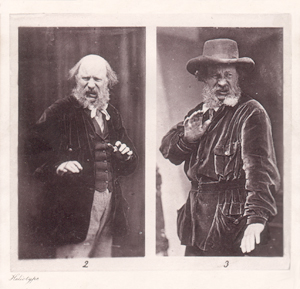
The term ‘disgust,’ in its simplest sense, means something offensive to the taste. It is curious how readily this feeling is excited by anything unusual in the appearance, odour, or nature of our food. In Tierra del Fuego a native touched with his finger some cold preserved meat which I was eating at our bivouac, and plainly showed utter disgust at its softness; whilst I felt utter disgust at my food being touched by a naked savage, though his hands did not appear dirty. A smear of soup on a man’s beard looks disgusting, though there is of course nothing disgusting in the soup itself. I presume that this follows from the strong association in our minds between the sight of food, however circumstanced, and the idea of eating it… As the sensation of disgust primarily arises in connection with the act of eating or tasting, it is natural that its expression should consist chiefly in movements round the mouth. But as disgust also causes annoyance, it is generally accompanied by a frown, and often by gestures as if to push away or to guard oneself against the offensive object. In the two photographs (figs. 2 and 3, on Plate V. above) this expression is simulated with some success. With respect to the face, moderate disgust is exhibited in various ways; by the mouth being widely opened, as if to let an offensive morsel drop out; by spitting; by blowing out of the protruded lips; or by a sound as of clearing the throat. Such guttural sounds are written ach or ugh; and their utterance is sometimes accompanied by a shudder, the arms being pressed close to the sides and the shoulders raised in the same manner as when horror is experienced. Extreme disgust is expressed by movements round the month identical with those preparatory to the act of vomiting.
that’s it for today. the book is just chock full of goodies so expect more eventually. note that these paragraphs are not shown in the exact form as published in the original book. paragraphs were combined and slightly edited for easy consumption. a great big ach or ugh to you, naked savages.
Read Less...
my spiritual retreat
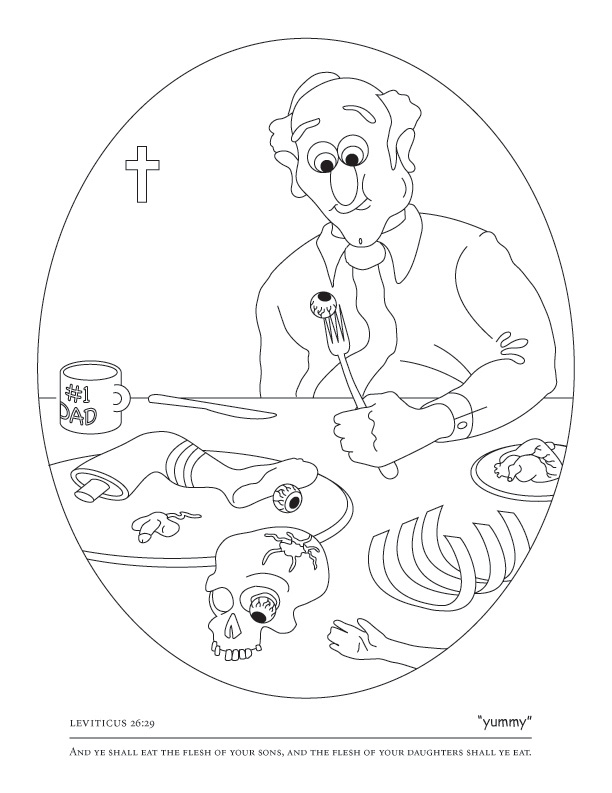
 been busy the last couple of days working on the forthcoming nonist activity book, the first volume of which is bible themed! i happen to own a few nifty k-mart bought jesus coloring books and was inspired to add to this educational oeuvre myself. once finished it will be free to download in it’s entirety. think of it as a sort of public service. after all why should jack chick have all the fun? so far i’ve been focussing on some delightful old testament scripture. i’m enjoying it so much that i’ve somewhat neglected my posting duties here. as such i thought that instead i’d offer our fine readers a peak at what’s to come. this illustration (click thumbnail) is for leviticus 26:29 “And ye shall eat the flesh of your sons, and the flesh of your daughters shall ye eat.” expect further educational and spiritually uplifting pages to color as well as word-puzzles, mazes, color by numbers, spot-the-difference, mad-libs, etc. now, i gotta get back to my good works.
creative commies
 inspired by xeni jardin’s flag on boingboing (illustrating matt bradleys copyleft idea) i whipped up this bit of soviet constructivist goodness this morning (click the thumbnail for full artwork). for those of you who missed it, bill gates, of ludicrously rich fame, decided recently it would be a good idea to equate free culture advocates with communists, or to be more specific “new modern-day sort of communists.” how generous of the sort of modern-day robber baron. anyhow, the image is a rework of an old soviet poster which you can see here. Greg DeKoenigsberg (lead web engineer for Red Hat Network) expressed interest in a t-shirt. i’m reluctant to do a cafepress style tee, but if anyone else has interest leave a comment and we’ll go from there. forward the cause comrades!
belief is like a guillotine, just as heavy, just as light
edge recently released it’s annual question, and this year it’s the thrillingly nonist-sympathetic : “WHAT DO YOU BELIEVE IS TRUE EVEN THOUGH YOU CANNOT PROVE IT?” the 120 answers come from edge’s community of biologists, physicists, archeologists, psychologists, computer scientists, neuroscientists, writers, and other similarly brainy folks engaged in interesting works, and are on the whole fascinating. what do highly educated people trained to evaluate evidence in order to reach conclusions secretly suspect in their heart of hearts? “it is impossible to make an operational distinction between reality and information. that people gain a selective advantage from believing in things they can’t prove. that our universe is not accidental. string theory a futile exercise. that black holes do not destroy information. that human consciousness is a conjuring trick…” etc. i for one believe that time does not exist, that scale is infinite in both directions, and that humanity will go extinct long before our sun goes super nova white dwarf. but then i also believe my cat henry is in fact a being from another world who will one day quietly jump from a crouching position launching himself into the sky, and with front paws outstretched, grey fur gently moving in the wind, he will make his way back to his home somewhere in deep space. in any case the edge question is interesting, as is the edge site in general which contains many
goodies. in related news check out these extremely handsome monkeys.
more old moldy art?
 tom and i finally managed to mount an excursion to the newly re-opened moma yesterday. the line was of near space mountain proportions, winding it’s way around the building through a series of crowd control barriers. it was raining. i arrived about 20 minutes early. in that small swath of time i’d say at least 220 people made their way into the unassuming new digs. at the new $20 admission price that’s at least $4,400 dollars in 20 minutes. not bad. so how was the actual experience once we made it inside? also not bad. somehow not quite amazing, not quite mind blowingly fantastic but certainly not bad.
the space is admittedly fantastic. i could not help but feel like a small plastic figurine in an architectural model or worlds fair poster from the 30’s. it is huge, open, airy, minimal, with the odd stink of “the future” still fresh everywhere. before actually glimpsing any of the collection i found myself thinking back to when i’d get high and make long, slow, meandering, solo excursions through our beloved museums. i imagined the hours i could happily fritter away in a private world of hallucinatory, epiphany-dotted wandering, lost in the shifting crowds. the new building just seems made for it. having left that all behind me i was happy to just stick my hands in the pockets of my corduroy blazer, and soberly execute the two-man, synchronized, museum blow through. and after a semi-covertly smoked cigarette in the courtyard that’s what we did. we didn’t do too much dawdling. we avoided the video installations as best we could, we rejected the architecture galleries out of hand, and we read precious little above and beyond the artist name for any given piece, even so it took us a good two hours to make our way through.
obviously i can’t speak for tom, but i came away feeling oddly torn. on the one hand the space itself was impressive. on the other, though most of the expected masterpieces were present and most of the heavyweights represented in some manner, i managed to come away feeling distinctly unimpressed with the art. sounds ridiculous, but there it is. i came away feeling how distinct an oxymoron the name “museum of modern art” inherently is.
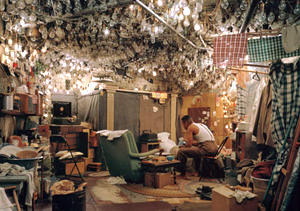
there were certainly high points and little shivers of excitement. the contemporary galleries on the second floor felt wonderful to stroll through, filled with more electricity than the work on display deserved to generate. the small scale prints and photography on floors above were enjoyable as well. as you move further upward through the museum toward the masterpieces of modern painting the galleries seem to shrink. the effect is like heading up into the crowded attic of a family home to view the heirlooms which though undoubtedly priceless become over generations more holy, more weighty, more revered, and thus, paradoxically, less meaningful somehow as physical objects. as we climbed higher into the galleries i found myself feeling the same way i felt recently at the national museum in washington, bored. i know it’s sacrilege to say, but that’s the essence of it. i was bored. get your stones cocked and ready to cast: i’m fucking tired of picasso. i never liked matisse or de kooning. pollock is soul crushingly boring. and starry night? it’s been reproduced to the point of being meaningless. ok? there. i said it.
perhaps my attic metaphor is not quite right now that i think about it. after all, who’s attic is crammed so full of people it’s impossible to even get a full view of grandmas moth eaten wedding dress? let alone get a few quiet unjostled moments to ponder it? i guess in reality that’s part of the problem. the masterpieces in the moma’s permanent collection, of which there are unarguably very many, would really need an intimate viewing to be able to reveal themselves to us in any personal way beyond the crushing weight of words written about them. and that’s just not possible. in a certain way i wish they’d create a room to permanently house Les Demoiselles d’Avignon, the starry night, Dance (first version), One (Number 31, 1950), flag, The Persistence of Memory, the false mirror, Unique Forms of Continuity in Space, and Bicycle Wheel. 1951 (third version, after lost original of 1913). then they could create a separate entrance and funnel the greater part of the crowds into this one room. allowing the rest of us to actually get a glimpse of what remains. while they’re at it if they made a doorless room in the basement and put de kooning’s woman, 1 inside i’d be extremely gratified.
in any case, as i said, there was a lot to enjoy. the contemporary galleries had some zing, though again as stated, what felt like more than deserved. the matthew barney piece for instance, stripped of context, had zero power, and seemed more peculiar than profound. koons’ vacuum cleaners were, as always, insulting. hirst’s spot paintings were, as always, bloodless and cold. meanwhile gursky’s photographs seem less interesting with each viewing. but to spite these and many other ho-hum contemporary works there were a few that left a mark for me. jeff wall’s light-boxed photograph after invisible man by ralph ellison, the prologue. 2001 (above) was incredible and stopped me in my tracks. on the wall beside it josiah mcelheny’smodernity, mirrored and reflected infinity, 2003, (thumb at top) was also strangely gripping. it’s hard to get a sense of these works (especially “modernity…”) from the links but they were both almost painfully crisp and alive. similarly julie mehretu’s empirical construction. instanbul (below) was fascinating to take in. there were others of which i neglected to note artist or title, and unfortunately the moma offers precious little specific information on their anemic website, unless that is you are in the market for a poster of the starry night. so, as always, you’ll have to take the trip, stand in the line, pay the dough, and mine the gems for yourself.
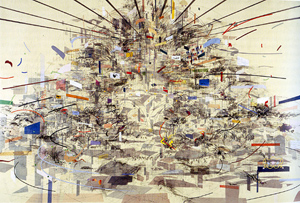
so in the end, for me, the moma trip was decent. the space is wonderful, the work is by and large exactly what you’ve come to love or be bored by, which is to say exactly what you expect. all that remains is for the museum to decide whether it is in fact the care taker of “classical modernism,” a sort of new offshoot of the met meant to enshrine a time period, or wether it is a living institution devoted to “the art of our time” as they choose to describe themselves. i am not at all sure it can be both.
Read Less...
a free man’s worship
“that man is the product of causes which had no prevision of the end they were achieving; that his origin, his growth, his hopes and fears, his loves and his beliefs, are but the outcome of accidental collocations of atoms; that no fire, no heroism, no intensity of thought and feeling, can preserve an individual life beyond the grave; that all the labours of the ages, all the devotion, all the inspiration, all the noonday brightness of human genius, are destined to extinction in the vast death of the solar system, and that the whole temple of Man’s achievement must inevitably be buried beneath the debris of a universe in ruins—all these things, if not quite beyond dispute, are yet so nearly certain, that no philosophy which rejects them can hope to stand. only within the scaffolding of these truths, only on the firm foundation of unyielding despair, can the soul’s habitation henceforth be safely built.” excerpted from a free man’s worship by bertrand russell.
behold! iterated substrates
 way back when i posted an exceptionally nifty java aplet called bubble chamber. well i was wandering around and found myself back at it’s creator jared tarbell’s website. normally i wouldn’t bother to re-blog the same site twice but since last time he’s added some more really incredible algorithmic art. the thumbnail is from substrate. his gallery of computation has many
other goodies as well. blows me away. it’s amazing what a tight, subtle, color palette can do for auto-generated compositions. he offers archival quality prints of select algorithms, and though he’s made all the code open source, i say support the artist!
2004 in art-tech
many of the cool, weird, or gimmicky art gadgets i came across last year never made it into a post. i decided in an effort to clean out the musty old link folders i’d gather together some of the better stuff i’d collected and post it all to make way for the all-new 2005 isht that’s sure to begin piling up as of today. what follows is not exactly a best of list in that the real cream of the crop has already made it onto the nonist, but there are some very neat things here and it seems a shame to just throw it all out…
22 pop, or the typewriter that sends email. great mod. rich sent me this link a long long time ago. the designer has a bunch of other interesting stuff on his site including the uncle phone which i love. if you search around his site, particularly the background section you’ll come across lots of other goodies.

not-so-white walls, or interactive wallpaper. this is really cool. “Here, the surface and patterns of what appears to be ordinary wallpaper are actually interfaces that act as switches or displays. The physical interaction allows the home dweller to dim lights, turn on or off home appliances, or see messages and images displayed on the wall. You can read your email on the wall, for example, or view pictures taken with your mobile phone camera.” here’s the designer dario bruzzini’s site.

the seelinder. not art exactly but super cool. it’s a cylindrical three-dimensional colour television that can be viewed from any angle and doesn’t even require the viewer to don funny glasses. remember “obi won, your our only hope?” of course you do, well, this is almost as good, or perhaps better, since it’s real.
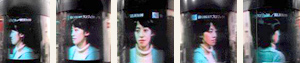
chronos chromos concrete a lot like the wallpaper mentioned previously, but works inside the wall itself. “Thermochromic ink is mixed with concrete. Nickel chromium wires, which heat up when electric current is passed through them, are set beneath the concrete surface. The area above the wire changes colour when a certain temperature is reached. The arrangement of these wires beneath the concrete allows the display of graphics and information.” cool.

juggernaut. this artist, phil ross, creates totally self contained survival capsules made to house one plant. very cool, though a bit on the low tech looks wise considering how precise and calculated the work is. maybe that’s part of the point, i don’t know. but i like it. similar works by ross were shown at the garden lab experiment show.

autoportrait. a refurbished, reprogramed assembly line machine arm which draws portraits ” The resulting image is individual and unpredictable. With both technical ability and the capability to recognize the characteristics of a human face, the robot hand forms his own style.” so cool.
other work by the group robotlab includes the jukebots which are autonomous robotic dj’s. neat.

the data fountain. fountains which take in realtime data, in this case comparative currency rates, and display it through the height of the fountain’s stream. pretty cool i think. for a more complex and ambitious display of realtime data check out grey world’s the source which is located at the london stock exchange.

the tissue culture project includes, victimless leather, the extra ear, the pig wing project, semi-living worry dolls, and disembodies cuisine. “The Tissue Culture & Art Project (TC&A) was set to explore the use of tissue technologies as a medium for artistic expression. We are investigating our relationships with the different gradients of life through the construction/growth of a new class of object/being – that of the Semi-Living.” pretty wild stuff

almost certified (grade A noise for non-discerning consumers) a mechanical sound installation. “a distributed network of precarious egg-tapping robots. each unit, individually amplified, features a select unconventional egg. calculated sequences emerge, conducted by beautifully rendered software on a resurrected mainframe (a sweet mac LC3). interesting / whacky.

photo form a unique tile studio which provides designers the ability to create bas-relief tiles from photographs. Utilizing our patent pending process called Photo-Cast ™, we can create bas-relief tiles from any type of two dimensional image. very cool.
here are a bunch more that might be worth your time.
the invisible force or the amazing psychic table. neat.
the drift table. The Drift Table allows people to float slowly over the British landscape from the comfort of their own home.
biopresence or the dna tree.
paragrahpie, or the most distracting drawing table in history.
troika studios check out the devices section for jealous tv signal jamming picture frames and microphones which pick up the secret lives of our electronics.
the art robots talent show. especially liked sisyphus, three blind mice, and the wildflower thingamabob.
lemur or the league of electronic musical urban robots. check out the guitarbot.
and just for good measure, the sensory homunculus.
anyone with some goody i missed is more than welcome to add on.
Read Less...











 i was fortunate enough to receive a 1st edition copy of a book published in 1872 titled: expression of the emotions in man and animals by one mr. charles darwin, whom you may have heard of (and if you’re mind is not clamped shut in a dogmatic vice you might also admire.) evidently this was the first scientific book to contain photographic reproductions, and they are doosies. i’ve decided to post some snippets at my leisure. today i will offer a bit of contempt, sneering, and defiance for your browsing pleasure. for example, concerning the lovely 19 century lass pictured here: “The partial closure of the eyelids, or the turning away of the eyes or of the whole body, are highly expressive of disdain. These actions seem to declare that the despised person is not worth looking at or is disagreeable to behold. The accompanying photograph (Plate V. fig. 1 thumbnail) shows this form of disdain. It represents a young lady, who is supposed to be tearing up the photograph of a despised lover.” thought that was rather poetic.
 been busy the last couple of days working on the forthcoming nonist activity book, the first volume of which is bible themed! i happen to own a few nifty k-mart bought jesus coloring books and was inspired to add to this educational oeuvre myself. once finished it will be free to download in it’s entirety. think of it as a sort of public service. after all why should jack chick have all the fun? so far i’ve been focussing on some delightful old testament scripture. i’m enjoying it so much that i’ve somewhat neglected my posting duties here. as such i thought that instead i’d offer our fine readers a peak at what’s to come. this illustration (click thumbnail) is for leviticus 26:29 “And ye shall eat the flesh of your sons, and the flesh of your daughters shall ye eat.” expect further educational and spiritually uplifting pages to color as well as word-puzzles, mazes, color by numbers, spot-the-difference, mad-libs, etc. now, i gotta get back to my good works.
 inspired by xeni jardin’s flag on boingboing (illustrating matt bradleys copyleft idea) i whipped up this bit of soviet constructivist goodness this morning (click the thumbnail for full artwork). for those of you who missed it, bill gates, of ludicrously rich fame, decided recently it would be a good idea to equate free culture advocates with communists, or to be more specific “new modern-day sort of communists.” how generous of the sort of modern-day robber baron. anyhow, the image is a rework of an old soviet poster which you can see here. Greg DeKoenigsberg (lead web engineer for Red Hat Network) expressed interest in a t-shirt. i’m reluctant to do a cafepress style tee, but if anyone else has interest leave a comment and we’ll go from there. forward the cause comrades!