pigment and pulp vs. ones and zeros
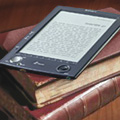 gizmodo had a tidbit earlier in the week on the much talked about sony reader, a promising gadget which uses the vaunted e-ink electronic paper tech to deliver a reading experience more akin to good ol’ pigment on pulp. its release is set for the spring and it seems positioned to be the first digital reader to have a chance at any measure of success on american shores. personally i’m torn. i find myself rooting for it and rooting against it at the same time.
it seems to me this gadget neatly encapsulates the competition within myself, and presumably within others, between two mind-sets.
on the one hand i can not deny the practical appeal of a small, lightweight, digital book. the benefits would seem many. multiple books, one for every mood or possibility, in your hand simultaneously. you could carry around a whole reference library with you wherever you go, plus the odd sci-fi tome or russian tragedy for long train rides besides. that’s appealing for sure, but interestingly it’s the exact factor which has me torn.
i love my books. i love the dusty old used bookstores. i am not above stopping to rifle through the books in a trash pile on the street. i am a book hoarder and what’s worse i am unable to throw away any books whatsoever. my apartment is slowly but surely transforming from humble but warm domicile, well suited to human habitation, into a messy store-room, so crammed with piles of books (and other things) as to make habitation seem an afterthought. so while i obviously treasure my books i also secretly despise them for crowding up my precious parcel of pricey urban space. and there-in lies the conflict.
the digital book appeals to my latent desire to simplify while simultaneously repulsing me by threatening my urge to collect. i am a consumer after all; a westerner who loves his “things.”
the corollary in some ways might be the recent digitalization of music. if the sales figures are any indication we’ve been able to let go of the compact disc and embrace the weightless, mass-less abstraction of the mp3. though it’s impossible to look across the room with satisfaction at our mp3 collections we’ve been won over by convenience and portability. we’ve transfered our “stuff-lust” from the packaging and physicality of the music itself to the music player alone. the feeling that our music collections, meticulously pruned and hard won, somehow reflected our personalities for all to see, is increasingly more wrapped-up in the tech you choose to play your collection on.
i for one am at the point where i can fully embrace music as incorporeal. i’m ready to digitize and sell all of my discs. i think, “they are a pain in the ass, they are ugly, and they are insubstantial anyway.” but then with music it’s easier isn’t it? we’ve abandoned music’s outer-shell in stages. we’ve been obliged to switch to smaller and less satisfying packages since the l.p. with each new format being cheaper and carrying less emotional punch and subsequently less perceived value. i mean has anyone ever really treasured a shitty plastic c.d.?
books on the other hand have been around, mostly unchanged, for a loooong time. they are ingrained in our cultures and held-up in our minds as items of value. books are items to respect and cherish; items to hand down even. i know that considering the statistics, and the precipitous drop in quality evidenced by a stroll through the bookstore, this outlook might seem overly romantic, but ,of course, that’s the point. this view of books is ingrained and no amount of dan brown or “chick lit” or self-help tripe will likely change that.
the promise of these gadgets, aside from the brute convenience, is of course the promise of freely available information. the thought of being able to access every book ever published, of being able to reference any book at any time, of being able to form surprising connections, and of having the knowledge of the world available to copy, cut, paste, reorganize, print, etc… well that is very attractive as well; utopian almost. but if the evolution of the net and its content is any indication it’s a promise which will never be realized, but exist only to be dangled. a promise which will be impeded at every turn and hobbled by every exec with his eyes on his holdings. formats will change yearly and force us to buy everything again. in as much the digital book will never become the library of alexandria we might hope it to.
with all these things in mind i have to imagine books will have a harder time making the transition from tactile treasure to digital abstraction. until tech companies find a way to infuse these gadgets with enough emotional resonance to satisfy our bookish needs i imagine it will be a long hard slog, no matter how irrational the desire to fill our homes with unmanageable weights of flammable, yellowing, paper might be. then again, we seem to have happily abandoned our board games for playstations, our c.d.‘s for mp3s, our pens and paper for email, our yard sales for ebay, our singles bars for online dating services, our newspapers for websites, can the abandonment of the book be far behind?
i want a sony reader but also do not want one. perhaps the best course of action would be to use it for reference books, guilty pleasures, and cheap paperbacks exclusively while continuing to let the art books and literature and esoteric pile up? might be a good strategy for book stores as well.
one last thought: the sony reader’s counterpart in japan, the libre, has seen some modest success already. i can’t help but think this speaks to a cultural difference. after all when i think of simplifying my life and my surroundings, of letting go of my “stuff” i think of it as an eastern kind of thing. the idea of a simple, clean habitat, free of teetering piles, has always resonated as a desire for a more japanese / buddhist style of living. that may be ignorance on my part or just more romanticism (tokyo sure does not look “simple”) but perhaps with that kind of eastern cultural heritage doing away with the piles and objects and “stuff” is easier emotionally?
anyone have any thoughts on the matter?
Read Less...
searching for the god particle, finding art
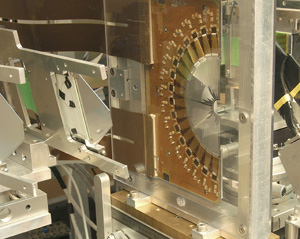
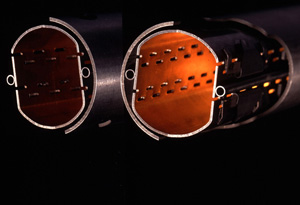
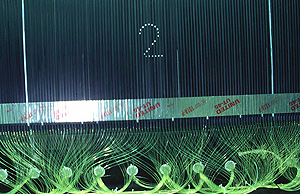
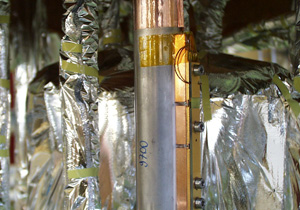
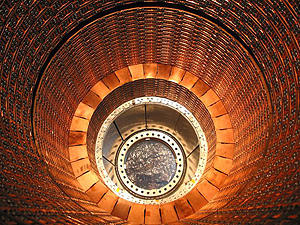
 was reading the bbc story today updating one-and-all on the progress of cern’s Large Hadron Collider set to start smashing particles together in 2007. the super-collider and its search for the higgs boson is fascinating. especially if you consider the completely hypothetical nature of the whole endeavor. it is, i believe, the most expensive scientific endeavor currently happening on planet earth and yet the there is at least a 50 / 50 chance it will yield exactly nothing. i can’t imagine how they secured financing for the thing! imagine they must have been some pretty snazzy powerpoint slides. anyhow as with nasa’s projects there is a delightful byproduct to all the tech and sweat, though it’s one which is of no concern to anyone…
in search of (5) the first person to…
 in this our fifth installment of our occasional in search of series (see earlier installments 1, 2, 3, 4) i take a slightly different tact. this time around rather than scour the internet for relevant links to a particular concept i focus instead on the broad subject of “the first person to…” the findings were vast and the possibilities many. i decided to throw out the Neil Armstrongs and yuri gagarins of history (since you’ve already had their great accomplishments effectively drilled into your poor malleable little skulls) and to focus instead on some possibly lesser known “firsts.” collected below you will find the group of firsts i managed to collect before the vastness of cyberspace overcame me and i passed out. enjoy.
The first recorded case of an actor performing took place in 534 B.C. when the Greek performer Thespis stepped on to the stage at the Theatre Dionysus and became the first person to speak words as a character in a play.
In 1837, Robert Cocking became the first person to die from a parachute accident.
Saint Stephen was the first person to die because he loved Jesus so much that he wouldn’t stop talking about Him.
Steve Man is the first person to live in total constant intimate contact with a computer, the first semi-cyborg. Over the past twenty years, Steve Mann has been his own human guinea pig, testing his various wearable computer prototypes on himself.
The first person to add a fifth dimension to Einstein’s four was the German mathematician Theodor Kaluza in 1919.
joseph Déjacque was the first person to describe himself as a “libertarian”, in an 1857 letter which represents the first appearance of the term in print.
On September 9th, 1908 Lieutenant Thomas E. Lahm became the first passenger to fly on an airplane. on September 17, 1908 he became the first person to die in a powered airplane.
on march 24th, 1898 Robert Allison of Port Carbon, Pennsylvania became the first person to buy an American-built automobile when he bought a Winton automobile that was advertised in Scientific American.
Gaspard-Félix Tournachon, known as nadar, became the first person to make aerial photographs from a hot air balloon in 1858.
Dave Kunst is the first person to walk round the earth. which is to say the first person verified to have completed circling the entire land mass of the earth (with exception of the oceans) on foot.
On April 24th, 1967 Vladimir Mikhaylovich Komarov became the first person to die during a space mission after the lines of his spacecraft’s parachute became tangled during descent.
Actress Linda Hunt was the first person to win an Academy Award for portraying a person of the opposite sex; she won the Best Supporting Actress Oscar in 1983 for her performance as Billy Kwan, a male photographer, in The Year of Living Dangerously.
On March 18th, 1965, cosmonaut Alexei Leonov of the former Soviet Union became the first person to walk in space.
in 2003, 21-year-old Brandon Vedas, aka ‘ripper’, became the first person to kill himself online with an audience watching, signing off with the words: “I told u I was hardcore.”
the first person to log a perfect score on a coin-operated Pac-Man was Hollywood, Fla., resident Billy Mitchell. In 1999, Mitchell tallied 3,333,360 points (the highest score the board will accommodate) on a single quarter by eating every dot, fruit and ghost in his path without losing a man. It took him six hours.
in 2004 David Welch became the first person to win protection as a whistleblower under the Sarbanes-Oxley Act, passed by Congress in 2002 in the wake of corporate scandals at Enron, WorldCom and other firms.
The underlying structure of living things began to be appreciated in the 17th Century when the microscope was invented. In the 1660’s, Robert Hooke, an English scientist, was the first person to see cells though cell theory didn’t develop until the 19th Century.
The first person to see the Crab Nebula was an English physician and amateur astronomer, John Bevis in 1731.
Anton van Leeuwenhoek was the first person to see and describe bacteria in 1676. He used only a single lens and not the compound lens of the true microscopes we employ today; which makes his observations all the more amazing.
The first person to see new york from above in an airplane was Wilbur Wright, in 1909. His first test flight was an unannounced hop around the harbor, startling those who happened to see it. Word spread; crowds crammed the waterfront from Brooklyn to Lower Manhattan. Then he took off again, going up to 200 feet, buzzing the Cunard liner Lusitania.
On September 3, 1935 Malcolm Campbell reached 304.331 miles per hour on the Bonneville Salt Flats in Utah, becoming the first person to drive an automobile over 300 mph.
New Zealander Alexander von Tunzelmann became the first person to set foot on Antarctica, at Cape Adare, in 1899.
On July 31, 1790 inventor Samuel Hopkins of Pittsford, Vermont became the first person to be issued a patent in the United States. His patented invention was an improvement in the “making of Pot Ash by a new apparatus & process”.
Joseph Pline is the first person to use the word “aeroplane” in a 1855 paper proposing a gas filled dirigible glider with propellers.
Charles Brooks Jr. (April 1, 1942 – December 7, 1982) was a convicted murderer who was the first person executed by lethal injection in the United States. It was the first execution in Texas since 1964.
In August 1961, cosmonaut Gherman Titov was the first person to suffer from “space sickness” (i.e. motion sickness in space, not to be confused with “space madness”).
in 1988 bill cosby became the first person to personally accept his Razzies (The Golden Raspberry Awards or Razzies intended to dishonor the worst acting, screenwriting, song-writing, directing, and films that the film industry had to offer.) he won 3: Worst Picture, Worst Actor and Worst Screenplay for Leonard Part 6.
in 2002 Steve Fossett became the first person to fly solo around the world nonstop in a balloon.
The first person to be executed via the electric chair was William Kemmler in New York’s Auburn Prison on August 6, 1890.
Rudolf Schenk became the first person to escape from a stricken aircraft with an ejector seat on January 13, 1942, when he ejected from his Heinkel He 280 prototype jet fighter.
Sir John Sinclair the Scottish politician and writer was the first person to use the word “statistics” in the English language, in his vast, pioneering work, Statistical Account of Scotland.
in the early 1980’s, Mark Gonzales was the first person to ollie up a curb and to clear a set of stairs.
The first person to seriously apply general relativity to cosmology without the stabilizing cosmological constant was Alexander Friedmann. Friedmann discovered the expanding-universe solution to general relativity field equations in 1922, which was proved by Edwin Hubble’s observations in 1929.
Hennig Brand was the first person to discover a new element. Brand was a bankrupt German merchant who was trying to discover the Philosopher’s Stone — an object that is supposed to turn inexpensive metals into gold. He experimented with distilling human urine until in 1669 he finally obtained a glowing white substance which he named phosphorus. He kept his discovery secret, until 1680 when Robert Boyle rediscovered it and it became public.
in 1989 A federal grand jury indicted Cornell University student Robert T. Morris, Jr. for releasing a computer worm, thus he became the first person to be prosecuted under the 1986 Computer Fraud and Abuse Act. He was convicted in 1990, sentenced to three years of probation, 400 hours of community service, a fine of $10,050 and the cost of his supervision.
Charles F. Dowd (co-principal of the Temple Grove Ladies Seminary in Saratoga Springs, New York) was the first person to propose multiple time zones for any country, those for the railways of the United States. He did not propose their extension to the entire world.
Paracelsus, “the Father of modern toxicology.” who lived in the 15th century was the first person to explain the dose response relationship of toxic substances.
in 1963 winston churchill became the first person to receive Honorary U.S. Citizenship.
Ivan Meštrovi?, the Croatian sculptor, renowned as possibly the greatest sculptor of religious subject matter since the Renaissance, was the first person to have a one man show at the Metropolitan Museum of Art in New York City.
willard scott was the first person to portray the mcdonalds’ clown ronald mcdonald. he played Ronald in the first three television ads featuring the character.
englishman Thomas Stevens was the first person to circle the globe by bicycle.
after developing some of the earliest devices to be used in radio astronomy, Robert Hanbury Brown used his “optical stellar intensity interferometer” and became the first person to measure the diameter of the star Sirius.
The Hispanic ascetic Priscillian of Avila was the first person to be executed for heresy, only sixty years after the First Council of Nicaea, in 385. He was executed at the orders of Emperor Magnus Maximus, over the procedural objections of bishops Ambrose of Milan and Martin of Tours, who claimed the Churches’ right to punish its own.
On July 9, 2005, Danny Way jumped the Great Wall of China on a skateboard, becoming the first person to clear the wall without motorized aid.
... and that just about does it for me folks, my eyes are bleeding, and i loathe to become the first person to dye from posting an over-long blog post. until next time…
Read Less...
the gun-toting socialist wonder woman
 came across the odd story of octobriana, a comic book heroine best described as a sort of gun-toting socialist wonder woman from behind the iron curtain, her name referring to the october revolution, who was let loose on the western world in the early 70’s. the character herself is no great shakes (violence and tits, vengeance with a gun and a grimace, nothing we haven’t seen a million times before) but the origin of the character is pretty fascinating in that it centers on a whacky underground soviet resistance movement which itself has since been widely regarded as a literary hoax.
the story is thought to be the concoction of a czech émigré by the name of petr sadecky, who in 1971 approached the British publisher Tom Stacey Ltd with materials for a book he titled: octobriana and the russian underground. the book’s origin story no doubt added a subtext and weight to the otherwise run-of-the-mill comic. it goes essentially as follows:
in the late 1950’s, an underground dissident group calling themselves the PP, for Progressive Politics, forms behind the iron curtain. kruschev’s notion of de-stalinization was a guiding principle, for though they held the ideals of the revolution close to their hearts, they despised the oppression and totalitarianism of the Stalin years. They attended Komsomol meetings (the Communist Youth League), and publishing anti-Stalinist leaflets and manifestos.
by 1960 the PP became disillusioned, realizing they could never change the status quo, they decided to withdraw into isolation. After a period of dabbling with philosophies of passive resistance like Buddhism the PP began to investigate free love. soon after they morphed into the PPP, the progressive political pornography group. In an era when the representation of sex was taboo the PPP devoted itself to utilizing ‘obscenity’ as a means to voice their growing discontent with the Communist system.
this new group were organized into cells across the ussr and kept in touch by a secret samizdat publication called mtsyry. evidently their main activities included getting drunk, speaking out against the Soviet authorities, having orgies (sometimes they watched girls perform striptease acts in front of a portrait of Lenin, to the strains of The Internationale), and most importantly creating comics strips about their symbolic heroine octobriana.

quote: Octobriana is presented as a wild, savage warrior woman. Long blonde hair, tied-back in a high pony-tail by a leopard’s tail. Her large breasts barely hidden by a skimpy silk-scarf with tight snake-skin slacks and cowboy boots. She has, what appears to be, a live snake around her wrist. Her facial features suggest that she maybe of Mongolian or Chinese in origin. Her eyebrows meet in the middle and above them she wears a large red star on her forehead. Fighting with a Smith-Wesson revolver and a wavy, kriss dagger. Her name was said to mean The Spirit Of The October Revolution!
they did so under the the collective pen-name of ‘Roy Pavel Drakov’ as they would have been “packed off to forced labour camps in Siberia” were they caught. under such threat and pressure the popularization of octobriana, in the east let alone the west, would seem unlikely. which brings us back to petr sadecky. evidently when he escaped to the West he manage to smuggled out some copies of the Octobriana strips.

efforts to authenticate Sadecky’s claims were supposedly made but it’s tough to confirm the existence of a secret underground organization back there behind the iron curtain! so in the end, having to take sadecky at his word, or more likely not giving a crap / recognizing some good p.r. when they see it, the strips, along with their fantastic stories of origin were published in britain, the united states, and west germany.
almost immediately after publication another version of octobrina’s origin came to light.
quote: A conflicting version put about by Reima Mäkinen of Finland, still included Sadecky, but in a quite different light. Reima claimed Sadecky asked the Czechoslovakian artists (Bohumil Konecny, Sdneck Burian and Milos Novak) to create an adventure strip for him, called Amazona. As soon as they had done so, it is alleged, Sadecky scarpered to England with their work, where he copied their work and sold it as Octobriana.
ouch. so, far from being a member of some dissident underground group, resisting stalinism and embracing sex under threat of imprisonment, sadecky was actually an all too average shyster who stole the whole thing from his comrades and repackaged it? no! how very un-idealistic!

the story in some ways ends there because rather than defending himself history notes that shortly after octobriana and the russian underground was published, sadecky vanished without a trace.
in fact octobriana’s story does not end there at all because an integral part of sadecky’s origin tale dealt with the “true communist” ideals of the ppp. he’d explained that the ppp did not believe in the private ownership of ideas and thus octobriana was meant to be part of the public domain.
so essentially even though his claims on the whole were never corroborated, and were actually challenged directly by other possible creators, the character of octobriana has never the less remained in the public domain just as he’d suggested. strips featuring the character (as well as a film) have continued to crop up to this day.

in a way the character of octobriana might literally be thought of as the very first creative commie.
lastly, for those of you thinking, “pointless post! i’ve never heard of her. why indulge such silly and oblique arcana?!” i offer this weighty evidence of octobriana’s true permanence!
________________________________________________
anyhow, all info for this post was taken from the following sources:
the few viawable pages at octobriana.org.
octobriana online.
this page titled icon or myth.
the octobrina page of the international calalogue of superheroes.
the essay art of adult architecture or the politics of pornographic planning. from cut-up.
and john a. short’s essay the origin of octobriana.
for further reading check out the 3 part Octobriana a ruský underground which covers far more ground than my little snippet here.
Read Less...