







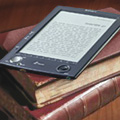
 gizmodo had a tidbit earlier in the week on the much talked about sony reader, a promising gadget which uses the vaunted e-ink electronic paper tech to deliver a reading experience more akin to good ol’ pigment on pulp. its release is set for the spring and it seems positioned to be the first digital reader to have a chance at any measure of success on american shores. personally i’m torn. i find myself rooting for it and rooting against it at the same time.
it seems to me this gadget neatly encapsulates the competition within myself, and presumably within others, between two mind-sets.
on the one hand i can not deny the practical appeal of a small, lightweight, digital book. the benefits would seem many. multiple books, one for every mood or possibility, in your hand simultaneously. you could carry around a whole reference library with you wherever you go, plus the odd sci-fi tome or russian tragedy for long train rides besides. that’s appealing for sure, but interestingly it’s the exact factor which has me torn.
i love my books. i love the dusty old used bookstores. i am not above stopping to rifle through the books in a trash pile on the street. i am a book hoarder and what’s worse i am unable to throw away any books whatsoever. my apartment is slowly but surely transforming from humble but warm domicile, well suited to human habitation, into a messy store-room, so crammed with piles of books (and other things) as to make habitation seem an afterthought. so while i obviously treasure my books i also secretly despise them for crowding up my precious parcel of pricey urban space. and there-in lies the conflict.
the digital book appeals to my latent desire to simplify while simultaneously repulsing me by threatening my urge to collect. i am a consumer after all; a westerner who loves his “things.”
the corollary in some ways might be the recent digitalization of music. if the sales figures are any indication we’ve been able to let go of the compact disc and embrace the weightless, mass-less abstraction of the mp3. though it’s impossible to look across the room with satisfaction at our mp3 collections we’ve been won over by convenience and portability. we’ve transfered our “stuff-lust” from the packaging and physicality of the music itself to the music player alone. the feeling that our music collections, meticulously pruned and hard won, somehow reflected our personalities for all to see, is increasingly more wrapped-up in the tech you choose to play your collection on.
i for one am at the point where i can fully embrace music as incorporeal. i’m ready to digitize and sell all of my discs. i think, “they are a pain in the ass, they are ugly, and they are insubstantial anyway.” but then with music it’s easier isn’t it? we’ve abandoned music’s outer-shell in stages. we’ve been obliged to switch to smaller and less satisfying packages since the l.p. with each new format being cheaper and carrying less emotional punch and subsequently less perceived value. i mean has anyone ever really treasured a shitty plastic c.d.?
books on the other hand have been around, mostly unchanged, for a loooong time. they are ingrained in our cultures and held-up in our minds as items of value. books are items to respect and cherish; items to hand down even. i know that considering the statistics, and the precipitous drop in quality evidenced by a stroll through the bookstore, this outlook might seem overly romantic, but ,of course, that’s the point. this view of books is ingrained and no amount of dan brown or “chick lit” or self-help tripe will likely change that.
the promise of these gadgets, aside from the brute convenience, is of course the promise of freely available information. the thought of being able to access every book ever published, of being able to reference any book at any time, of being able to form surprising connections, and of having the knowledge of the world available to copy, cut, paste, reorganize, print, etc… well that is very attractive as well; utopian almost. but if the evolution of the net and its content is any indication it’s a promise which will never be realized, but exist only to be dangled. a promise which will be impeded at every turn and hobbled by every exec with his eyes on his holdings. formats will change yearly and force us to buy everything again. in as much the digital book will never become the library of alexandria we might hope it to.
with all these things in mind i have to imagine books will have a harder time making the transition from tactile treasure to digital abstraction. until tech companies find a way to infuse these gadgets with enough emotional resonance to satisfy our bookish needs i imagine it will be a long hard slog, no matter how irrational the desire to fill our homes with unmanageable weights of flammable, yellowing, paper might be. then again, we seem to have happily abandoned our board games for playstations, our c.d.‘s for mp3s, our pens and paper for email, our yard sales for ebay, our singles bars for online dating services, our newspapers for websites, can the abandonment of the book be far behind?
i want a sony reader but also do not want one. perhaps the best course of action would be to use it for reference books, guilty pleasures, and cheap paperbacks exclusively while continuing to let the art books and literature and esoteric pile up? might be a good strategy for book stores as well.
one last thought: the sony reader’s counterpart in japan, the libre, has seen some modest success already. i can’t help but think this speaks to a cultural difference. after all when i think of simplifying my life and my surroundings, of letting go of my “stuff” i think of it as an eastern kind of thing. the idea of a simple, clean habitat, free of teetering piles, has always resonated as a desire for a more japanese / buddhist style of living. that may be ignorance on my part or just more romanticism (tokyo sure does not look “simple”) but perhaps with that kind of eastern cultural heritage doing away with the piles and objects and “stuff” is easier emotionally?
anyone have any thoughts on the matter?