








 This is a reply I posted to the sl4 mailing list, and I s’pose it would make a fairly decent nonist post. John K. Clark (pen name fudley) wrote: > > The question therefore is: “Is Free Will a truly complete illusion?” No. The question is, what the hell do you mean by this very odd phrase “free will”? Over the years philosophers have come up with some very very very dumb stuff, but none dumber than “free will”. They argue back and forth about it, they squabble if a particular biological organism called “Homo Sapiens” his this mysterious property or not, and yet never once do they explain what the fucking hell the words “free will” could possibly mean. Idiotic! I don’t demand a rigorous definition, that would be asking far too much, just give me a vague hint of what the words “free will” could possibly mean, and then I’ll tell you if Homo Sapiens has this odd property or not.
So that’s what fudley wrote, and tbuckner is pretty well in full agreement with him. I replied as follows:
Most people, in discussing free will, assume it’s boolean: either you have ‘it’ or you don’t. And most seem to assume free will is something ineffable and unbounded, when in reality there are many constraints on our behavior. I don’t think it’s useful to think about it that way.
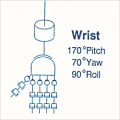
I prefer to think about “degrees of freedom” in a behavioral sense, by analogy to mechanical degrees of freedom (you probably know the term, but here’s a good explanation: degrees of freedom.
“In total, your arm has seven degrees of freedom: three in the shoulder, one in the elbow, and three in the arm below the elbow. Three degrees of freedom are sufficient to bring the end of a robot arm to any point within its workspace, or work envelope, in three dimensions.”
So think of that as a metaphor for the possible choices and mental states a given entity can have. Until somebody shows me different, I assume a rock or an ice cube or my couch have exactly zero degrees of freedom. They have no mental states and only behave according to what physics and chemistry make them do. There are inanimate objects which can do pretty complicated things: a bucket of gasoline can sit quietly, and then burn down my garage; my computer can do lots of stuff I don’t understand, but since it doesn’t quite have a mind, it’s still an inanimate object.
Degrees of freedom begin to crop up when an assemblage of inanimate matter becomes complex enough to behave as if it had a self, however primitive. It’s generally agreed that prions are dead matter, viruses are (barely) alive, and bacteria are fully alive since they take full responsibility for their own metabolism. Fully alive entities may lack consciousness, but they do have tropisms, toward light or food, for example. Still, the degrees of freedom we find in single-celled creatures are so slight as to be barely worth mention.
Plants and simple animals have more complex behaviors, and animals with bigger brains have increasing degrees of freedom. By the time we work our way up to mammals, we have beings who actually do have some concept of freedom; they are capable of caring when they don’t have it. I had a pet rat named Houdini (he was an escape artist). When kept in a cage he couldn’t get out of, he would lay there with his chin on his paws. He was truly depressed! Eventually, he ended up living in the cellar, uncaged. He had the run of the place, and would kill mice when they tried to steal his food. He liked it there; I would go down and call him, and he’d come (he loved steak tips). The point of this story is that, although a rat may not have an unlimited behavioral repertoire, it has enough intelligence and enough of a self-concept to have preferences. Are we therefore to say that a rat has zero free will?
Now, a hard-ass determinist can say, “But rats and humans are ultimately just more complex molecular machines, and if each mental state is fully dependent on previous states, and if our behavioral space is not infinite, then WE DON"T HAVE FREEE WIIIILLLLL! EEEEEEEEEEEK!!!” We’re just Chinese Rooms? Ah, that’s the problem with denying free will entirely; you’re telling people they have no feelings, no inner lives, no choice. So we are forced to imagine what magical quality is lacking that a being with free will would have, when any yak farmer can tell you he’s got free will.
So consider humans: there are no creatures we know of that have a wider behavioral repertoire than humans. From helpless, speechless, half-instinctive babies we have the potential to become astronauts, concert pianists, BASE jumpers, sex fiends, embezzlers, computer programmers, Buddhist monks, war criminals, comedians, and guys who hug wild grizzly bears until they get eaten. Humans have a LOT of free will. Some more than others; does a garment worker trapped in Saipan with her passport in the boss’s safe have as much free will as the centimillionaire designer whose name is on the labels she sews? Obviously not!
There’s more than one dimension of free will in humans, anyway. There’s freedom of movement, what you can afford to buy, who you can sleep with, whether you can get that sex-change operation, who will take your calls, who will obey your orders. In these areas (power, basically), that rich fashion designer has it all over our poor seamstress. But perhaps there are things she can do that he can’t, or at least things she could do if she had time and leisure. Perhaps she is a lucid dreamer, knows three languages, and so on. Having potential freedoms means nothing if one lacks the imagination or intellect to pursue them. As practically everyone is stupid in some areas, so everyone is unfree in those areas, even if they don’t know it.
I recall a story about Gurdjieff, the Russian mage, behaved toward a particular woman who arrived at the Priory to study there. She, as I recall, was very intellectual (or wanted to be seen as such) and rather an impatient type A person. Gurdjieff was nasty to her, wouldn’t give her the time of day. He hounded her until she left, and one of his disciples asked him why. Gurdjieff replied that she was a waste of time, and she would never change. The disciple met her ten years later, and found her to be close-minded and insufferable; her worst qualities had grown, but otherwise, Gurdjieff had been exactly right. For some reason, she could not change.
So what sense does it make to say “Do humans have free will or don’t they?” As doctors now know there are many completely different diseases under the heading of ‘cancer,’ and many different rhinoviruses under the heading of ‘common cold,’ so are there many not-quite-the-same freedoms under the heading of “Free Will.”