



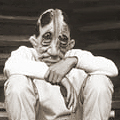
 the facts, culled from the encyclopedia of photography: ralph eugene meatyard did not begin to photograph until 1950. he made his living as an optician photographing mostly on weekends. he was a “sunday photographer” who exhibited with Ansel Adams, Aaron Siskind and workshopped with Minor White. his photographs present a world of somnambulistic mystery, a realm of disquieting intimations. Children appear as masked figures in decrepit rooms, enacting inscrutable dramas or charades. In every image there is something askew. his work was often accompanied by written texts. he was an avid reader, deeply influenced by modernist literature, especially Pound, Stein, and William Carlos Williams. He died in kentucky in 1972.
an opinion from Contemporary Photographers, St James Press, 1985:
He was a good-looking man with a mildly saturnine air and an unexpected history of ill-health. He never spoke of such troubles, or said a word about his photographs. But, he’d happily show you 200 new prints in the family parlor if you asked him. He had a pretty wife and three kids. He worked as an optician, grinding lenses, and had a company called “Eyeglasses of Kentucky” in a little shopping center. Just an ordinary guy. Like Franz Schubert or Henry James, he could make the “ordinary” scare you to death or sing like a bird.
Gene’s reading was all over the ballpark but his attentions were very honed down. If you wrote poetry, he read it- there are few people like that on the planet. He seemed thoroughly at ease in Blue-Glass Limbo. A rube he wasn’t. He rode quietly around in “The Strange,” like city folks used to ride out to “The Country.”


concerning the posthumous embrace of postmodernism, from mario cutajar:
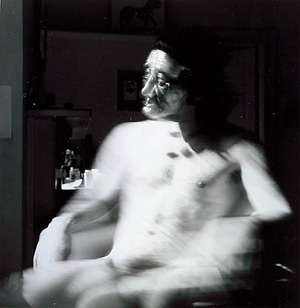
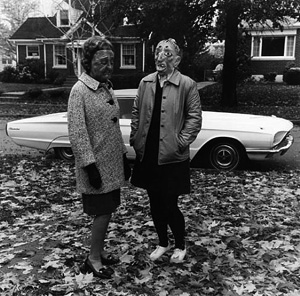
The basis for this induction of Meatyard into the postmodernist pantheon is the blatant theatricality of his staged images, and his quite evident disdain for the objectivity of photography. That these qualities distinguish his work from that of his anti-pictorialist contemporaries (Ansel Adams, Edward Weston and other proponents of “pure” photography) is unquestionable. But there are other qualities (or lack of) in Meatyard’s work that make it equally resistant to postmodernist affiliation. For one thing, it is neither ideologically motivated nor self-consciously subversive. It is not constrained by the petty resentments of identity politics. It is free of both smarty pants irony and the cheap, cultivated anomie of the unattached (Meatyard was a family man). It is personal in the way personal used to mean before Americans started to flock to talk shows to compete at being freaks.
The images he is justly renowned for (among 25 on display) are the ones of children and adults wearing dime-store Halloween masks. The device is so transparent that part of the pictures’ intrigue is why they work at all. They do because of Meatyard’s eye for setting and pose, because of his ability to extract startling black-and-white contrasts from the silver-rich photographic paper he used (contrasts that create amorphous voids out of which the masked figures materialize like apparitions), but just as importantly because Meatyard never tried to disguise his artifice. Later on toward the premature end of his life when he shot the Lucybelle Crater series, he even dispensed with the murky backgrounds and relied entirely on the transgressive impact of his masked figures nonchalantly inhabiting the daylit world like regular folk—as if they belonged.
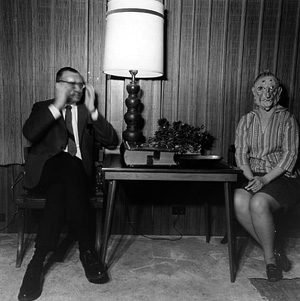
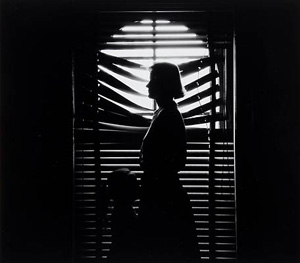

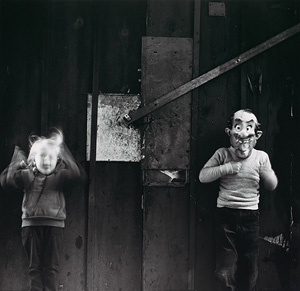
from the horse’s mouth (via scheinbaum & Russek LTD):
Meatyard once wrote: “I work in several different groups of pictures which act on and with each other—ranging from several abstracted manners to a form for the surreal. I have been called a preacher—but, in reality, I’m more generally philosophical. I have never made an abstracted photograph without content. An educated background in Zen influences all of my photographs. It has been said that my work resembles, more closely than any photographer, ‘Le Douanier’ Rousseau—working in a fairly isolated area and feeding mostly on myself—I feel that I am a “primitive photographer.”
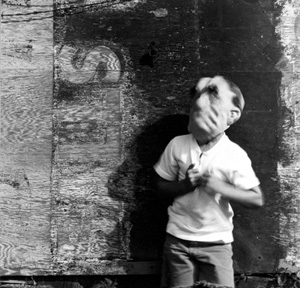

my opinion? creepy, poetic, disconcerting, silly, weird, and beautiful, in context of its time or out. also quite possibly the greatest surname in the history of the arts.
for more check out the george eastman house still photograph archive, the masters of photography site, the village voice, and artnet. hope you enjoyed.