








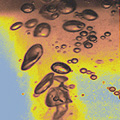
 came across a post at we make money not art this morning about a project called camera lucida, an interactive “sonic observatory” allowing participants to view sonoluminescence in action, till now a phenomena only viewable in a highly specialized sonochemical laboratory. along with some historical information they offer a video of the camera lucida in action. it’s a fine idea and i’m sure in person the effect must be pretty amazing, the video i suspect does not do the project justice. so what exactly is at work here and what is sonoluminescence?
the most simple concise answer: the process by which acoustic energy is turned into light. offering slightly more detail is this definition: Sonoluminescence is the conversion of sound into light, in which acoustic waves aimed at a water tank create bubbles which collapse to release light flashes.
a scientific american article from 1995 puts it this way:
Imagine you are riding a roller coaster. First, you chug up a long incline slowly. When you get to the top, your car free-falls, speeding up until it reaches the bottom of the drop, where the deceleration crams you into your seat. That sensation is what you would feel if you were riding a pulsating bubble of air trapped in water—except that the drop would reach supersonic speeds and at the bottom you would be crushed into your seat with a force equal to 1,000 billion times your weight.
Obviously, more than your stomach would react to such a ride. As for the bubble, it responds to the extraordinary force by creating a flash of light only a tiny fraction of a second long.
ah, i see. very simple.
well, not really. in fact, though It was first discovered by scientists at the University of Cologne in 1934 (as a an unintentional result to work on sonar), no one is 100% sure what really causes the phenomena. with advances in reaserch, namely “single bubble Sonoluminescence” where by a single bubble, trapped in the acoustic standing wave, emits a pulse of light with each compression of the standing wave, the physical mechanics of the process have become more evident but the mystery of how a low-energy-density sound wave can concentrate enough energy in a small enough volume to cause the emission of light is still unsolved.
one theory posits that the puzzling glow emitted may be caused by a tiny jet of liquid that shoots across the interior of the bubble at supersonic speed and slams into the opposite side.
another theory argues that the collapse of a bubble produces a shock wave, something like the one in a sonic boom but spherically symmetric. The wave crushes the gas in the bubble, heating it up as the wave passes. Then, when the shock wave reaches the center of the bubble and rebounds, it heats the gas again, and in the process can produce temperatures as large as 100,000o C. with this theory in mind a few physicists have speculated that the collapsing shock wave could raise the temperature so much that nuclear fusion, the combining of small nuclei to make a larger nucleus, with a substantial release of energy, might be possible.
a few interesting factoids:
1) the temperature inside the collapsing bubble is hot enough to melt steel. in fact recent temperature measurements of 20,000 degrees Kelvin [35,540 degrees fahrenheit] make it over 4 times hotter than the temperature of the surface of the sun.
2) when using a single bubble the flash of light lasts an incredibly short time, a few tens of trillionths of a second. the entire spectrum of colors in an SL flash shines for 35-380 picoseconds.
3) Sonoluminescence bubble collapse at more than four times the speed of sound.
4) The only liquids that have produced sonoluminescence are pure water, aqueous solutions and ethanol at -115° C.
anyhow the video which accompanies the camera lucida project, as i’ve said, does not necessarily dazzle the eye as i’m sure seeing it in person would, and since i’d rather not ply you with nothing but dry science i’ll instead do what i do best- i’ll ply you with pretty pictures. below you will find a Sonoluminescence related gallery of images. i particularly like the “frankenstein feel” which results from the various funky apparatus set ups combined with the, well, luminescence.

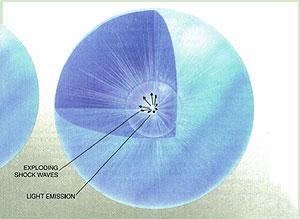
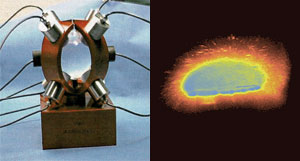
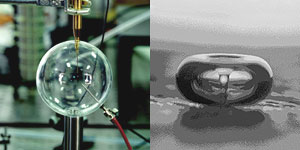
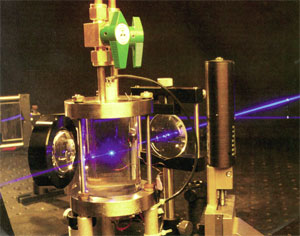
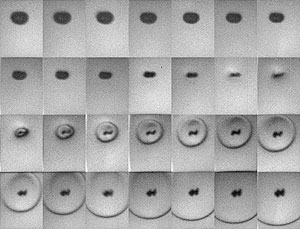
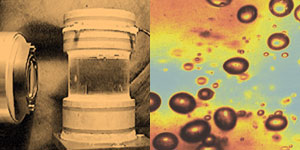
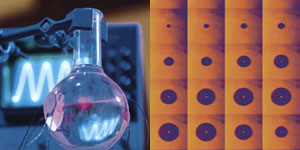


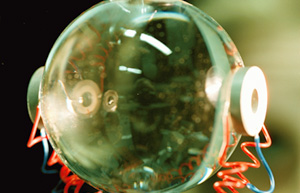
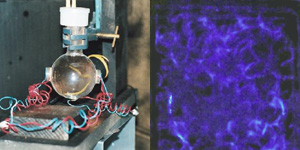
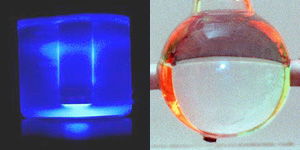
without context but beautiful none the less.
lastly i’ve reproduced some of the “historical notes” from the camera lucida website below because i found them particularly interesting and found the flash scrolling text particularly annoying.
There are very ancient traditions probing the connection between light, sound and color, which have usually lead to rather pertinent cosmological implications. The Greek philosophers, Aristotle and Pythagoras, speculated that there must be a correlation between the musical scale and the rainbow spectrum of hues. That idea fascinated several Renaissance artists including Leonardo da Vinci (who produced elaborate spectacles for court festivals), Athanasius Kircher (the popularizer of the “Laterna Magica” projection apparatus) and Archimboldo who (in addition to his eerie optical-illusion portraits composed of hundreds of small symbolic objects) produced entertainments for the Holy Roman Emperors in Prague.
Although very much a part of his scientific imagination, Sir Isaac Newton had never applied the idea of colors corresponding to musical tones, for example by constructing an instrument that would produce colors and tones simultaneously. Nevertheless, he invented (and we have to call it that) the seven colors of the spectrum, based on the analogy with the seven notes of the diatonic scale. It appears that it was his assistant, endowed with better eyesight, who divided up the spectrum of sunlight refracted by a prism, but it was certainly Newton who had instructed him to make seven divisions. As a result of this decision, most people today believe unthinkingly that the rainbow has seven colors, called red, orange, yellow, green, blue, indigo and violet.
In searching for the rationale behind the spectrum, Newton discovered another musical dimension. It was while experimenting with the colored rings that appear when two pieces of glass are pressed together (“Newton’s rings”). He calculated the spaces between the two plates that gave rise to different colors - spaces of the order of a ten-thousandth of an inch - and found that they were proportioned as the cube roots of the squares of the string lengths that would have given the corresponding intervals. It was through such calculations that he later discovered the wave lengths of light.
be sure to visit the camera lucida page for further information including a bit on the ocular harpsichord.
for more info on Sonoluminescence from the scientific perspective try mit’s links page, or check out the sci-am article mentioned earlier.
for more related visual stimuli see here.