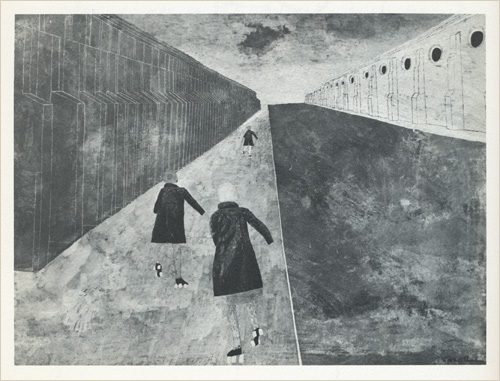
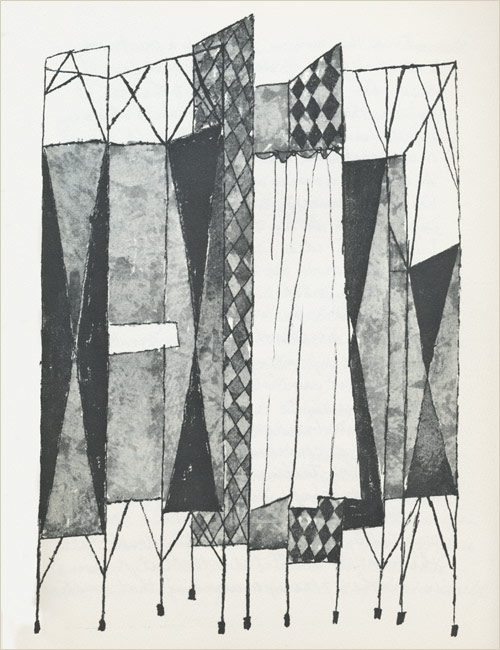
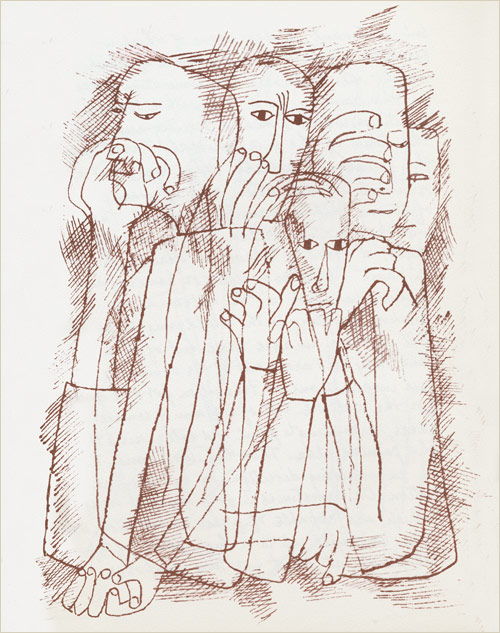
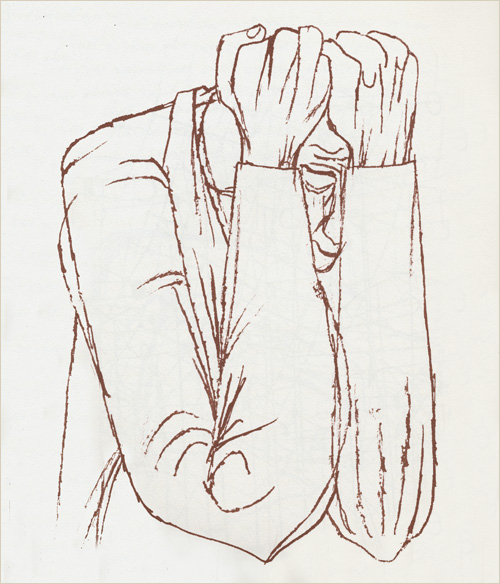
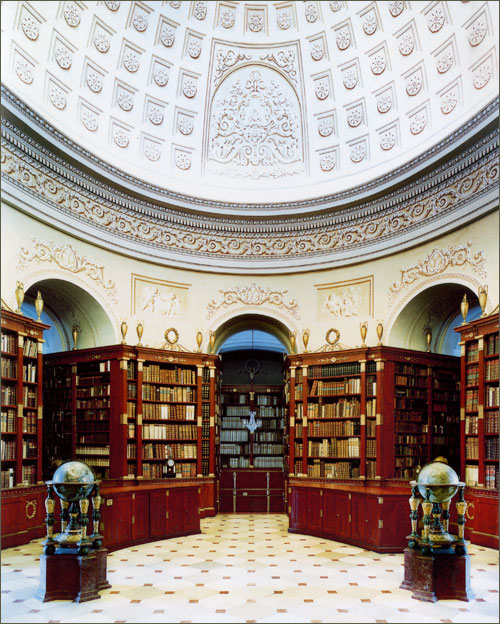
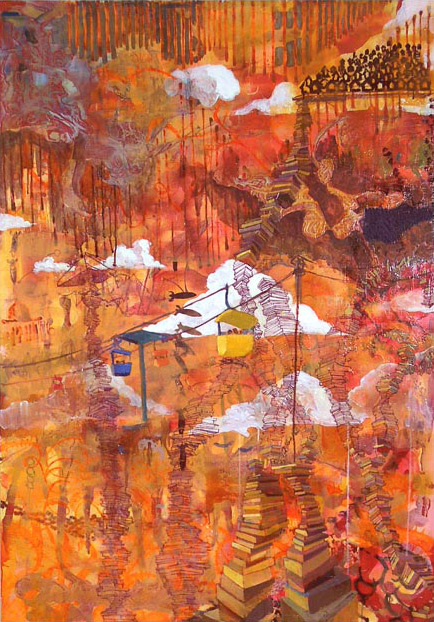
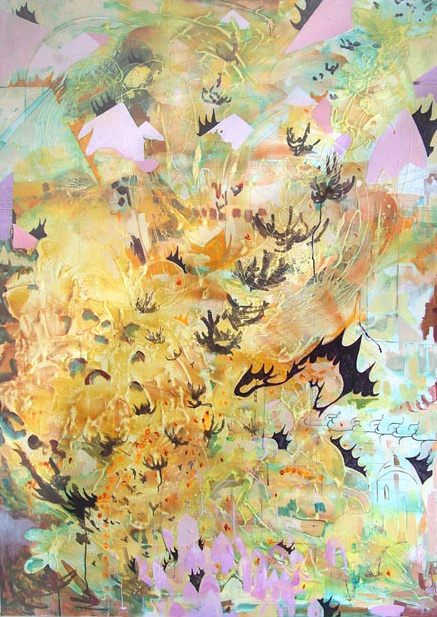
The world, so far as he knew it, was terrifically boring, with all those endlessly angling hallways leading to dead-ends or back onto themselves. He constantly snorted his impatient youthful frustration at the crushing “sameness” of it all. By the age of 8 he’d grown tired of scraping his horns up and down the lengths of those uniform walls and abandoned his explorations all together. It should be said, I suppose, that the world was terrifically lonely as well. Aside from the occasional appearance of Daedalus (and the rare glimpse of Icarus at his heels) he was as alone as a man with a bull’s face could be, which, as the less handsome among us can attest, is very alone indeed. In the main his days were spent sitting in a corner listening to the phorminx of his stomach play accompaniment to his snorts.
During his 9th year he began hearing voices. They were clipped whispers which in the perfect silence of the walled world echoed like a Sybil’s fiat. At first he was terrified; His bull’s brain bred to fear the hunter. He crouched deeper into his chosen shadow, hyperventilating, his tongue lolling and slick. He hid and he listened and for weeks kept still as a stone.
Slowly, one by one, the voices quieted until the only sound remaining was that of a single pair of sandals, their light steps tapping out a confused staccato once or twice a day. Emboldened by familiarity and hunger he began venturing out in their intervals of inaction.
The first body he encountered was thin and small. It laid face down in a corner, its knees bent, its hindquarters in the air. The smell of blood from its scraped knees and cheeks was faint but enthralling. He emptied his bladder dramatically, snorting and stomping and dropping his horns low, then, satisfied that the body was submissive, he sniffed carefully about its edges. It was dead and it was the first meat he’d seen since the voices invaded. He choked it down looking again and again over his shoulder.
He found 12 more bodies in as many days; All dead. 7 were large and 5 more, like the first, were small and soft. He dragged each to the center of the world and stacked them in a pile. He’d never seen so much meat in one place at one time, and were it not for the staccato sandals which still made their ragged music occasionally, he might have been… happy. He wasn’t bored any longer, nor was he hungry. What was happiness if not that?
The last body he found was also small and soft. It lay in the middle of a hall with a little sack clutched in its arms. At the sound of his water smacking the floor it moved, its sandals scraping two lazy parabolas in the dust. It was not dead but neither did it run. When he jabbed it experimentally with his horn it did not cry out. He dragged it to the center of the world but did not drop it on the meat pile.
For months he shared his meals with it. He shared the water which arrived via Daedalus’ hidden shoots and ladders. He inhaled its smell deeply, he mated with it, and he watched daily as it moved an ivory stylus across one of the tablets from its sack. He’d never known companionship, never known the pleasure of watching another empty their bowels, never known that rattling sobs and wet eyes could be so beautiful.
Learning to read had been a wonder. Once he was made to understand that the symbols in the wax tablets held meaning, were connected each to an idea outside itself, he wanted to lay eyes on little else. Meat was plentiful and mating was easy, but reading! That was different. It revealed to him existence beyond his confused hallways. She explained and explained again, every day for months. His first hard-earned moments of comprehension, when they came, were like a long dawn over a new world. Everything was transformed. The walls no longer seemed so infuriatingly uniform. The shadows seemed half as dark and simultaneously twice as deep.
But, alas, these were merely quiet contentments before a gathering storm of anguish.
One day, after mating, his female lay down in the corner where he threw his marrow-sucked bones, and never got up again. He poked at her bruised flanks with a gentle horn but knew instinctively that he was alone once more. He thought of her weeping face, her pink parts, the days of sounding out words between sobs. Though he snorted nervously and his fur bristled, his spirits were not completely broken. “I have the sack of tablets” he thought wanly as he moved her battered body to the meat pile.
He spent the next months plodding through every tablet in the sack, those which he’d read before as well as those which his mate had kept from him. (She’d always say of these “They are too difficult for you.”) It was here, reading alone in the heart of the labyrinth, that the sun set on his new world. In its dusk he learned the truth of things, of men, of gods, of his parents, and of himself.
He read of Poseidon’s agreement with Minos. He read of Pasiphae’s lust and of Daedalus’ means of assuaging it. He read of his own birth and the construction of his world built for amusement and agony. He read of Athens’ defeat and Aegeus’ bargain to send 7 youths and 7 maidens every nine years into the labyrinth. He learned his own name – Asterius – and turning finally to the tablet his mate had written, was impelled for the first time in his life to sound out the word “minotaur” in his mind.
This last tablet was an account of life in the labyrinth. It was filled with bitterness and horror, made up as it was of words like “monster,” “revulsion,” and “misery” flanking the ever repeating phrase, “I wish to die, please Gods let me die.” Had he but known how Asterius would have wept like the soft one who so despised him.
Epilogue
The Athenian meat eventually ran out and though it might seem masochistic Asterius just sat reading and re-reading the tablets each day. There was nothing else but his hunger pains and the silence. By turns he became sullen and angry. First brooding over his own newly realized miseries, then imagining, in great detail, what he would do to the next batch of children who dared drag their sandals into his darkness. He shat on the bone pile and slept clutching the sack of tablets.
More Athenians did come in time, 7 youths and 7 maidens, whom he watched from the darkness, his snorting anger tempered by longing. At first he approached them submissively with a tablet in hand, but each time they only shrieked and cursed him and fled into the darkness. Finally he lost patience and began hunting them, tearing with his horns and mating with their corpses. Even with a full belly and empty balls, however, his life as one with knowledge was a misery.
Eventually the realization struck him that he might take up the ivory stylus himself and write his own words into the margins of a tablet. It took much trial and error, but after nearly a year he set down that stylus having written a single message to the world above with its cruel men and capricious Gods:
“Had I only been born opposite of what I am, with a bull’s powerful heart and a man’s cunning mind, I might have been a beloved hero among you. Instead I find myself with the weak heart of a man and the dim mind of a bull, a monster, who you’ve trapped in the dark and universally despise. – The Minotaur.”
Theseus would find him brooding over this very passage 9 years later.
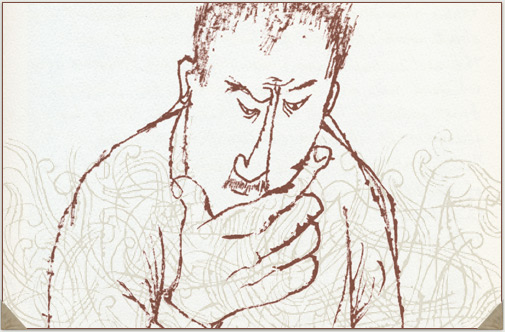
Truth: The Minotaur Reading
In that I can not not find any information specific to this piece I will instead offer a pertinent section from a review written by Roddy McDevitt from Queen Street gallery:
“Carters’ work is fresh and authentic. It is both daringly simple and deeply resonant. This is a result, of course, of her subject matter. She poeticizes the figure by creating eerie composite creatures. Whether cast in bronze or drawn in charcoal, the work, it seems to me, breaks down into either the lyrical single figure or the dramatic interaction of two or more figures. Her single figures, naked men with perfectly integrated animal heads: bull, horse, bear, fox, rabbit, all seem lost in contemplation of the mystery of their own existence.
The dramatic configurations are fabulous and thus exotic. We are like Alice through the looking glass, propelled into a dreamworld overflowing with marvelous creatures thoroughly absorbed in their own encounters with each other. This ‘Carter world’ is exciting, magic-fueled, utterly mysterious yet completely realized. The bold and beautiful visions of Beth Carter help us dream the mythology of our own existence.”
For my part all I’ll say is I came across this piece by accident but was, in fact, oddly moved by it, as I hope the extrapolated story above testifies.
For more of Beth’s work see the following:
For a pervious “extrapolation” see:
For previous alternate mythologies see:
Hope you enjoyed.
hide full text